



Marbled Top Bedside Chest
A marbled top bedside chest combines compact nighttime storage with the cool, hard surface of natural stone.
Marbled Top Bedside Chest
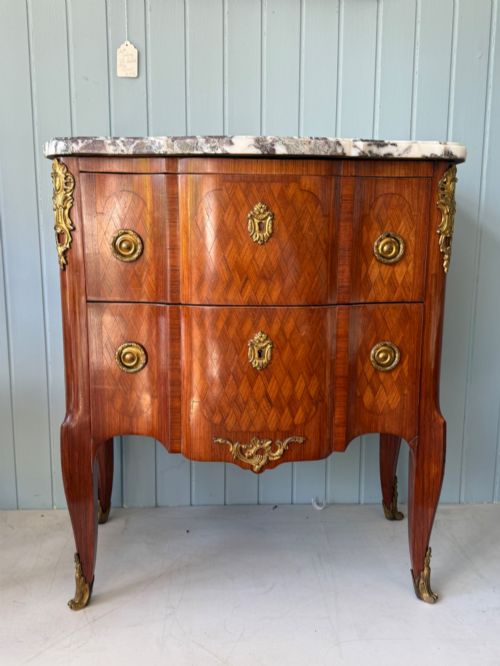
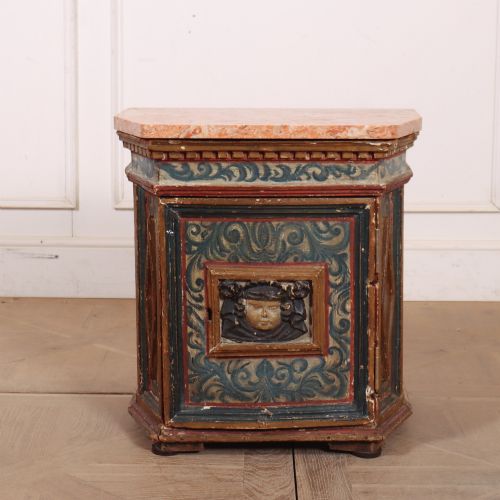
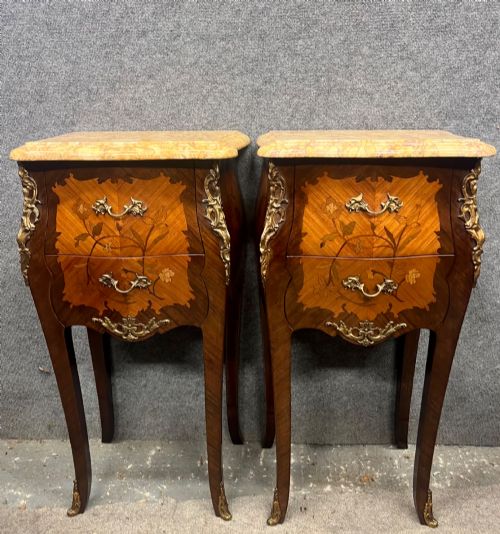
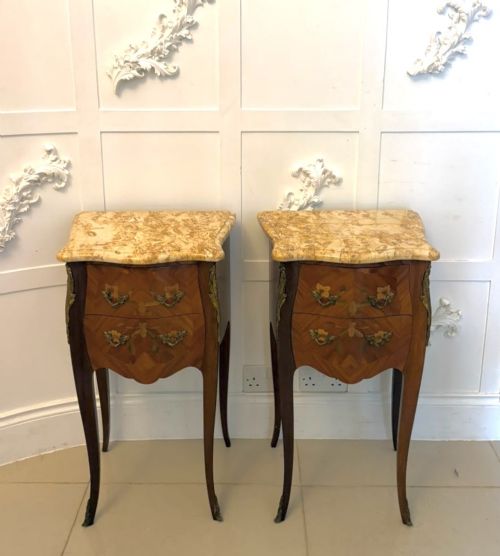
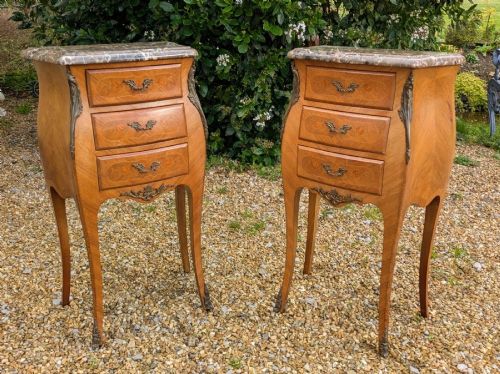
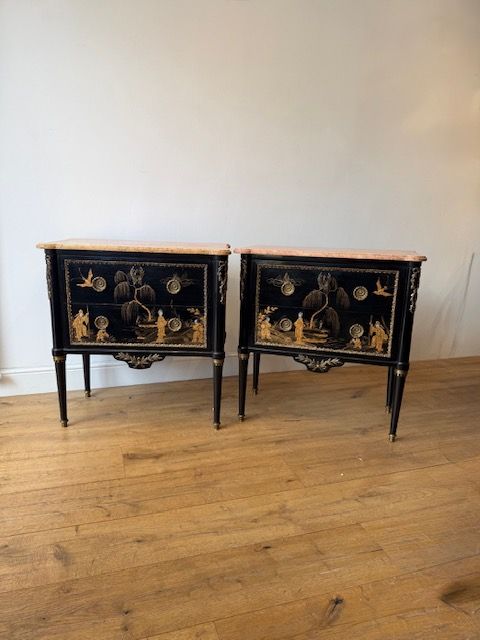
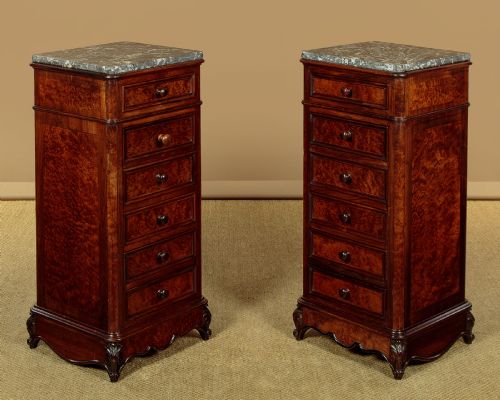
A marbled top bedside chest is a small storage piece designed for the bedroom, typically taking the form of a miniature commode, cabinet or drawer pedestal. These pieces frequently appear in pairs, scaled to sit neatly beside a bed to hold evening necessities.
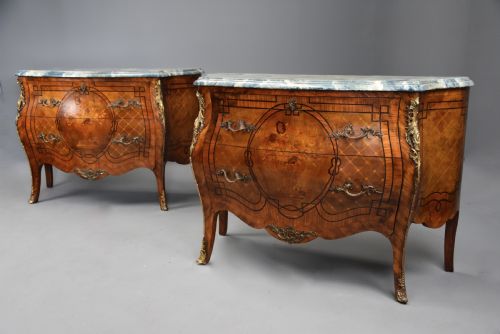
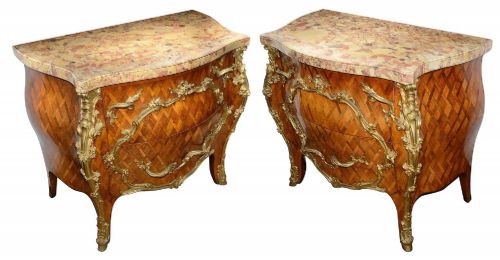
The selections span from the eighteenth century through to the early twentieth century, with a strong presence of nineteenth-century French designs. Makers drew heavily on Louis XV and Louis XVI revivals, producing bombe shapes alongside straight-fronted variants.
While traditional bedside tables offer wooden surfaces, the inclusion of a marble top introduces a contrasting mineral element. This specific type serves both a practical function as a water-resistant table top and a decorative role through the grain of the stone.
Materials and construction
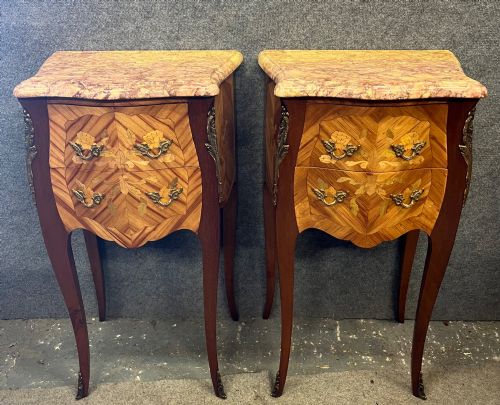
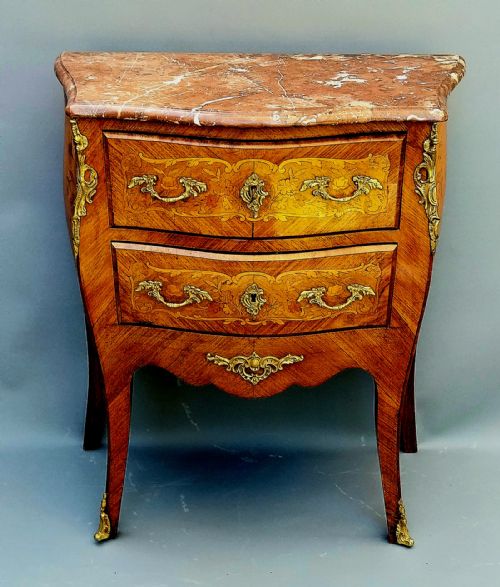
Cabinetmakers built the carcass using timbers such as walnut, mahogany, rosewood and kingwood, often applying intricate marquetry and parquetry veneers in geometric or floral patterns. On many examples, these wooden veneers are paired with contrasting exotic woods to create decorative panels across the drawer fronts and sides.
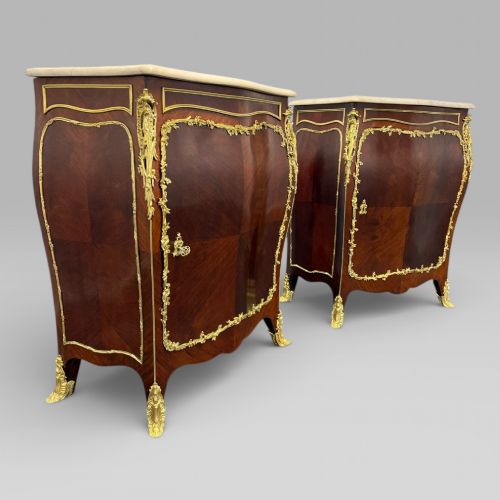
Mounts cast in ormolu and gilt bronze accent the corners, handles and feet, framing the wooden body. The stone slab fitted to the top is cut to follow the contour of the cabinet, whether rectilinear or curved into a bombe profile.
Listings feature items built across three centuries, spanning from 1750 through the nineteenth century to the 1930s.
Distinctions in craftsmanship
The refinement of a marbled top bedside chest rests on the precision of its veneer work and the integration of its metal mounts. Finer pieces display seamless parquetry where wood grains match precisely across curved surfaces, while simpler versions rely on plain walnut or painted finishes.
The weight and thickness of the marble slab, along with the crispness of the gilt bronze or ormolu chasing, separate standard utilitarian pieces from high-status examples designed for formal chambers.
E Kahn
The Marbled Top Bedside Chest Glossary
- Bombe
- A swelling, outward-curving chest profile typical of French rococo furniture. This contour requires skilled carpentry to shape the wooden carcass and fit the stone top accurately.
- Ormolu
- Gilt bronze mounts applied to furniture edges and feet for decoration. The metal is cast and chased to produce sharp ornamental detail.
- Marquetry
- Inlaid wood veneers forming decorative pictures or patterns. Craftsmen assemble different coloured timber pieces to create floral or geometric designs across drawer fronts.
- Parquetry
- Geometric patterns formed by wood veneers arranged in grid or repeating tile motifs. It provides a structured contrast to curving floral marquetry.
- Commode
- A low chest of drawers or cabinet originating in France. In smaller dimensions, it functions as a bedside storage unit.
Marbled Top Bedside Chest: Frequently Asked Questions
What periods do these chests come from?
The pieces span from the mid-eighteenth century up to the early twentieth century. Many date from the nineteenth century, reflecting revivals of earlier French court styles.
Earlier examples from the 1750s sit alongside later revival pieces produced around 1900 and 1930.
Are they usually sold in pairs?
A significant number of these cabinets and chests appear as matching pairs. This makes them suitable for placing on either side of a bed.
Single pieces also occur frequently for use in tighter spaces or as standalone lamp tables.
What wood types are used?
Construction relies heavily on walnut, kingwood, mahogany and rosewood. Many surfaces feature detailed marquetry or parquetry veneers.
Some variants utilise painted finishes or lacquer work rather than exposed wood grain.
How do I care for the marble top?
The stone surface requires wiping with a damp cloth and mild soap. Avoid acidic liquids which can etch the polished finish.
Waxing the wooden carcass separately keeps the timber conditioned without affecting the stone.