



Marble Top Writing Cabinet
A marble top writing cabinet brings together fine cabinet-making and functional writing space, topped with cool stone for everyday use.
Marble Top Writing Cabinet
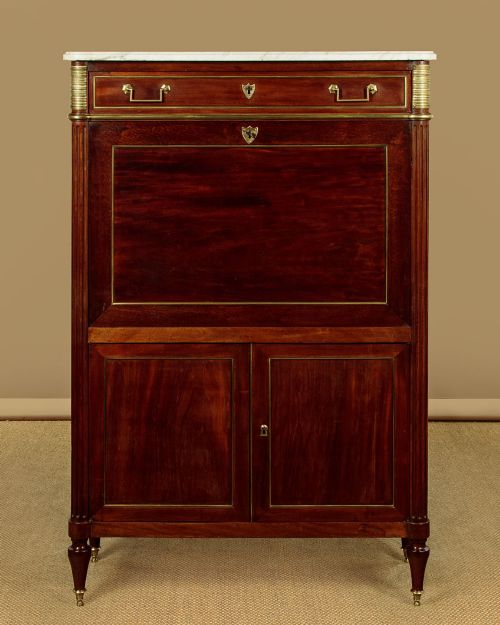
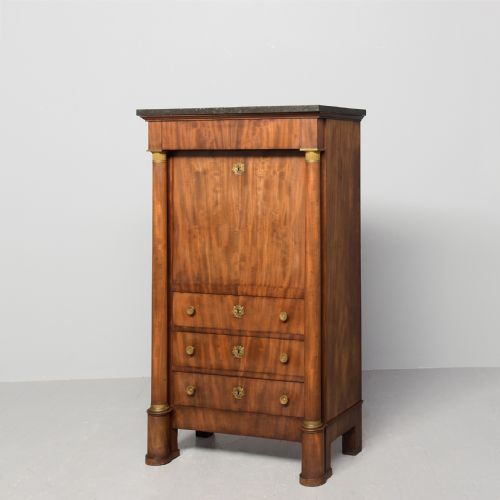
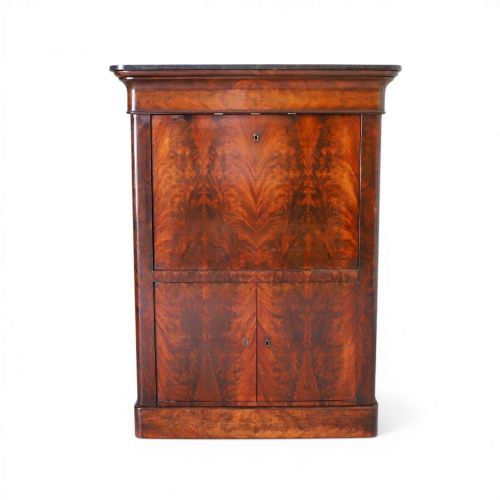
A marble top writing cabinet encompasses formal escritoires, secretaire abattants, and bonheur du jours originating mainly from the nineteenth century. These pieces combine a vertical or compact writing cabinet with a solid stone slab surface across various French and Regency aesthetics.
Makers and periods recorded in this inventory span decades of nineteenth-century European craftsmanship, dominated by walnut, mahogany, and exotic veneer carcasses.
Materials and construction
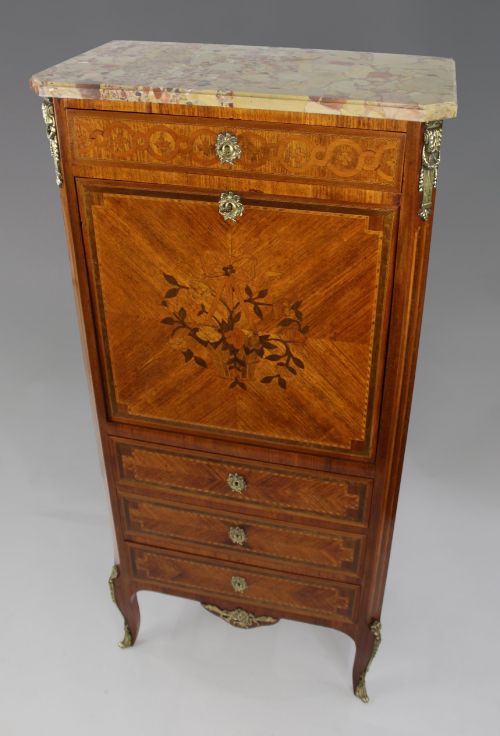
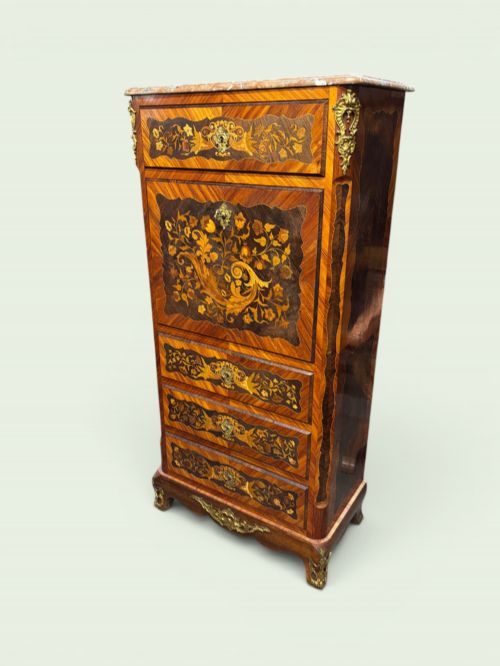
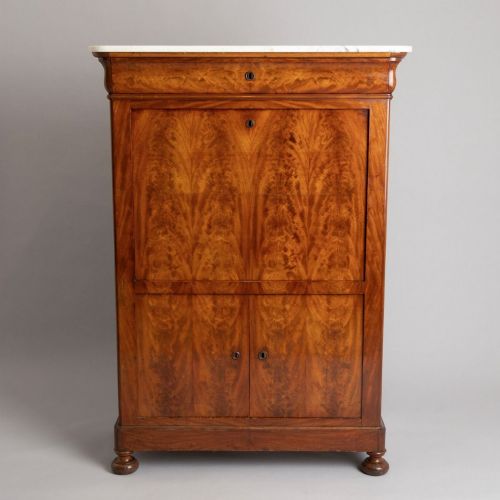
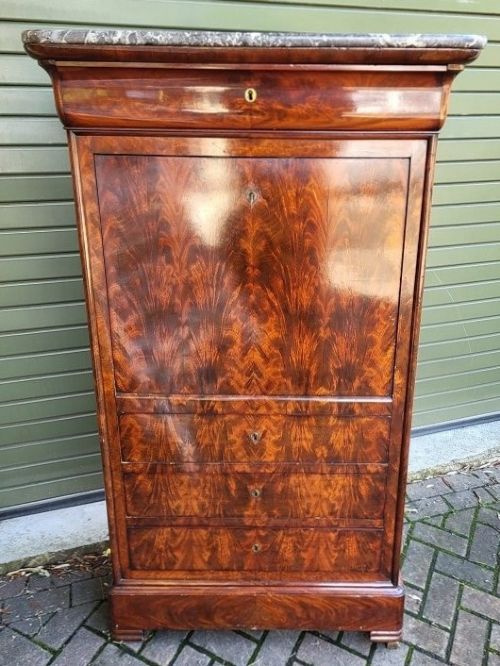
Construction relies on solid timber frames overlaid with choice veneers like kingwood, rosewood, tulipwood, and flame mahogany, often arranged in geometric parquetry or floral marquetry patterns. Carcasses are built to support heavy marble tops, which require precise fitting to the upper surface.
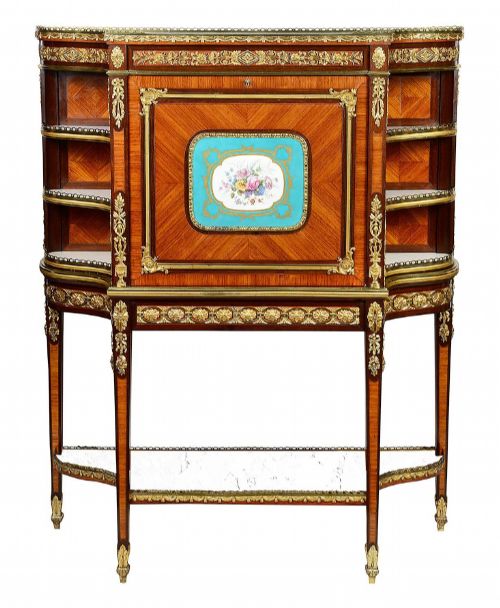
Metal ornamentation plays a major role in the execution, utilising cast or chased ormolu and gilt bronze mounts to accent corners, friezes, and key escutcheons. Brass details and secret internal compartments further demonstrate advanced nineteenth-century joinery techniques.
Many of these secretaires hide clever secret drawers behind dummy fronts, built specifically to keep private letters away from prying eyes.
Judging quality
Quality rests upon the crispness of the timber veneers and the intricacy of the marquetry work, where diverse fruitwoods create detailed pictorial or geometric motifs. Superior examples display seamless matching of grain across the drop front and drawers.
The standard of the metalwork defines the upper tier of pieces, seen in the sharpness of cast ormolu mounts and the weight of the original marble slab. Finer cabinets integrate secret drawers and internal fittings with smooth mechanical action.
Blake, London·John Mclean·Millet·Mathieu Befort
The Marble Top Writing Cabinet Glossary
- Secretaire abattant
- A tall, vertical writing cabinet featuring a hinged drop-front panel that opens to reveal a fitted desk interior and small drawers. This form conceals paperwork while maintaining a compact footprint against a wall.
- Ormolu
- Gilt bronze ornamentation applied to furniture mounts, cast and finished to provide metallic contrast against dark or veneered woods. It defines much of the decorative richness found on nineteenth-century French pieces.
- Marquetry
- The art of applying small pieces of veneer to a structure to form decorative patterns or pictures. Craftsmen utilise various coloured woods to achieve tonal depth without paint.
- Bonheur du jour
- A light lady's writing desk featuring a small cabinet or set of drawers atop the main writing surface. Originating in France, these diminutive pieces often stand on slender legs.
- Parquetry
- Geometric mosaic woodwork used for cabinet surfaces, constructed from small wood blocks fitted together in patterns like cubes or chequers. It creates a textured, optical effect across flat panels.
Marble Top Writing Cabinet: Frequently Asked Questions
What is a secretaire abattant?
A secretaire abattant is a tall writing cabinet with a vertical drop-front panel that lowers to serve as a writing desk. Inside, it typically contains an arrangement of small drawers and pigeonholes for correspondence.
The heavy marble slab sits directly on top of the cabinet frame, providing a durable and decorative upper surface that contrasts with the polished wood below.
How do I care for the marble top?
Marble requires gentle cleaning with warm water and a soft cloth to avoid scratching the polished surface. Acidic liquids like wine or citrus should be wiped away immediately to prevent staining.
Waxing the surrounding wood veneer helps maintain the finish, but care should be taken to keep polishes off the unsealed stone edges.
What is a bonheur du jour?
A bonheur du jour is a small, light writing desk equipped with a tiered cabinet or pigeonholes on the upper surface. These pieces were designed for casual correspondence in nineteenth-century drawing rooms.
They often feature delicate marquetry and ormolu mounts, standing on slender legs rather than the heavy carcasses of larger secretaires.
How do I spot nineteenth-century French styling?
Nineteenth-century French cabinets frequently display revival motifs drawn from the reigns of Louis XV and Louis XVI, characterised by curved cabriole legs or straight fluted columns. Ormolu mounts and floral marquetry are standard decorative elements.
Makers working in this era combined traditional cabinet-making with elaborate gilt bronze ornamentation and exotic wood veneers.