
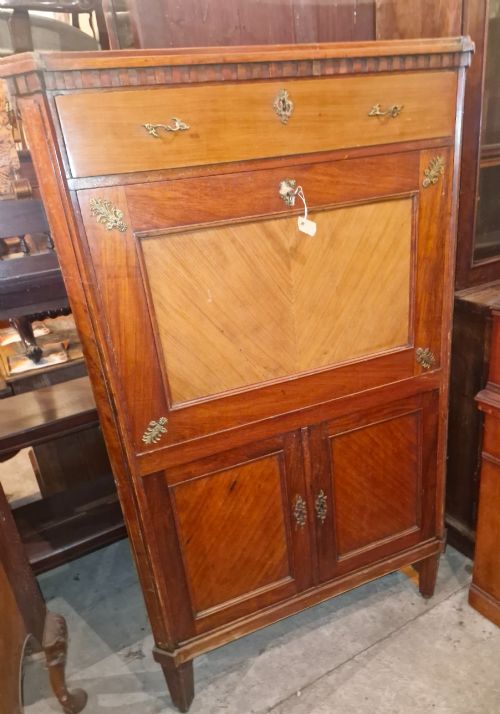

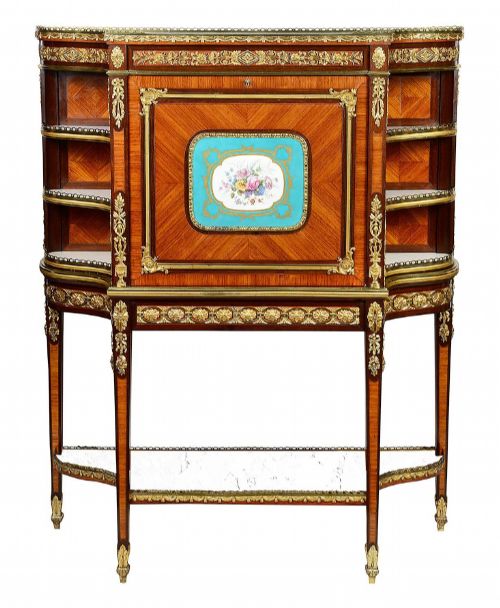
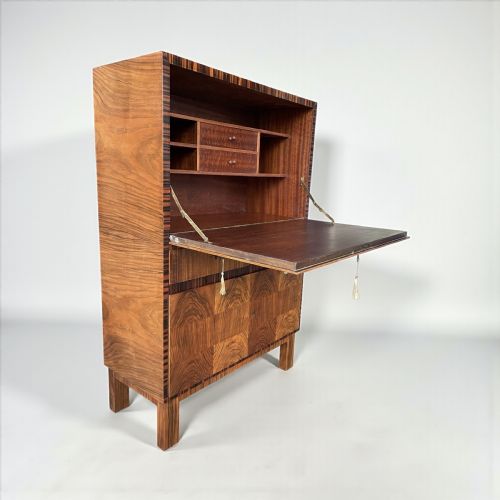


Parquetry Drop Front Cabinet
A parquetry drop front cabinet brings geometric wood veneer work and a hidden writing surface or storage space into a room.
Parquetry Drop Front Cabinet
When you search for a parquetry drop front cabinet, you are looking at writing desks, secretaire cabinets, and drinks cabinets that feature patterned wood veneers and a hinged panel which folds down for writing or serving. These pieces span the nineteenth and early twentieth centuries, drawing on historical French designs such as Louis XVI revival, Louis XV revival, and Art Deco styles.
The versions you are most likely to meet on this page take the form of the secretaire abattant, writing desks, and secretaire chests. They typically combine a vertical body with marble tops, gilt bronze or ormolu mounts, and fitted interiors behind the fall front.
How they were made
Cabinet makers built these pieces using foundational timbers such as mahogany, walnut, and fruitwood, which they then covered in decorative veneers of kingwood, tulipwood, satinwood, and rosewood arranged in geometric parquetry patterns. The woodwork relied on precise jointing to stabilize the dense arrangement of contrasting wood grain.
Mounts made from ormolu, gilt bronze, and brass were cast and chased to accent the corners, drawer pulls, and key escutcheons. Many examples were finished with shaped marble tops fitted directly to the upper surface of the cabinet carcass.
Listings for this phrase include pieces from the nineteenth century alongside 1930s Art Deco examples.
What varies in quality
The distinction between a standard piece and a finer example lies in the precision of the parquetry geometry and the crispness of the cast ormolu mounts. Finer cabinets exhibit seamless veneer alignment across opening doors and drop fronts, whereas simpler versions rely on painted rather than cast decorative details.
The choice of secondary woods and the complexity of the interior fitted compartments, including hidden drawers and mirror backs, also separate workshop tiers. Pieces bearing recorded signatures or maker attributions represent the higher end of the range.
Blake London·Millet
The Parquetry Drop Front Cabinet Glossary
- Parquetry
- Geometric wood veneer work arranged in repeating patterns such as cubes, lozenges, or squares. It creates a decorative surface using the natural contrasting colours of different timbers.
- Secrétaire abattant
- A tall upright cabinet featuring a hinged drop front panel that opens to reveal a writing surface and small pigeonholes or drawers. It conceals paperwork while maintaining a compact footprint.
- Ormolu
- Gilded bronze mounts applied to furniture for decorative accent. The technique involves coating a cast bronze base in a gold amalgam.
- Kingwood
- A dense, heavy exotic wood featuring rich brown and dark violet tones with distinct grain markings. It was heavily utilised by eighteenth and nineteenth-century cabinet makers for luxury veneering.
Parquetry Drop Front Cabinet: Frequently Asked Questions
What is a drop front cabinet used for?
These cabinets served primarily as writing desks or secretary desks, providing a vertical storage solution that opened into a flat writing surface when needed.
Over time, some variations were adapted to function as cocktail and drinks cabinets, concealing glassware and bottles behind the vertical doors.
How do I identify a Louis XVI style cabinet?
Louis XVI style pieces typically feature straighter lines and neoclassical symmetry, contrasting with the curved shapes of earlier Rococo designs.
They often incorporate fluted columns, straight tapered legs, and symmetrical parquetry patterns alongside ormolu mounts.
Are marble tops original to these desks?
Many nineteenth-century French secretaire cabinets were designed with fitted marble tops, usually in white or coloured varieties, sitting directly on the wood carcass.
These heavy stone slabs provided a stable and durable upper surface that complemented the gilt bronze mounts.
How do I clean parquetry veneer?
Parquetry surfaces require gentle dusting with a dry, soft cloth to prevent dirt from settling into the fine joints between the veneer pieces.
Avoid excessive moisture and modern chemical sprays, using only traditional furniture wax sparingly to maintain the finish.