

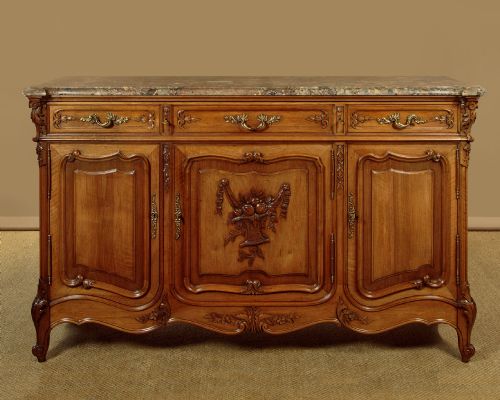
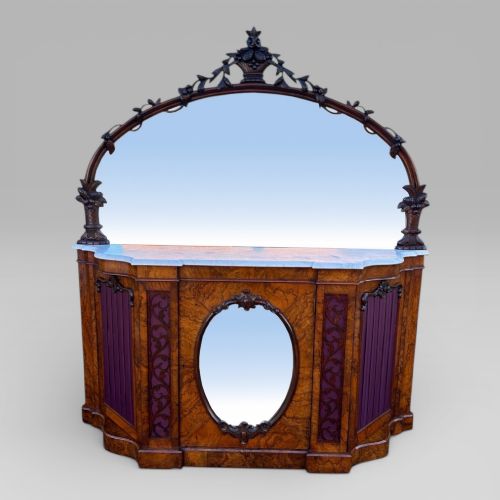
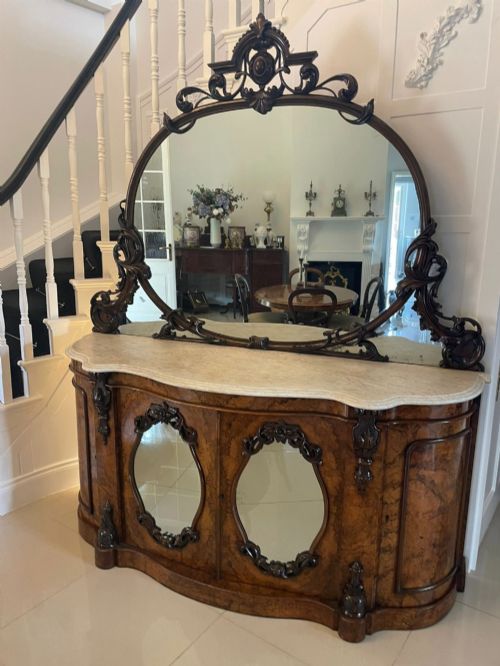
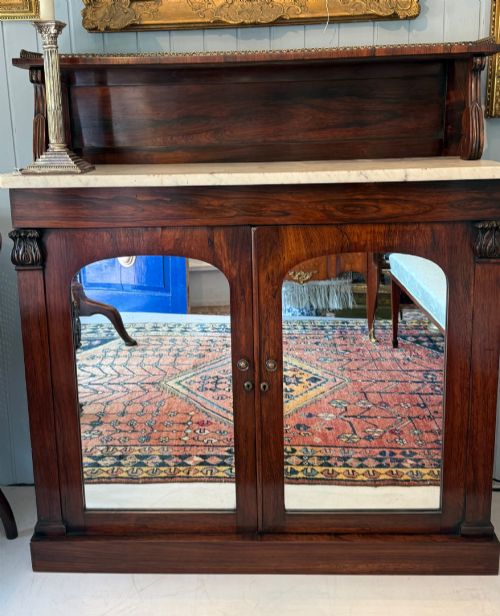


Marble Top Dining Credenza
These marble top dining credenza pieces offer solid surfaces and rich timber frames, bringing practical elegance to any room.
Marble Top Dining Credenza
A marble top dining credenza combines a durable stone surface with a wooden base, serving as a functional sideboard or buffet. These items appear across various nineteenth and twentieth century periods, reflecting diverse stylistic influences from Victorian revival to Art Deco.
Most examples found here date from the Victorian era or the early twentieth century, constructed in forms such as sideboards, credenzas, and buffets. Buyers encounter traditional French and English designs, often incorporating mirrors, grill fronts, or marquetry inlay alongside the characteristic stone slab.
Materials and construction methods
Cabinet makers utilised dense hardwoods including walnut, burr walnut, mahogany, and rosewood to build the foundational carcasses and frames. These timbers were frequently selected for rich grain patterns and finished with marquetry inlay or carved decorative details.
Heavy marble slabs form the distinctive tops, paired occasionally with brass hardware, glass panels, or velvet elements. Skilled joinery secures the substantial stone weight safely atop the wooden sideboard base.
Marble Top Dining Credenza Retail Price Guide 2026
Typical asking prices for marble top dining credenza among the pieces listed under this phrase on Sellingantiques today, from the lower quarter to the upper quarter. They describe what is for sale here now, not the wider market.
Listings span from the Victorian period through the 1930s, featuring walnut, mahogany, rosewood, and marble.
Distinguishing quality across examples
Superior pieces display exceptional timber selection, such as highly figured burr walnut or rosewood, combined with intricate marquetry and deep hand-carving. The integration of mirror backs and decorative brass elements elevates the sophistication of the build.
Simpler constructions rely on plain mahogany or walnut surfaces with minimal ornamentation, representing a more functional approach to the form. The choice of marble, from plain white varieties to patterned stone, further marks the distinction between standard and finer workshops.
The Marble Top Dining Credenza Glossary
- Credenza
- A sideboard or buffet cabinet typically used for storing dining room items and displaying objects on top. This form often includes enclosed cupboards and sometimes an elevated mirror back.
- Burr walnut
- A highly prized wood veneer taken from the burl growth of a walnut tree, showing swirling, intricate grain patterns. Cabinet makers utilised this material on prominent exterior surfaces for visual impact.
- Marquetry
- Decorative patterns formed by fitting together thin slices of various woods and other materials onto a structural veneer. This technique creates elaborate pictorial or geometric designs on sideboard doors and panels.
- Chiffonier
- A compact sideboard or low cabinet featuring shelves and cupboards, popular during the nineteenth century. These pieces offer similar storage utility to larger credenzas.
- Louis Philippe Style
- A mid nineteenth century French design movement favouring subdued curves, simple classical proportions, and rich mahogany or walnut timbers. Furniture from this tradition prioritises functional elegance over heavy ornamentation.
Marble Top Dining Credenza: Frequently Asked Questions
What is a marble top dining credenza used for?
These pieces serve primarily as storage cabinets and serving surfaces in dining rooms and living spaces. The heavy stone top provides a durable area for displaying decorative objects or placing dishes during meals.
Enclosed cupboards and drawers below accommodate tableware, linens, and dining accessories, combining practical storage with furniture presence.
How do I identify a Victorian marble top credenza?
Victorian examples frequently incorporate dark walnut or burr walnut timbers, often complemented by carved mirror backs and intricate marquetry inlay. The proportions tend to be substantial, reflecting the heavier aesthetic of the nineteenth century.
Detailing such as rounded corners, turned columns, and elaborate wood carvings helps separate these nineteenth century items from later twentieth century interpretations.
Are French and English styles different?
French versions, such as those influenced by the Louis Philippe period or French Provincial traditions, often utilise lighter fruitwoods or mahogany with restrained curves and cleaner lines. They focus on subtle proportion and smooth wood surfaces.
English Victorian pieces generally lean towards heavier walnut constructions, frequently featuring mirrored superstructures, carved wooden backboards, and more ornate decorative carving across the front doors.
How do I care for a marble top?
The stone surface requires regular cleaning with a damp cloth and mild, neutral soap to prevent staining from acidic liquids or oils. Avoid abrasive cleaners or harsh scouring pads that can scratch the polished finish.
Using protective mats under glasses and serving dishes helps preserve the condition of the marble over years of daily household use.