
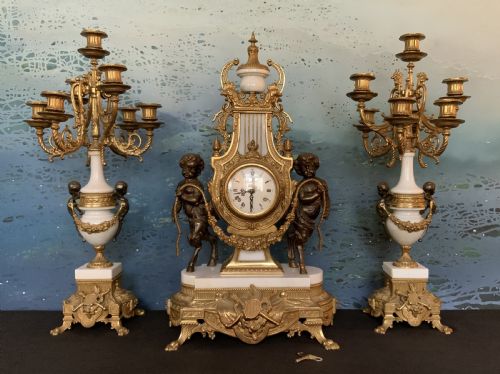


Marble Brass Clock Set
A marble brass clock set anchors a room with weight and precision, pairing stone and metal in grand domestic displays.
Marble Brass Clock Set
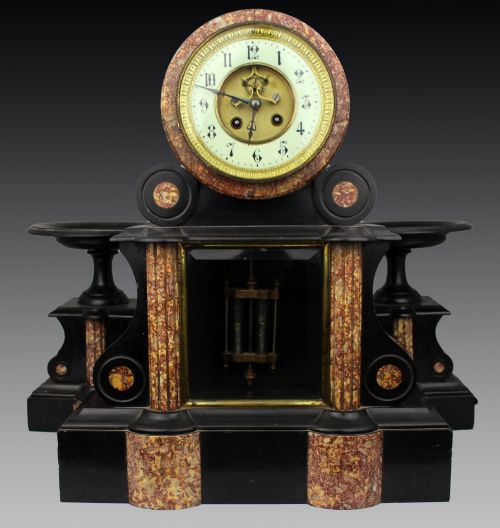
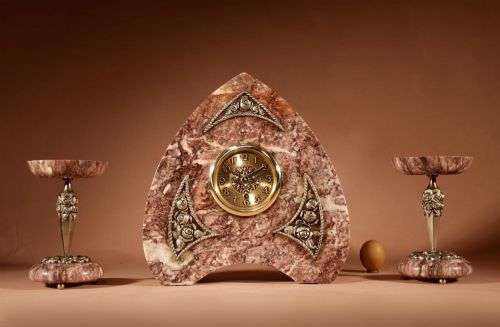
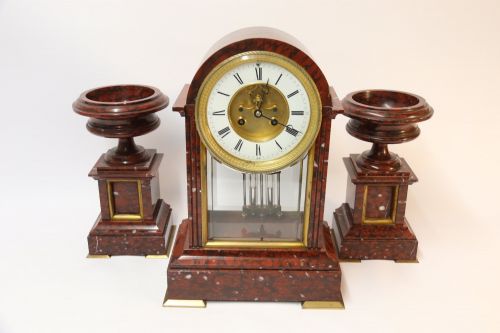
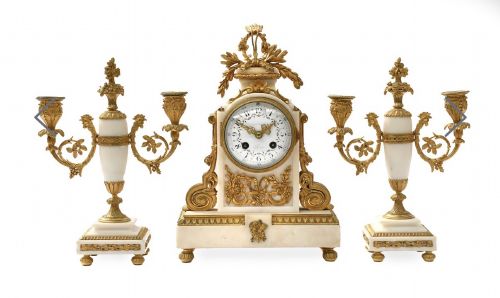
A marble brass clock set combines a central mantel timepiece with matching side pieces, most often paired candelabras or urns, designed to sit symmetrically on a fireplace or sideboard. When you search for a marble brass clock set, you encounter substantial three-piece arrangements originating predominantly from nineteenth-century French workshops alongside later Art Deco iterations.
The materials span diverse stones including black slate, green and pink marble, Siena marble, and onyx, matched with brass, gilt bronze, or ormolu mounts. Formats range from ornate Victorian Classical Revival portico designs and Louis XVI style garnitures featuring cherubs to cleaner geometric lines from the 1920s and 1930s.
Materials and construction
Construction relies on heavy natural stone bases shaped and polished to house mechanical eight-day movements, supplemented by cast brass, gilt bronze, or ormolu decorative elements. Dials frequently employ white enamel with painted numerals, protected behind glass bezels.
Makers integrated structural metal mounts and feet directly into the dense marble or slate bodies, securing heavy components with threaded pins and screws to support the weight of candelabra branches and clock housings.
Many sets include cherubs perched on the marble, keeping watch over the ticking hours with perpetual metallic sternness.
Assessing craftsmanship and finish
Quality reveals itself in the crispness of the cast metal mounts and the depth of the stone polishing, where finer examples display finely chiselled ormolu and unblemished marble surfaces. Lesser pieces feature simpler brass stampings and standard slate without decorative veining.
The refinement of the movement and dial execution separates standard production from superior work, seen in visible escapements, named maker signatures on the backplates, and hand-painted enamel details.
Japy Frères·Samuel Marti·Vincenti
The Marble Brass Clock Set Glossary
- Garniture
- A matching set of decorative objects, typically a central clock accompanied by two side pieces such as candelabras or urns. These groups create a balanced display on a mantelpiece.
- Ormolu
- Finely ground high-carat gold mercury-gilded onto a bronze base metal. This technique creates a rich, durable golden finish on decorative mounts.
- Champlevé
- An enamelling technique where troughs are dug into a metal surface and filled with vitreous enamel before firing. It frequently appears on decorative dials and bezels.
- Portico clock
- A architectural mantel clock supported by pillars or columns. This classical style often incorporates marble and gilt bronze elements.
- Eight-day movement
- A mechanical clock movement requiring winding once a week. This system was standard for substantial nineteenth-century mantel clocks.
Marble Brass Clock Set: Frequently Asked Questions
How do I wind my clock set?
Use the appropriate winding key on the dial holes, turning gently until you feel resistance. Avoid over-winding to protect the mainspring.
Ensure the clock stands on a level surface so the pendulum swings evenly and keeps accurate time.
Can these clocks run accurately today?
Most mechanical movements from the nineteenth and early twentieth centuries can keep reliable time if serviced by a professional horologist. Regular cleaning removes old oil and dust that impede the gears.
Minor adjustments to the pendulum suspension spring often correct daily timekeeping gains or losses.
Where should I place a garniture set?
These heavy sets require a sturdy, level mantelpiece, large sideboard, or heavy chest of drawers capable of supporting the combined weight of the stone and metal. Keep them away from direct heat sources and damp walls to protect the movement and marble polish.
Arranging the central clock between its matching candelabras maintains the intended visual symmetry.
How do I clean marble and brass?
Dust the marble and metal components regularly with a soft, dry cloth. Avoid harsh chemical cleaners or abrasive pads that can strip gilding or scratch polished stone.
Apply a tiny amount of neutral wax to stone surfaces if they appear dry, but keep all polishes away from the clock face and internal mechanics.