
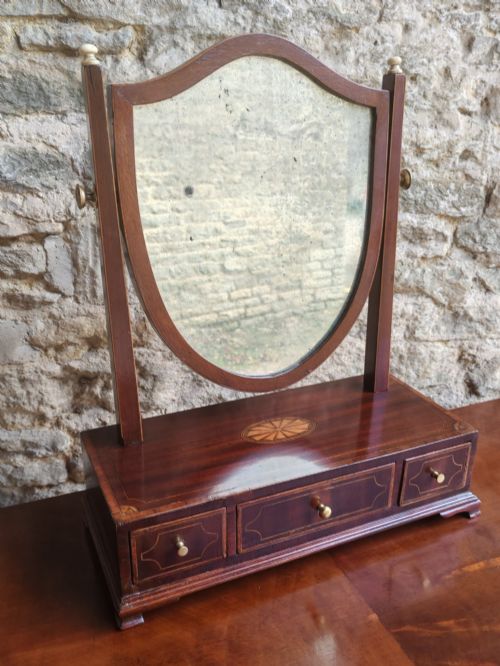
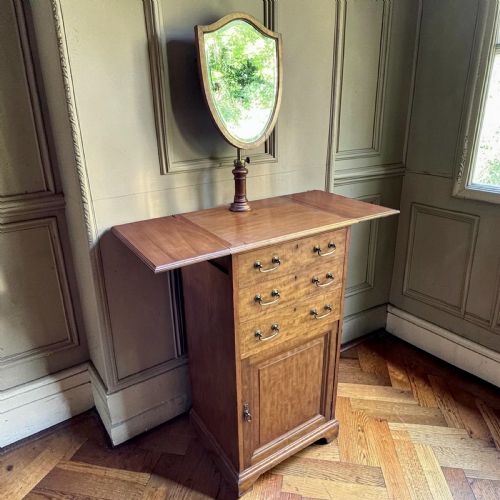


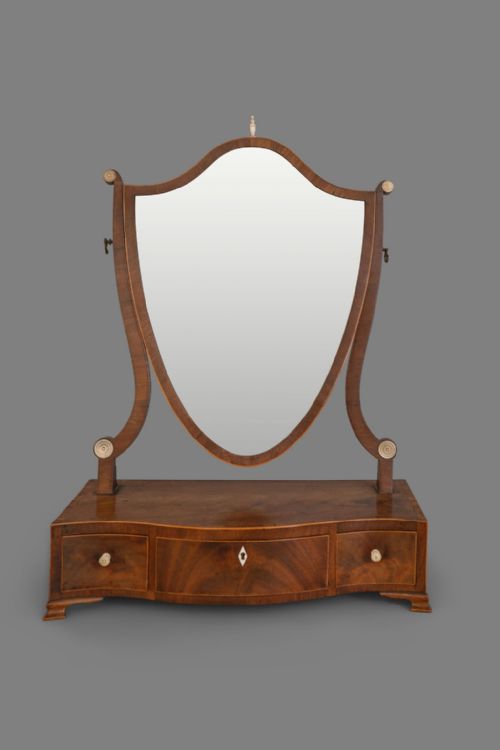


Mahogany Shield Mirror
A mahogany shield mirror brings warmth and functional elegance to a dressing space, combining rich timber with a distinctive curved frame.
Mahogany Shield Mirror
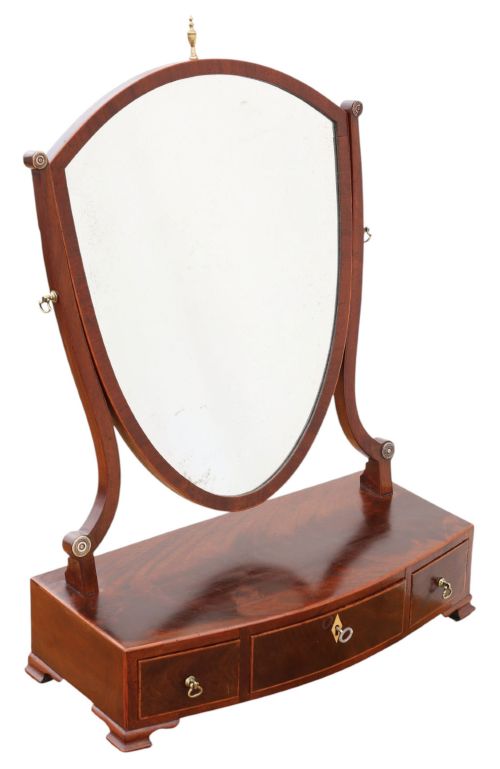
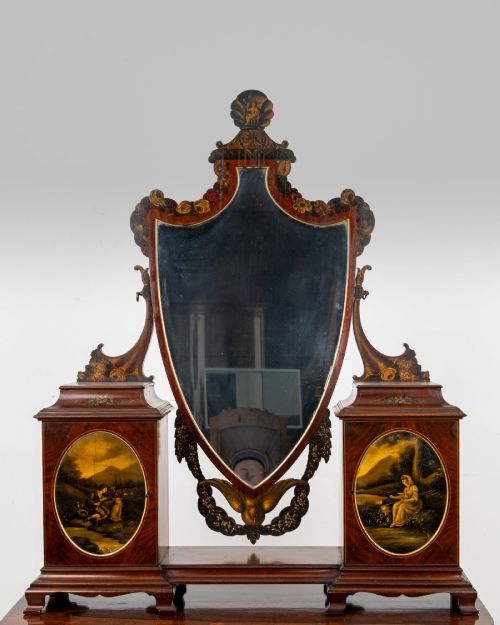
A mahogany shield mirror is a portable or fixed glass plate framed in timber, designed to sit upon a dressing table, chest or shaving stand. When you search for this phrase, you find pieces intended for personal grooming, dating from the eighteenth century through to the Edwardian period.
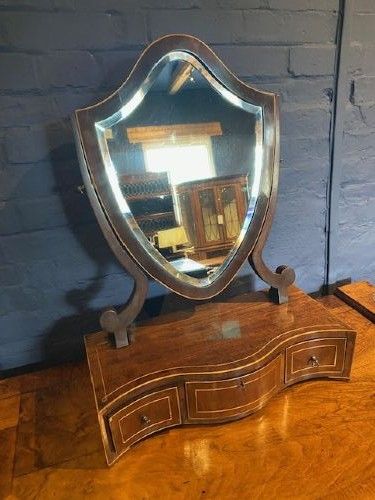
The form appears most frequently as a swing mirror mounted on scrolling uprights above a small base box, often fitted with drawers. Examples span Georgian, Victorian and Edwardian eras, with George III and Sheraton Revival versions showing the most refined proportions.
Materials and construction
Cabinet makers constructed these frames primarily in solid mahogany, sometimes incorporating secondary woods and decorative details such as satinwood inlay, bone escutcheons or crossbanding. The timber was selected for grain and colour, then polished to a deep lustre.
Brass and copper fittings, including pivot screws, arm plates and small knobs, allow the glass plate to tilt smoothly within its upright supports. The shield glass itself is held securely within a rebated wooden frame, backed with protective panels.
Secret compartments hidden inside the tiny base drawers of a dressing mirror offered gentlemen and ladies a private spot for tiny trinkets.
Distinctions in quality
Quality rests upon the proportion of the shield frame and the crispness of any woodwork or inlay, distinguishing finely articulated Georgian pieces from simpler later reproductions. The choice of timber grain and the delicacy of the scrolling horn supports reveal the skill of the original workshop.
Hardware also dictates worth, as original brass or copper counter-pivot fittings indicate an intact, uncompromised piece. Heavier base boxes with well-dovetailed drawers add structural integrity and utility to the design.
The Mahogany Shield Mirror Glossary
- Shield mirror
- A dressing glass cut to the pointed, curved outline of a heraldic shield. This silhouette became especially popular during the late eighteenth century.
- Swing mirror
- A glass plate pivoted on two horizontal screws between upright arms. This arrangement allows the user to tilt the reflection to various angles.
- Serpentine
- A curved outline featuring a convex centre flanked by concave sides. This shape frequently forms the front edge of the base box below the mirror.
- Cheval mirror
- A full-length swing glass supported on four freestanding legs. These larger pieces stand directly on the floor rather than resting on furniture.
- Crossbanding
- A narrow strip of veneer laid across the grain of the primary wood around the border of a panel. It creates a decorative framing effect on drawer fronts or base tops.
Mahogany Shield Mirror: Frequently Asked Questions
How do I date a mahogany shield mirror?
Dating relies on construction methods, timber choice and the shape of the base box. Earlier eighteenth-century examples tend to feature finer mouldings and hand-cut dovetails.
Later Edwardian revivals often incorporate lighter satinwood inlay and machine-cut elements while emulating earlier George III silhouettes.
Where should I place a table mirror?
These pieces sit comfortably atop a dressing chest, sideboard or dedicated dressing table where the height allows for easy grooming. They require a stable, level surface to support the weight of the swing frame.
Avoid positioning them in direct, harsh sunlight to protect the polished mahogany finish and the silvering on the glass.
Are the mirror plates original?
Many surviving pieces retain their original mirror glass, which can exhibit light foxing, minor speckling or slight darkening at the edges. Replacement plates do occur and are typically cleaner and more reflective than eighteenth-century originals.
Examining the backboards and how the glass is secured helps determine if the plate has been replaced.
What is the difference between a toilet mirror and a shaving stand?
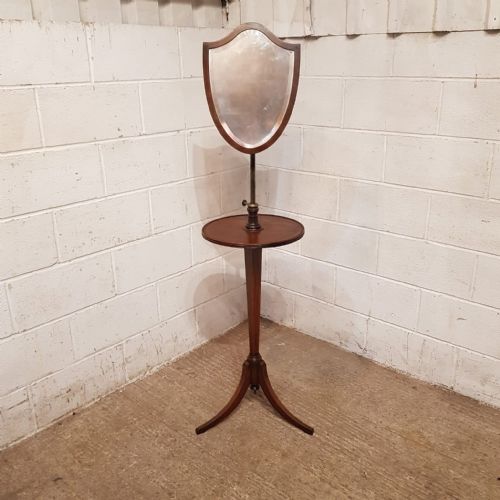
A toilet mirror is designed purely as a tabletop glass, occasionally featuring small storage drawers in its base. A shaving stand is a taller, self-contained piece of furniture incorporating the mirror alongside integrated storage for grooming utensils.
Shaving stands frequently date from the Victorian or Edwardian periods and offer a more substantial footprint in a room.