




Mahogany Revolving Tray Stand
These mahogany revolving tray stand examples, spanning the Georgian to Edwardian periods, provide practical tiered serving utility and table-top rotation.
Mahogany Revolving Tray Stand
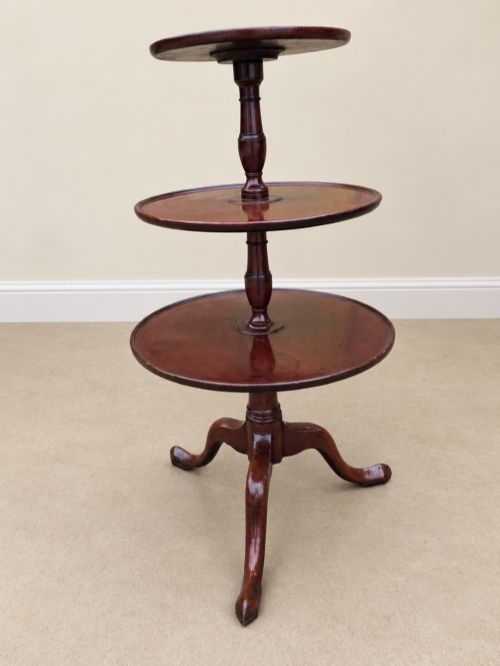
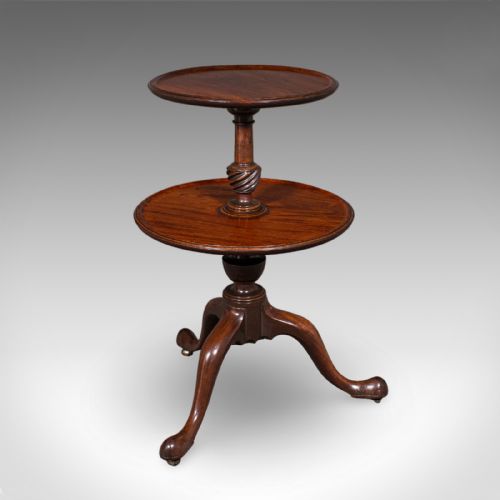
A mahogany revolving tray stand combines solid timber construction with functional movement, appearing as multi-tiered floor-standing dumb waiters or table-top lazy susan models. These pieces serve dining and tea functions, allowing dishes or condiments to rotate within reach.
The floor-standing versions typically feature two or three graduating tiers supported on a central column and tripod base. Table-top variants offer a compact revolving disc designed to sit directly on a dining surface.
Originating predominantly from the Georgian, Regency, and Edwardian eras, these items reflect changing dining customs across the eighteenth and nineteenth centuries. The selection here leans towards traditional mahogany timber construction with occasional brass fittings.
How they were made
Cabinet makers utilised dense mahogany for both the structural columns and the turned or moulded trays. This timber provided the necessary strength to support multiple stacked tiers without warping.
Revolving mechanisms relied on clever central pivot joints and turned spindles, allowing smooth rotation of the trays. Tripod bases were frequently fitted with shaped legs to ensure stability on uneven floors.
Some examples incorporated cast brass elements to reinforce joints or provide decorative accents to the revolving mechanism. Surface finishes were hand-polished to highlight the natural grain of the wood.
Mahogany Revolving Tray Stand Retail Price Guide 2026
Typical asking prices for mahogany revolving tray stand among the pieces listed under this phrase on Sellingantiques today, from the lower quarter to the upper quarter. They describe what is for sale here now, not the wider market.
The selection includes pieces from the Georgian, Regency, Victorian, and Edwardian periods, constructed predominantly in mahogany with occasional brass elements.
What varies in quality
The refinement of the turning on the central pillar and the proportions of the graduating tiers distinguish finer examples from standard workshop production. Superior pieces exhibit crisp moulding profiles and balanced tripod legs.
The smoothness and stability of the revolving mechanism indicate the precision of the original joinery. Heavier timber grades and well-fitted pivots maintain their alignment much better over centuries of rotation.
The Mahogany Revolving Tray Stand Glossary
- Dumb waiter
- A multi-tiered freestanding stand used for serving food and drink without requiring a servant present. These typically feature two or three revolving trays stacked vertically on a pillar.
- Lazy Susan
- A revolving tray placed on a table top to assist in moving food easily between diners. They appear in circular mahogany formats across various periods.
- Tripod base
- A three-legged support structure commonly found beneath the central column of floor-standing dumb waiters. This design ensures the stand remains stable on floorboards.
- Tier
- An individual level or tray on a stacked serving stand. Graduating tiers decrease in diameter from bottom to top.
Mahogany Revolving Tray Stand: Frequently Asked Questions
What is a dumb waiter?
A dumb waiter is a tiered serving stand designed to hold dishes, plates, or tea equipment during meals.
These pieces allow diners to help themselves to food and condiments without needing constant attendance from staff.
How do you use a lazy susan?
A lazy susan sits flat on a dining table or surface, allowing users to spin the central tray to reach shared items.
The revolving mechanism makes passing condiments or dishes around a group effortless during dining.
How many tiers do these stands have?
Most floor-standing revolving tray stands feature either two or three graduating tiers mounted on a central pillar.
Table-top versions generally consist of a single rotating circular tray.
What periods do these pieces come from?
The available items span several historical eras, including the Georgian, Regency, Victorian, and Edwardian periods.
Each period brings distinct stylistic nuances to the turning, timber selection, and base design.