

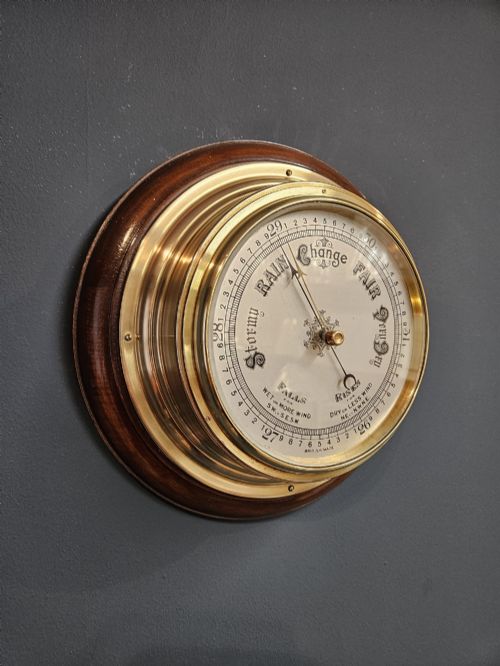
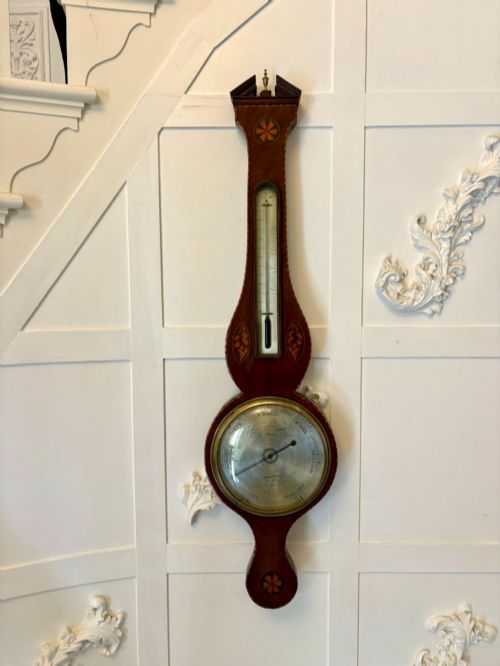
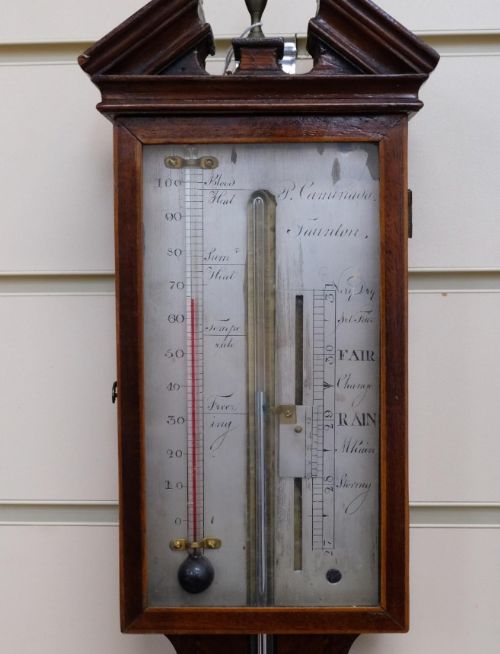
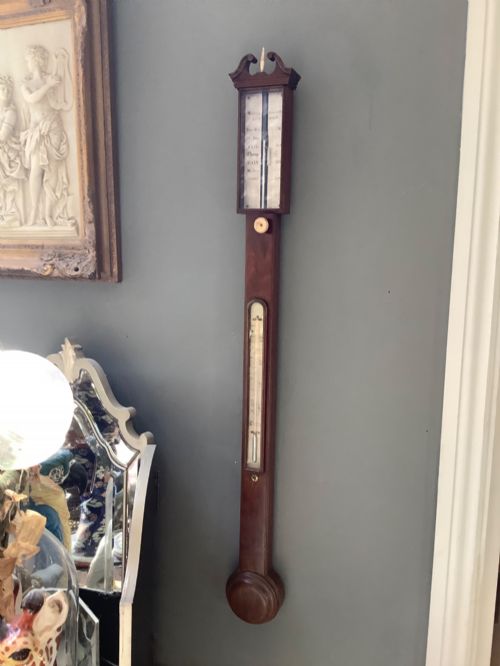
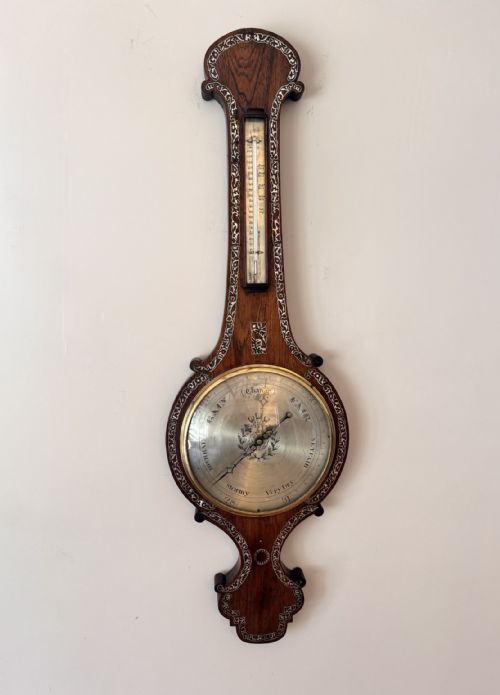





Mahogany Mounted Barometer
These mahogany mounted barometer examples bring precision meteorological recording and rich timber grain together on the wall.
Mahogany Mounted Barometer
A mahogany mounted barometer is a domestic or scientific instrument designed to measure atmospheric pressure, housed in a timber case. The selection spans Georgian, Regency, Victorian, and Edwardian periods.
The dominant forms on this page include the traditional stick barometer and the larger wheel barometer, alongside related scientific instruments. Makers frequently utilised rich mahogany veneers, often embellished with inlay, brass fittings, and silvered dials.
Buyers meet instruments ranging from provincial stick barometers signed by regional makers to sophisticated long range examples by renowned London opticians. Each piece serves as both a practical weather glass and a decorative wall furnishing.
How they were made
Cabinetmakers constructed the cases using solid mahogany and figured veneers, frequently shaping the timber into classic stick or wheel profiles. Artisans often incorporated contrasting satinwood stringing, shell inlays, or mother of pearl to ornament the facade.
Precision metrology relied on mercury contained within glass tubes, paired with engraved silvered metal or brass scales for reading barometric pressure. Specialised dial work and spirit levels added both utility and visual complexity to the finished instrument.
Mahogany Mounted Barometer Retail Price Guide 2026
Typical asking prices for mahogany mounted barometer among the pieces listed under this phrase on Sellingantiques today, from the lower quarter to the upper quarter. They describe what is for sale here now, not the wider market.
Listings feature mahogany mounted barometers spanning the Georgian, Regency, Victorian, and Edwardian periods alongside twentieth century scientific instruments.
What varies in quality
Quality rests in the legibility and fineness of the engraved silvered dial, where crisp lettering and detailed maker signatures elevate the instrument. The crispness of the mahogany case construction and the subtlety of any shell inlay or satinwood banding further distinguish superior examples.
The reputation of the maker plays a defining role in the standing of a piece, with signed instruments by established opticians commanding particular attention. Integrity of the timber and the preservation of the original glass and brass components govern the overall character of the barometer.
P. Caminada Taunton·Antoine Redier·Sandrino of Liverpool·Hayward of Ashford·Negretti & Zambra London·Gilbert London·Malacrida of Dublin·George Dollond of London
The Mahogany Mounted Barometer Glossary
- Stick barometer
- A vertical instrument where atmospheric pressure is read against a mercury column visible through a glass tube. These tall, slender pieces represent the traditional form of weather measurement.
- Wheel barometer
- A dial instrument utilising a concealed float and pulley system to translate mercury movement into the rotation of a pointer on a circular face. These banjo shaped cases often incorporate a thermometer and spirit level.
- Silvered metal
- A brass or copper plate treated with a silver compound to create a matte white surface for engraving calibrations and figures. This material offers high contrast against the dark timber housing.
- Satinwood
- A dense, yellowish timber utilised for contrasting inlay work, stringing, and paterae on mahogany cases. Craftsmen employed this wood to create decorative geometric patterns.
- Barograph
- A self recording meteorological instrument that draws barometric pressure fluctuations onto a rotating paper drum over a weekly period. These mechanical devices often feature heavy brass frameworks mounted on mahogany bases.
Mahogany Mounted Barometer: Frequently Asked Questions
How do stick and wheel barometers differ?
Stick barometers display the mercury column directly within a tall, narrow wooden trunk, offering a straightforward reading of atmospheric height. Wheel barometers use an internal mechanism to drive a hand around a circular dial, providing a more decorative face.
Both types served domestic interiors, though wheel instruments often included supplementary indicators like thermometers or hygrometers.
Can these barometers still measure weather?
Many historical barometers retain their internal glass tubes and mercury, allowing them to respond to changes in atmospheric pressure. However, shifting them requires professional care to prevent air entering the column.
Collectors generally treat them primarily as historical objects and decorative wall pieces rather than daily meteorological tools.
How should I hang a wall barometer?
These instruments require a secure fixing point directly into a wall stud or solid masonry, using a heavy duty screw or bracket suited to the weight of the timber and glass. Stability is essential because the case must hang entirely plumb for the internal mechanism to function correctly.
Placement away from direct sunlight and radiators preserves the finish of the mahogany and prevents timber warping.
What indicates an earlier Georgian period piece?
Earlier Georgian instruments typically feature simpler, slender mahogany stick cases with understated mouldings and minimal brass ornamentation. Signed brass plates and vernier scales without extensive decorative inlay often point to eighteenth century origins.
Later Victorian and Edwardian examples frequently embrace more elaborate wheel shapes, heavier mouldings, and intricate mother of pearl or satinwood decoration.