

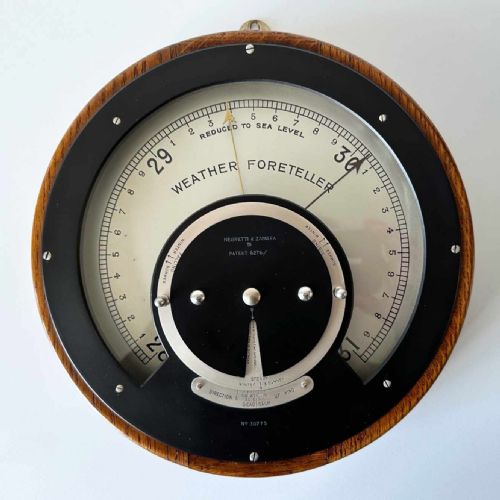
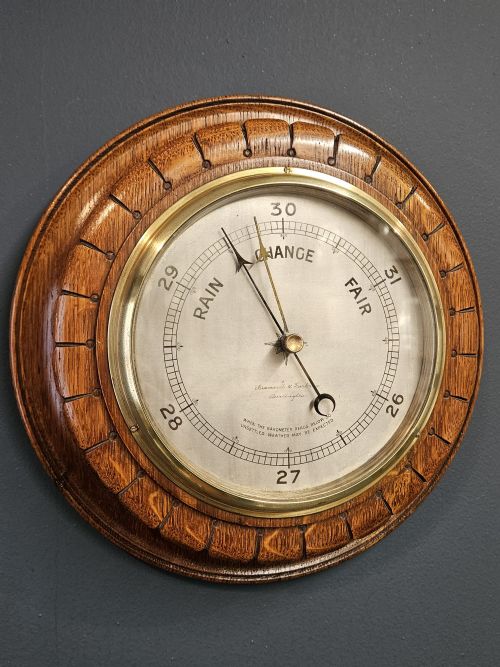


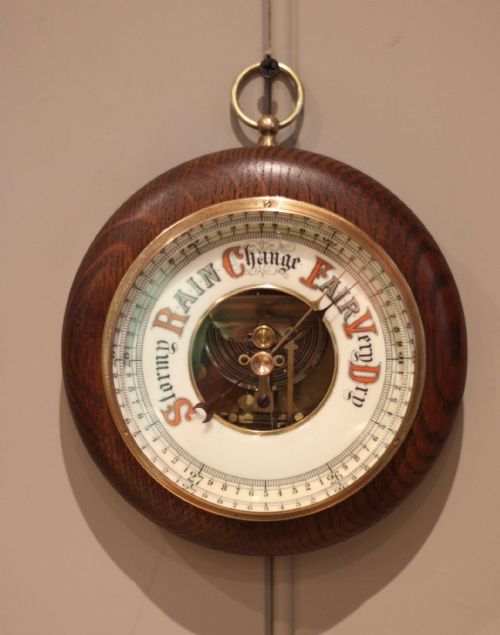


Circular Wall Barometer
A circular wall barometer brings reliable atmospheric measurement indoors, combining practical weather recording with period craftsmanship in oak, walnut, and brass.
Circular Wall Barometer
A circular wall barometer hangs in domestic interiors to measure atmospheric pressure, taking the form of a round dial mounted within timber or metal cases. Buyers searching for a circular wall barometer encounter examples spanning the Victorian and Edwardian eras.
The pieces listed here appear primarily in Victorian and Edwardian formats, ranging from plain oak or beechwood frames to intricate skeletonised movements and geometric timber designs. Makers such as Short & Mason, Negretti & Zambra, and Dollond represent the scientific instrument makers who produced these instruments.
Materials and construction
Cases utilise timber species including oak, walnut, beechwood, and ebonised wood, shaped into circular frames that house the internal aneroid mechanism. Many models feature geometric or carved decoration applied to the wooden surrounds.
Dials are constructed from silvered metal or ceramic, protected by glass bezels and fitted with brass or general metal components for altitude and pressure adjustment.
Listings feature oak, walnut, beechwood, and ebonised cases housing aneroid movements from the Victorian and Edwardian periods.
Judging quality and craftsmanship
Quality rests in the precision of the signed dial and the refinement of the timber casing, from simple turned beech frames to detailed skeletonised brass movements. Named makers with documented workshops command attention through superior legibility and finish.
The integration of patented altitude adjustment mechanisms and clean silvered metal dials indicates higher manufacturing standards, distinguishing standard domestic timepieces from precision scientific instruments.
Short & Mason·Negretti & Zambra·Bramwell & Harbron·Blake & Son·Dollond
The Circular Wall Barometer Glossary
- Aneroid barometer
- An instrument that measures atmospheric pressure without using liquid, relying on a flexible metal box that expands or contracts.
- Silvered dial
- A metal dial treated to achieve a frosted or satin silver finish, enhancing the contrast of the engraved markings.
- Bezel
- The retaining ring, often made of brass or metal, that holds the protective glass face in position over the dial.
- Skeletonised
- A design exposing the internal mechanical gears and levers of the barometer rather than concealing them behind a solid face.
- Patent
- A government licence conferring sole rights to an invention, frequently stamped on precision scientific instruments.
Circular Wall Barometer: Frequently Asked Questions
How do I hang a wall barometer?
These instruments require a secure fixing point on an interior wall, ideally away from direct heat sources or dampness that might affect the internal mechanism.
Ensure the mounting bracket or cord supports the weight of the timber and metal case safely.
What is an aneroid barometer?
An aneroid barometer measures air pressure using a sealed expansion capsule rather than liquid mercury, making it safer and easier to mount on a wall.
Needle movements respond instantly to pressure shifts, indicating changes in weather conditions.
How do I date a barometer?
Dating relies on the style of the timber case, the typography of the silvered dial, and any maker inscriptions recorded on the face.
Victorian and Edwardian pieces often display distinctive geometric woodwork or patent details that link them to specific decades.
Why does a dial have a second hand?
The secondary manual pointer acts as a marker to track whether atmospheric pressure rises or falls since your last observation.
Turning the central knob aligns this pointer with the main needle for comparison.