
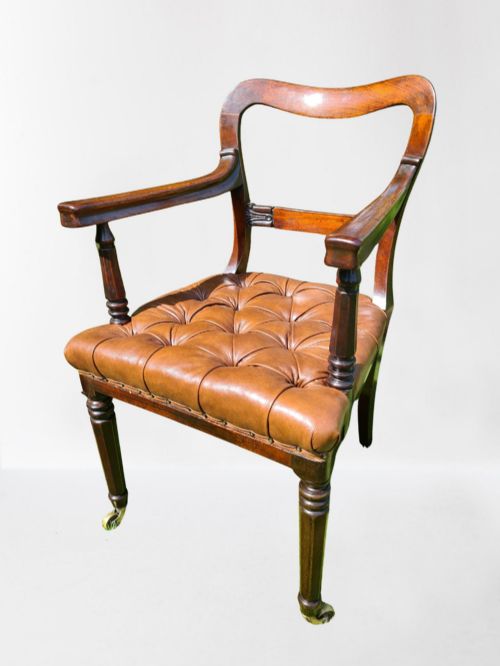
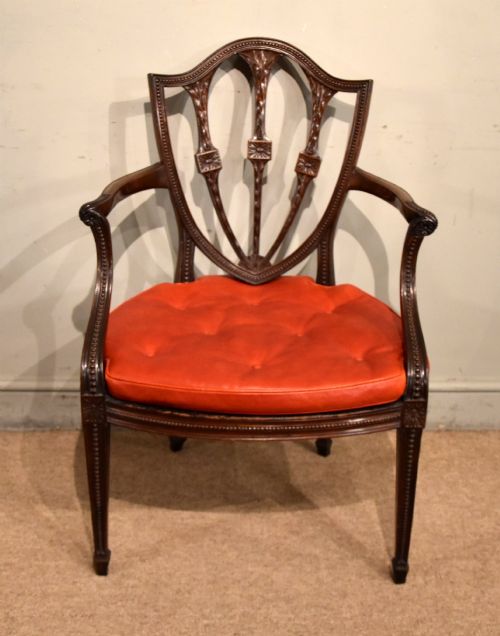


Mahogany Leather Elbow Chair
A mahogany leather elbow chair provides sturdy seating with arm support, combining rich timber and supple hide for daily use.
Mahogany Leather Elbow Chair
A mahogany leather elbow chair combines a sturdy dark timber frame with a padded hide seat or armrests for comfortable seating at desks and tables. When looking for a mahogany leather elbow chair, buyers encounter diverse forms ranging from formal Georgian designs to later Victorian and revival pieces.
The evidence shows these seats span the eighteenth, nineteenth, and early twentieth centuries, encompassing Georgian, Regency, and Victorian periods alongside later revivals. Common variations include desk chairs, carver chairs, and scroll-arm armchairs constructed from solid timber.
Examples often feature carved details, scroll arms, or brass accents, reflecting the dominant styles of their respective eras. The pieces recorded here demonstrate how cabinet makers adapted these armchairs for libraries, offices, and dining rooms.
How They Were Made
Craftsmen built the frames using solid mahogany, frequently augmented with secondary timbers such as oak and walnut, and occasionally finished with satinwood inlay or ebony details. This dense tropical hardwood provided the structural strength required for supporting arms and carved back splats.
Hides were stretched over padding for seats and arm pads, sometimes secured with brass nails or finished with hand-dyed treatments. Joinery relied on traditional mortise and tenon techniques to ensure stability across heavy daily use in studies and dining spaces.
The documented materials include mahogany, leather, brass, oak, walnut, satinwood inlay, and ebony.
What Varies in Quality
The definition in carving and timber selection dictates the distinction between standard workshop output and superior examples. Crisp execution on back splats and scroll arms separates finer productions from simpler utilitarian seating.
The integration of materials also influences the piece, where harmonious grain patterns in the mahogany complement the quality of the leather upholstery. Original components and unified period construction elevate the standing of an individual chair.
Shoolbred·Henry Maxwell·Cooper & Holt
The Mahogany Leather Elbow Chair Glossary
- Carver chair
- An armchair, typically designed to match a set of dining chairs and placed at the head of a table. These versions feature supportive wooden elbow rests.
- Elbow chair
- An armchair with a lower back and shorter armrests, frequently utilised at a desk or in a morning room. The designation covers various revival and period forms.
- Scroll arm
- An armrest carved or shaped into a tight outward or inward curve resembling a scroll. This feature appears frequently on Regency and Victorian iterations.
- Splat
- The central vertical slat in the back of a chair, often carved or pierced in Chippendale styles. Examples in the records display lambrequin or swag motifs.
- Chippendale
- A style originating from eighteenth-century design manuals, characterised by elaborate fretwork and carved mahogany frames. Revivals of this aesthetic emerged strongly during later decades.
Mahogany Leather Elbow Chair: Frequently Asked Questions
What is an elbow chair?
An elbow chair is an armchair featuring supportive rests for the arms, distinct from fully upholstered armchairs or side chairs without arms. They offer compact seating suited for desks and dining tables.
The listings show these forms spanning multiple centuries, often equipped with leather seats and mahogany frames for domestic utility.
Where were these chairs used?
These chairs served primarily in studies, libraries, and dining rooms as practical seating solutions for writing or dining. Their sturdy construction accommodated regular daily movement between tables and desks.
Period examples frequently appear as single desk chairs or matched pairs of carvers intended for the heads of dining tables.
How do I identify a Georgian chair?
Georgian chairs rely on solid mahogany frames, often featuring carved back splats and restrained decorative motifs without excessive ornamentation. Proportions tend to balance structural strength with refined aesthetic restraint.
Later revival pieces replicate these eighteenth-century characteristics, requiring careful examination of timber ageing and joinery methods to determine precise age.
Can I use one at a desk?
Many of these pieces function effectively as desk chairs, particularly variants specifically designated as elbow or desk chairs in the records. Their lower arms fit easily beneath standard table heights.
Some nineteenth-century examples incorporate swivel mechanisms or broader seats tailored specifically for office work and study environments.
What wood was used?
Mahogany serves as the primary structural timber across the recorded pieces, valued for its durability and rich dark grain. Secondary woods like oak and walnut appear in hidden structural components.
Cabinet makers occasionally added satinwood inlay or ebony details to enhance the visual appeal of specific revival and formal pieces.