
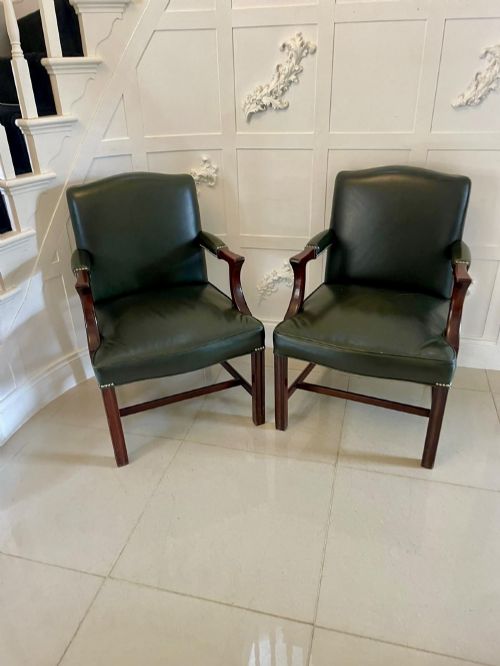
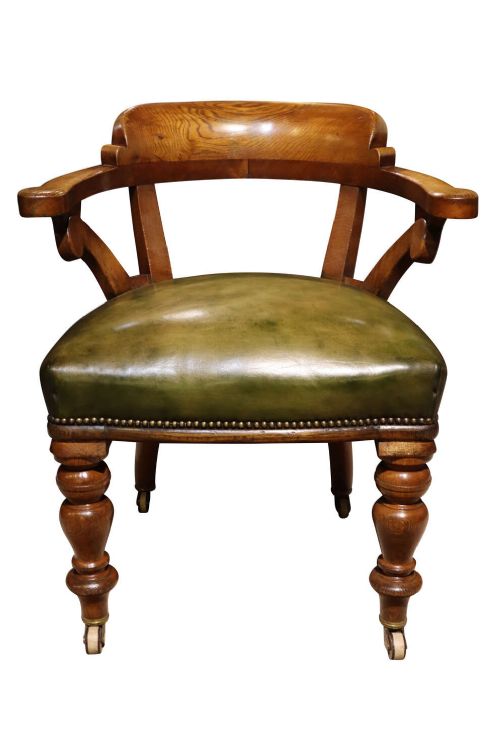
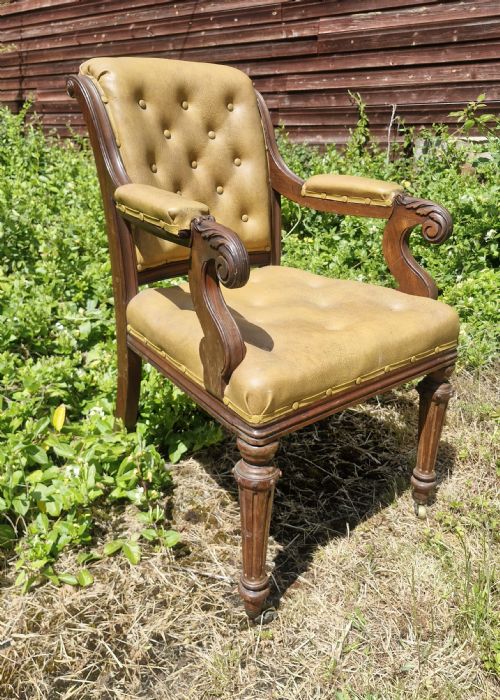


Leather Padded Armchair
These leather padded armchair examples span Victorian, Edwardian and later periods, offering solid timber frames and supportive seating for any study.
Leather Padded Armchair
A leather padded armchair brings together robust timber construction and a supportive upholstered seat, forming a practical seat for studies, libraries and offices. The selection ranges from Victorian library chairs and Edwardian swivel seats to mid-nineteenth-century mahogany desk chairs and Regency designs.
Buyers meet variations built for specific tasks, including desk armchairs, rocking chairs and smokers bows. Many pieces employ mahogany or oak frames, pairing dark or golden timber tones with inset leather pads.
Examples from the nineteenth century often display carved walnut or mahogany frames, while later pieces from the early twentieth century introduce swivel mechanisms and lighter oak constructions.
Materials and construction
Frames rely primarily on hardwoods such as mahogany, oak and walnut, shaped through turning and carving to form cabriole legs, bow backs and elbow rests. Brass elements occasionally appear on castors and fixings, while cane panels support specific bergère styles.
Upholstery centres on leather inserts or padded seats, sometimes secured with brass studs along the edges. Timber components are joined using traditional methods to withstand daily use in domestic and office settings.
Factors of distinction
Quality rests in the choice of timber and the depth of carving on the frame. Solid mahogany and golden oak structures with well-fitted joints demonstrate superior cabinet-making compared to plainer utility builds.
The integration of the leather pad relative to the timber frame dictates the visual harmony of the piece. Well-executed turned supports, crisp carving and original brass hardware elevate individual examples.
Thonet·Watkins And Doncaster·Daws
The Leather Padded Armchair Glossary
- Bergère
- An enclosed armchair with woven cane panels on the back and sides, often fitted with a loose upholstered seat cushion. This French-inspired form appears across various revival periods.
- Smokers Bow
- A low-backed wooden armchair with a rounded continuous rail and turned spindles, frequently found in office and domestic settings. It provides sturdy seating with a low profile.
- Cabriole Leg
- A furniture leg that curves out and then in, resembling the leg of an animal. This decorative feature appears on numerous Victorian library chairs.
- Elbow Chair
- An armchair with shorter arms designed to fit beneath a desk or table top. These pieces serve practical workspace functions while retaining supportive backrests.
- Swivel Desk Chair
- A rotating chair fitted to a central pivot mechanism, commonly produced during the Edwardian period for office use. It allows movement for working at large desks.
Leather Padded Armchair: Frequently Asked Questions
What periods do these armchairs come from?
The listings include pieces spanning the eighteenth, nineteenth and early twentieth centuries. Victorian and Edwardian examples appear frequently alongside Regency and earlier items.
Craftsmanship methods shift across these decades, moving from hand-carved mahogany frames to early twentieth-century swivel office variants.
How were these chairs used originally?
These seats served primarily in studies, libraries and offices as practical furniture for reading and writing at large desks. Heavy timber frames and leather pads provided durable support for daily work.
Certain forms, such as library chairs and smokers bows, also functioned in domestic reception rooms and smoking parlours.
How do I care for the leather?
Leather pads benefit from regular dusting and occasional conditioning to maintain the supple quality of the hide. Keeping timber and leather away from direct heat sources prevents drying and cracking.
Applying suitable balms preserves the original colour and texture of the antique surface over years of use.
Are these chairs suitable for modern desks?
Many desk armchairs and swivel variants fit underneath standard modern desk heights, though seat heights vary across different periods. Measuring desk clearance helps ensure a comfortable fit for daily workspace use.
Ergonomics differ from modern office chairs, as these antique designs rely on fixed wooden frames and padded leather seats.