
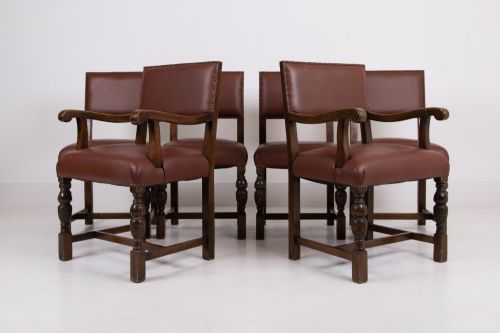


Stud Detail Armchair
These stud detail armchairs combine supportive seating with traditional hardware, offering robust construction for daily use.
Stud Detail Armchair
A stud detail armchair provides structured seating through upholstered frames finished with decorative metal tacks or nails along the seams. When buyers search for a stud detail armchair, they encounter versatile seating options spanning various historic revivals and modern eras.
The pieces on this page comprise dining chairs, wingbacks, tub chairs, and library armchairs. Origins stretch from nineteenth century designs through to nineteen twenties club seating, reflecting multiple decorative traditions.
Wooden frames underpin these seats, frequently paired with hide or textile coverings. The metal tacks serve both to secure the upholstery edges and to provide a distinct perimeter ornamentation.
How they were made
Construction relies on sturdy timber frameworks, with oak, mahogany, ash, and general wood components providing the structural skeleton. Joinery methods support heavy daily use, particularly in dining chairs and library armchairs.
Upholstery materials include leather, velvet, damask, and fabric panels stretched over padding and secured to the wooden substructure. Metal brass tacks or studs are driven individually along the outer borders of the textile or hide.
Carving and shaping techniques define the stylistic periods, from Jacobean revival motifs to bentwood shaping and os de mouton scrollwork. Each framework dictates the precise placement of the metal hardware.
Listings feature oak, mahogany, and ash woods combined with leather, velvet, and damask upholstery across nineteenth and early twentieth century periods.
What varies in quality
The integrity of the underlying timber frame establishes the foundational worth of each chair. Solid woods like oak and mahogany outlast softer timbers, maintaining stability across decades of domestic service.
The grade of upholstery materials and the precision of the tack placement determine the refined appearance of the piece. Uniform spacing of the metal studs and high-grade leather or textile coverings distinguish superior examples.
Stylistic execution ranges from simple utilitarian seating to heavily carved throne chairs and detailed club fauteuils. Finer pieces display careful attention to period revival details and joinery execution.
Watkins And Doncaster
The Stud Detail Armchair Glossary
- Stud detail
- Upholstery finishing technique using decorative metal tacks driven in rows along the seams. This method secures the fabric while adding a metallic border to the design.
- Wingback
- An armchair with side panels designed to shield the sitter from drafts. These tall backrests often feature prominent upholstered wings.
- Fauteuil
- An open-armed upholstered armchair originating in France. The wooden framework remains partially exposed around the arms and legs.
- Os de mouton
- A curved furniture leg shape resembling a sheep's bone. This scrollwork appears on seventeenth and nineteenth century seating.
- Bentwood
- Wood softened by steam and bent into curved forms. This technique creates lightweight yet resilient chair frames.
Stud Detail Armchair: Frequently Asked Questions
What is a stud detail armchair?
A stud detail armchair is a seat featuring upholstery secured or decorated with visible metal tacks along the seams. These chairs appear in various styles from the nineteenth and early twentieth centuries.
They combine wooden frames with leather or fabric coverings, utilising the metal hardware for both structural fastening and decorative outline.
How do I style a wingback armchair?
Wingback armchairs work well beside fireplaces, in libraries, or as reading seats in living spaces. Their high backs create a distinct focal point in a room.
Pairing them with wooden side tables or traditional rugs complements their historical appearance and sturdy proportions.
What materials are used in these chairs?
Construction materials include hardwoods such as oak, mahogany, and ash for the frames. Upholstery consists of leather, velvet, damask, and standard fabrics.
Metal components typically involve brass studs or tacks applied along the outer edges of the fabric.
How do I identify a Victorian armchair?
Victorian armchairs often display revival styles such as Gothic, Jacobean, or Chippendale influences. They utilise dense woods and heavy upholstery.
Examining the carved wooden details and joinery helps distinguish nineteenth century pieces from later twentieth century reproductions.