

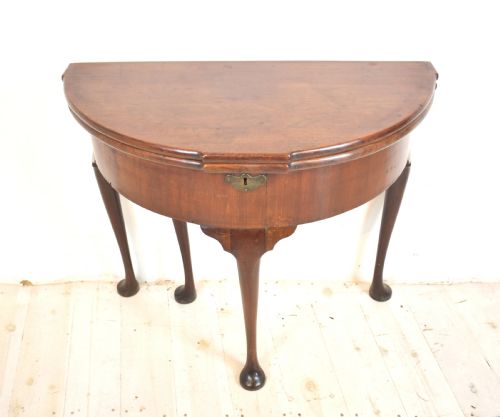

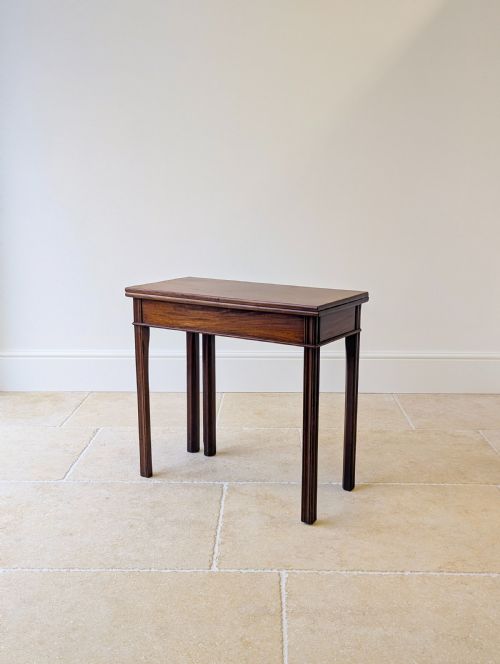


Mahogany Gateleg Tea Table
These mahogany gateleg tea table listings bring together drop leaf surfaces and occasional forms from the eighteenth century to the Edwardian era.
Mahogany Gateleg Tea Table
A mahogany gateleg tea table combines drop leaves with hinged legs that swing out to support the extended flaps. Buyers searching this phrase will find an array of tables designed primarily for serving tea or operating as compact occasional surfaces.
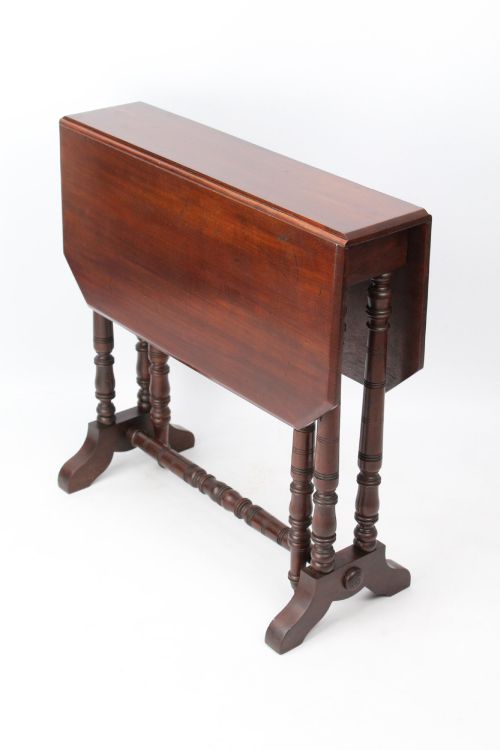
The selections span distinct historical periods, including the Georgian era, the Victorian period, and Edwardian interpretations. Many examples take the form of narrow Sutherland tables with slender spider legs or fold-over tops intended for domestic spaces.
Materials and construction
The primary timber across these listings is mahogany, sometimes utilised in solid form or enhanced with ebonised finishes. Makers incorporated secondary woods and decorative elements such as satinwood inlay, boxwood strings, and brass fittings.
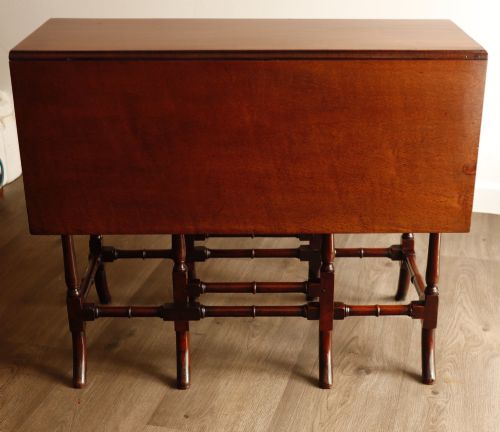
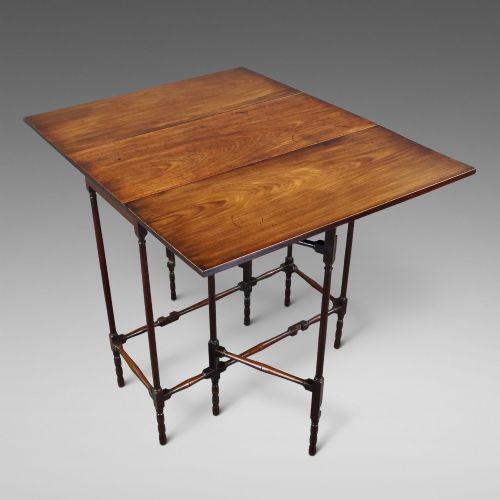
Drop leaf actions rely on pivoted gateleg frames or delicate spider leg structures that fold neatly beneath the leaves. Joinery techniques from the eighteenth century through to nineteen-hundred prioritised stability alongside the mobility of folding flaps.
Listings span Georgian, Victorian, and Edwardian periods, utilising mahogany alongside satinwood inlay, boxwood, and brass.
What varies in quality
Quality reveals itself in the crispness of the cabinetwork and the subtlety of decorative additions like satinwood banding or fine stringing. Superior examples maintain structural integrity at the gateleg hinges and feature well-figured timber grains.
Earlier eighteenth-century pieces often display hand-carved details and refined proportions, whereas later Edwardian iterations focus on compact utility and crisp inlay work.
The Mahogany Gateleg Tea Table Glossary
- Gateleg table
- A table with hinged leaves supported by legs that swing outward like a gate. This construction allows the surface area to expand or contract according to domestic needs.
- Sutherland table
- A narrow drop leaf table featuring particularly slender legs and leaves that drop almost vertically. It was developed during the nineteenth century to save space.
- Spider leg table
- An occasional table built with exceptionally thin, turned legs designed to maximise lightness and portability. These are frequently found on eighteenth-century examples.
- Drop leaf
- A hinged section of a table top that can be folded down when not in use. It rests on movable supports to create an extended surface.
- Satinwood inlay
- A contrasting light-coloured wood inserted into the mahogany surface to form decorative bands or geometric patterns. It appears frequently on Edwardian pieces.
Mahogany Gateleg Tea Table: Frequently Asked Questions
How do I date a mahogany table?
Dating relies on stylistic markers, construction methods, and timber characteristics. Eighteenth-century pieces often show simpler structural joints and fine spider legs.
Victorian and Edwardian versions frequently incorporate satinwood inlay, ebonised finishes, and mass-produced hardware components.
Where were these tables used?
They served primarily in reception rooms and parlours for serving tea or displaying decorative objects. Their folding mechanism made them adaptable to smaller spaces.
When not extended, the drop leaves allowed the furniture to sit flat against a wall until needed.
What is a Sutherland table?
A Sutherland table is a specific form of drop leaf table characterised by exceptionally narrow leaves and slender legs. They fold down into a very compact profile.
Victorian and Edwardian makers produced numerous variations of this form in solid or inlaid mahogany.