

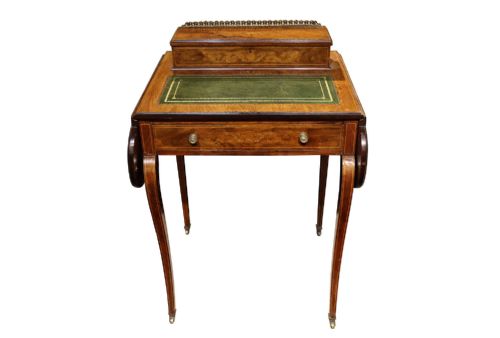
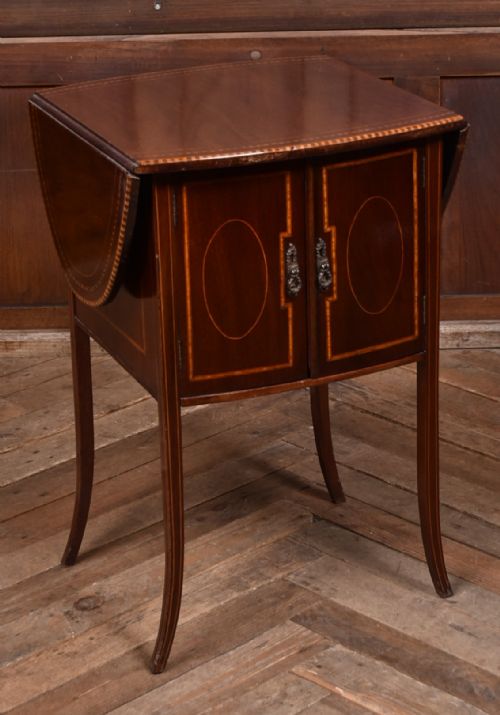


Edwardian Inlaid Drop Flap Table
An edwardian inlaid drop flap table offers compact elegance for the home, combining rich timbers with delicate decoration.
Edwardian Inlaid Drop Flap Table
When you search for an edwardian inlaid drop flap table, you are looking at versatile pieces designed for sitting rooms and boudoirs. The most common versions on this page date from the Edwardian period or around nineteen hundred, alongside occasional Victorian examples and an eighteen eighty piece.
These tables appear in several forms including side tables, occasional tables, writing tables, lamp tables, tea tables, coffee tables, and Sutherland tables. They feature drop flaps, drop leaves, or four flaps that expand the surface when needed.
The dominant timbers in the evidence are mahogany and rosewood, supported by walnut. Many pieces show Sheraton Revival influence through classical decorative motifs.
Materials and construction
Makers built these tables primarily using solid and veneered mahogany and rosewood, with occasional walnut. These timbers provided a stable, handsome ground for decorative work.
Surface ornament relied upon satinwood inlay, satinwood stringing, boxwood, and marquetry. Brass fittings appear on pieces such as lady's writing tables with fitted interiors.
Edwardian Inlaid Drop Flap Table Retail Price Guide 2026
Typical asking prices for edwardian inlaid drop flap table among the pieces listed under this phrase on Sellingantiques today, from the lower quarter to the upper quarter. They describe what is for sale here now, not the wider market.
The listings on this site span the Edwardian period, nineteen hundred, the Victorian era, and eighteen eighty, using mahogany, rosewood, and walnut.
Assessing quality
Quality in these tables rests upon the crispness of the marquetry and the precision of the satinwood and boxwood inlay. Finer examples display meticulous attention to detail in the contrasting wood veneers and fitted internal compartments.
The choice of primary timber also dictates the character of the piece, with richly figured rosewood and well-grained mahogany sitting at the higher end of the range compared to simpler walnut or standard mahogany construction.
The Edwardian Inlaid Drop Flap Table Glossary
- Drop flap
- A hinged leaf on the side of a table that drops down when not in use. It allows a piece to occupy less floor space in a compact room.
- Marquetry
- Decorative veneer applied to a surface in wood patterns and pictorial designs. It uses various coloured woods to create contrast.
- Satinwood
- A light yellowish timber prized for its lustrous grain. Makers used it extensively for contrasting inlay work and banding.
- Sheraton Revival
- A late nineteenth and early twentieth century design style inspired by the furniture of George Sheraton. It favours neoclassical restraint, slender legs, and fine inlay.
- Sutherland table
- A narrow drop leaf table where the flaps are exceptionally wide and the base folds flat. It was popular in the Victorian and Edwardian eras for small spaces.
Edwardian Inlaid Drop Flap Table: Frequently Asked Questions
How do I date an Edwardian table?
Edwardian tables date from the reign of King Edward VII between nineteen hundred and nineteen ten. They often retain original labels, lighter timber tones, and Sheraton Revival motifs.
Comparing construction methods and secondary woods helps confirm the period.
What is marquetry?
Marquetry is the art of applying pieces of veneer to a structure to form decorative patterns or pictures. Craftsmen cut contrasting woods together to ensure a tight fit.
This technique distinguishes more decorative occasional and centre tables.
How do I care for rosewood?
Rosewood benefits from regular dusting with a dry, soft cloth and protection from direct sunlight. Avoiding extreme humidity changes preserves the polished surface.
Minimal intervention keeps the timber oils and natural grain stable over time.