




Mahogany Drop Trunk Clock
Mahogany drop trunk clock examples combine practical timekeeping with striking timber grain, offering wall-mounted historical utility for any room.

Mahogany Drop Trunk Clock
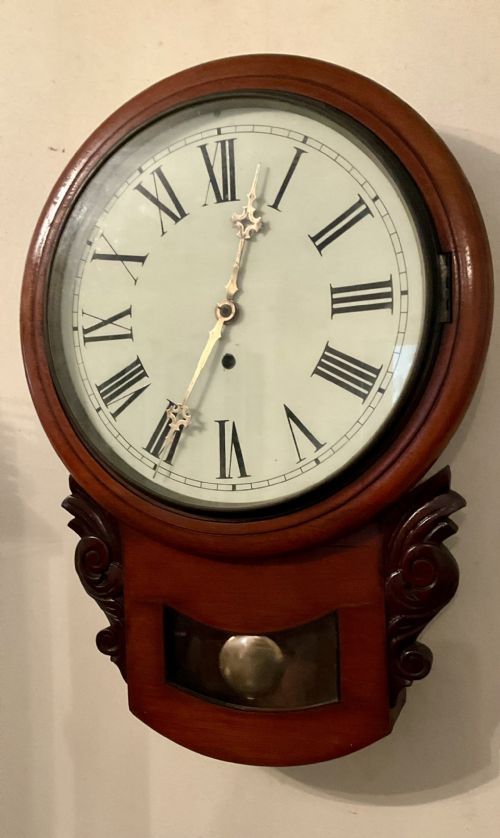
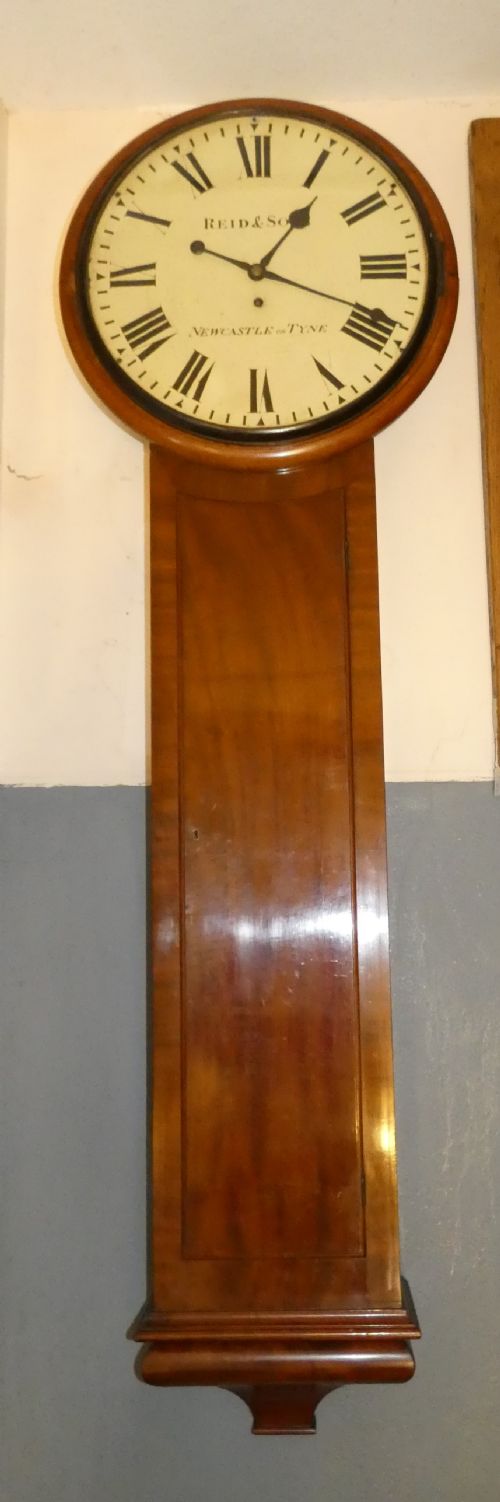
A mahogany drop trunk clock is a wall-mounted timepiece featuring an upper dial and an extended lower case, often called a drop dial or drop trunk. These timepieces served utilitarian roles in railway stations, offices, and domestic halls during the Georgian, Regency, and Victorian periods.
The version most commonly met on this page is the nineteenth-century English wall clock housed in solid mahogany or flame mahogany veneer, frequently retaining an eight-day movement. Examples span from early nineteenth-century fusee models to later provincial and London-signed pieces.
How they were made
Cases are constructed from timber such as mahogany and oak, often highlighted with flame mahogany veneer to give the trunk door visual depth. Dials utilise painted enamel, wood, or brass, protected behind hinged glass bezels fitted into turned wooden surrounds.
Mechanisms rely on brass wheel trains driven by fusee or weight-driven movements, sometimes incorporating striking or bell-chime functions. Iron components support internal brackets, while brass details accent the visible dial hardware and side inspection doors.
Listings feature mahogany, oak, brass, and glass across Victorian, Regency, and Georgian periods.
What varies in quality
Quality rests in the crispness of the timber cabinetry and the sophistication of the internal movement, distinguishing standard timepieces from fine London-made fusee clocks. The depth and figure of the mahogany veneer across the trunk dictate the visual presence of the piece on the wall.
Maker signatures inscribed on painted dials or engraved plates elevate historical interest, while the proportion between the upper dial frame and the lower drop trunk reveals the maker's eye for balance.
Joseph Mansfield·John Walker·R. Roberts·John Thwaites·J.W. Enock·Halliday And Rich
The Mahogany Drop Trunk Clock Glossary
- Fusee
- A conical pulley connected to the mainspring by a chain or cord that ensures even power delivery as the spring unwinds. This mechanism improves timekeeping accuracy throughout the running period.
- Drop dial
- A clock design featuring a circular dial section above an extended lower case that houses the pendulum. This configuration accommodates the pendulum swing while maintaining a compact wall footprint.
- Tavern clock
- A large public house clock with an oversized dial and a long trunk, designed for readability in communal spaces. Many examples date from the eighteenth and nineteenth centuries.
- Enamel dial
- A metal face covered with a fused glass powder coating to create a smooth, white background for painted numerals. These dials require careful handling to prevent hairline fractures.
- Regulator
- A precision pendulum clock designed for high accuracy, often featuring a subsidiary second hand. They were traditionally used to set other timepieces in workshops and railway offices.
Mahogany Drop Trunk Clock: Frequently Asked Questions
How do I wind a fusee wall clock?
Use the appropriate winding key inserted into the dial aperture, turning it gently clockwise until resistance is felt. Care must be taken not to overwind the mechanism.
Ensure the key matches the square arbor precisely to avoid damaging the internal components during routine maintenance.
Where should I hang a drop trunk clock?
Mount the clock securely to a solid wall stud using appropriate fixings to support the weight of the timber case and movement. Position it away from direct heat sources and damp areas to protect the wood and veneer.
Select a height that allows easy access for weekly winding and regular pendulum adjustment.
What is the difference between a fusee and a weight-driven clock?
A fusee movement uses a spring-driven barrel regulated by a conical pulley and chain to maintain steady force. This system allows the clock to operate reliably within a relatively shallow wall case.
Weight-driven movements rely on descending weights suspended by cords or chains, requiring a longer drop trunk to accommodate the travel distance of the weights.
How do I tell if the dial is original?
Examine the paint texture and the ageing around the winding holes and screw fixtures for signs of consistent wear. Original painted enamel dials often show subtle crazing or hairline ageing appropriate to their period.
Check whether the maker's signature matches the lettering style and period conventions of the recorded workshop.