
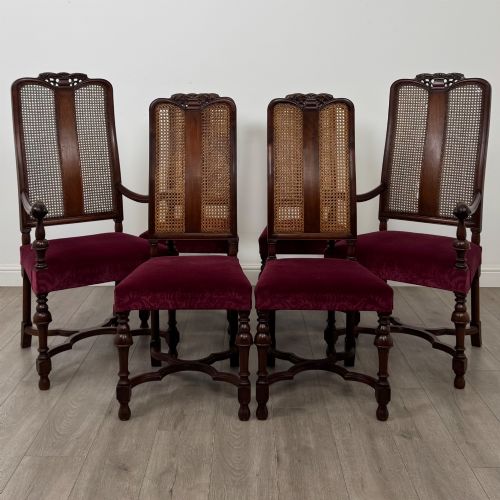
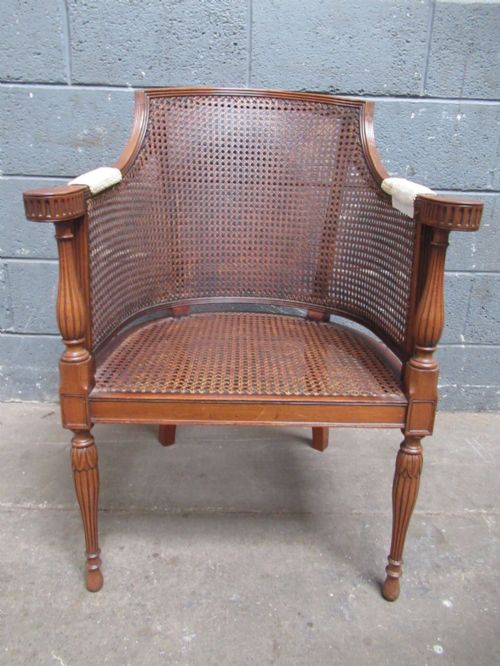
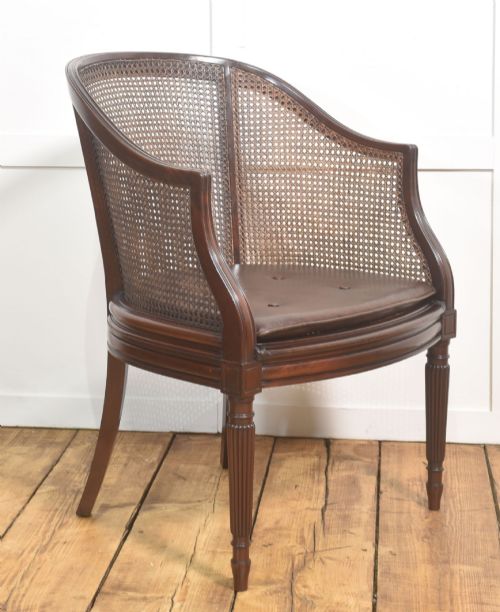
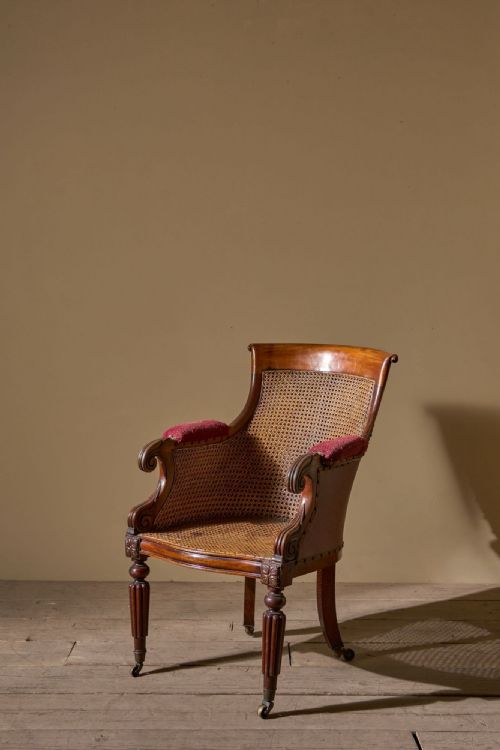

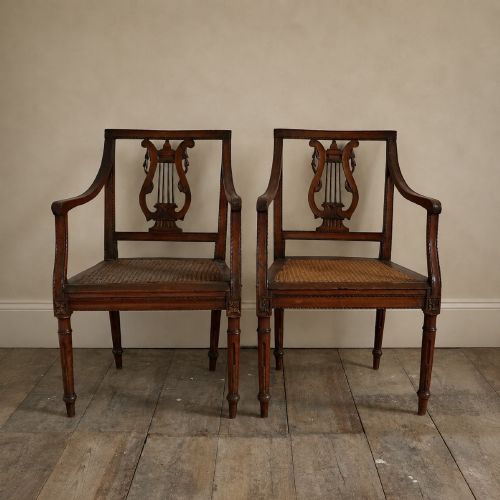
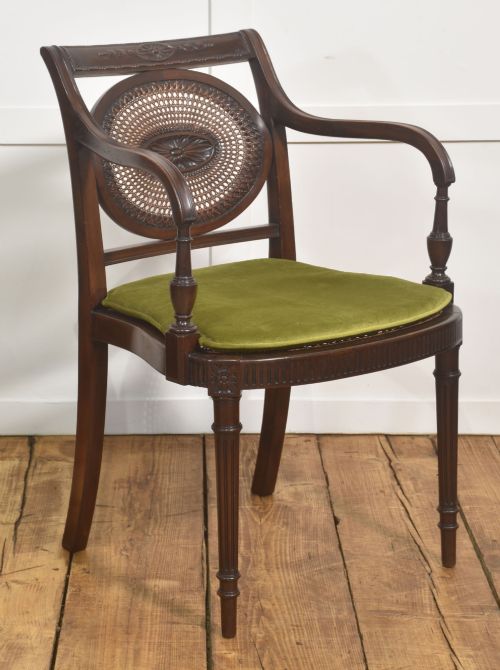

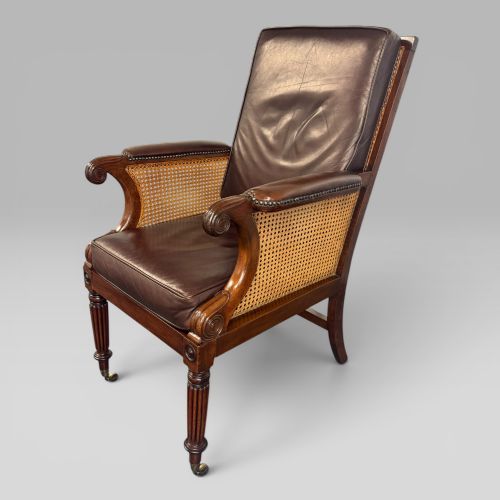
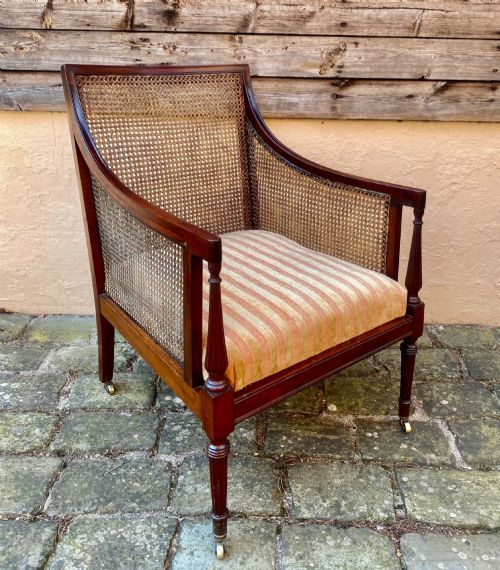
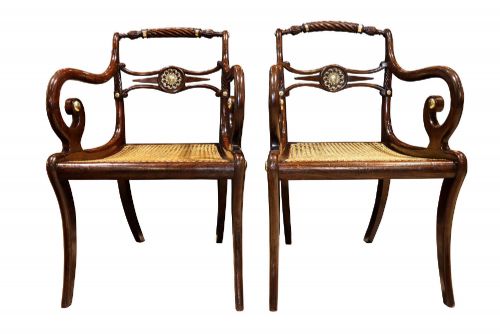
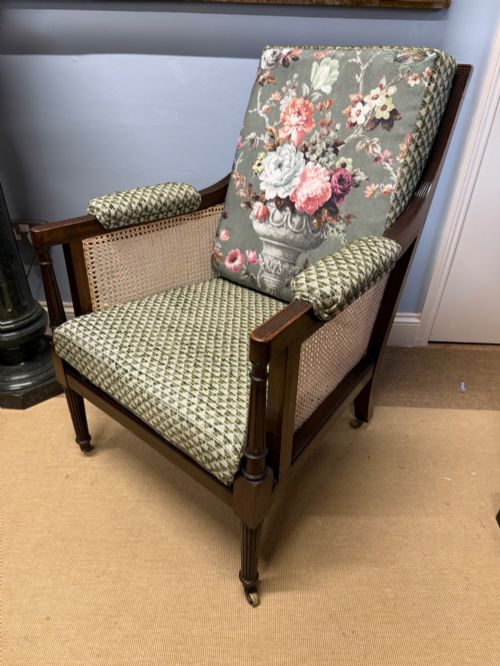
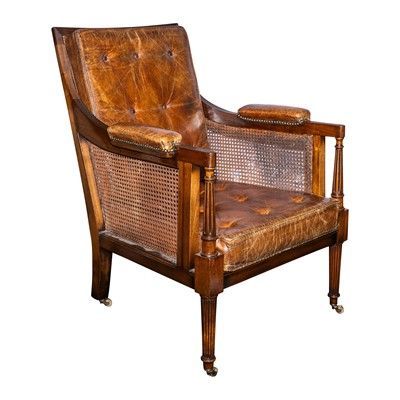
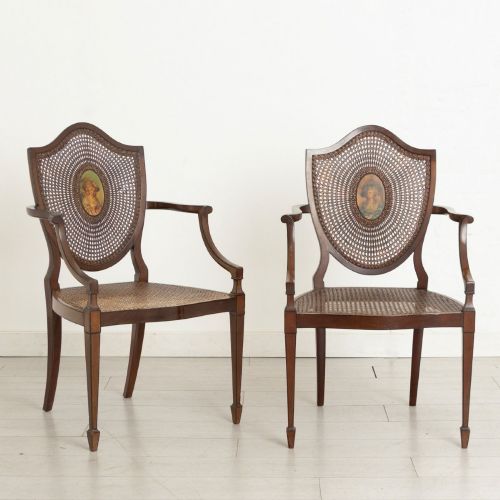
Mahogany Cane Armchair
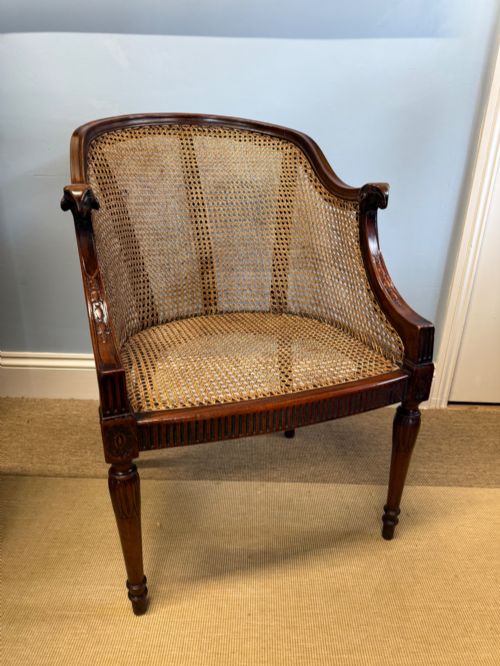
A mahogany cane armchair brings tactile woven seating and rich timber grain together, offering a stately silhouette for library or drawing room.
Forms and periods
A mahogany cane armchair is defined by its timber frame and woven panels, appearing most frequently on this page in Edwardian interpretations, Regency styles, and Art Deco iterations. You will encounter library armchairs, tub chairs, and low-slung bergère forms that utilise open woven backs or seats.
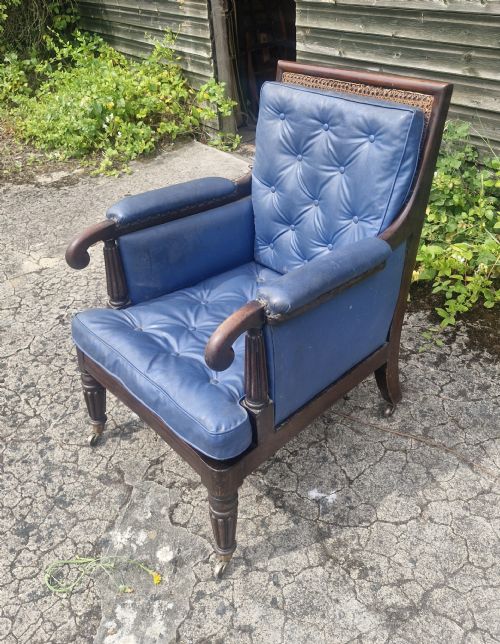
The historical spread reaches from the Regency period through the Victorian and William IV eras into the early twentieth century, including Sheraton Revival and Louis XVI Revival designs. These seating options range from occasional chairs to library armchairs complete with cushions, leather, fabric, or velvet upholstery.
Makers and workshops produced matching pairs and larger suites, alongside single armchairs intended for specific domestic corners. The defining characteristic across these pieces remains the combination of dark timber frames with permeable cane work.
Materials and construction
Frames are constructed from solid mahogany, sometimes enriched with carved details, brass mounts, or Chinoiserie decoration. Artisans shaped the timber to form curved tub structures, open armrests, and rake-backed frames designed to support seated occupants.
Cane panels, including split cane and rattan cane variations, are hand-woven directly into the frame perforations or inserted into channels. Additional padding and loose cushions upholstered in leather, velvet, or fabric provide extra comfort where the cane alone is not used.
Retail Price Guide 2026
Typical UK retail prices for mahogany cane armchair, calculated from the Sellingantiques database of over a million retail prices indexed since 2003. This retail price guide relies exclusively on Sellingantiques data; no external sources or auction records are used, so the figures do not describe the wider market.
Listings feature mahogany, cane, rattan cane, leather, fabric, velvet, and brass across Edwardian, Regency, and Art Deco periods.
Judging execution
Quality resides in the tightness and regularity of the cane weave and the integrity of the mahogany joinery. Superior examples maintain structural rigidity in the frame without looseness in the arms or legs, while the woven panels show consistent tension across the curved backrest or seat.
The refinement of the timber carving and the retention of original elements, such as cushions and decorative brass accents, separate standard production pieces from finer examples. The smoothness of the polished mahogany surface reflects the underlying cabinetmaker's skill.
The Mahogany Cane Armchair Glossary
- Bergère
- An enclosed upholstered armchair with wooden framing and cane sides or back, commonly paired with loose seat cushions.
- Cane
- Woven material derived from the peeled bark of rattan palms, utilised for flexible and breathable seat panels and backrests.
- Sheraton Revival
- A late nineteenth and early twentieth century design movement that reinterprets the neoclassical geometry and delicate proportions associated with eighteenth century cabinetmaker Thomas Sheraton.
- Tub Armchair
- A deep-seated chair featuring a continuous curved back and armrest rail forming a rounded enclosure.
- Regency Style
- A nineteenth century aesthetic revival drawing upon classical Greek and Roman motifs, characterised by clean architectural lines and dark polished woods.
Frequently Asked Questions
How do I care for cane seats?
Keep cane panels supple by wiping them occasionally with a damp cloth to prevent the natural fibres from drying out and snapping. Avoid placing these armchairs near direct heat sources or in overly dry indoor environments.
Support the woven areas with appropriate cushions if the seating is used heavily day to day. Distribute weight evenly and check the underside for signs of tension loss in the interwoven strands.
Were these chairs used at dining tables?
While most pieces on this page function as library armchairs, occasional chairs, or low lounge seats, some historical suites include matching carvers meant for the ends of dining tables. The lower arm heights and broader proportions generally suit relaxation rather than upright dining.
Library and bergere variants were specifically built for reading rooms and withdrawing spaces, often accompanied by plush cushions upholstered in leather or velvet for prolonged sitting.
How can I tell Edwardian from Regency pieces?
Edwardian interpretations frequently exhibit lighter mahogany frames, revival styling influences like Sheraton or Louis XVI motifs, and machine-finished or neat hand-woven cane panels dating around nineteen-ten. Regency pieces rely on heavier classical proportions, deeper timber tones, and structural hallmarks typical of the early nineteenth century.
Examining the construction methods inside the seat rails and the patina of the mahogany polish helps clarify the age of the frame. Revivals often copy earlier proportions while retaining turn-of-the-century joinery techniques.
What is split cane?
Split cane utilises the flattened exterior skin of the rattan vine, presenting a smooth, glossy surface on the outer face and a rougher texture underneath. This material is threaded through frame holes to create durable, breathable panels.
It differs from solid cane strands by offering a flatter profile across the backrest or seat. This technique appears frequently on early twentieth century bergère frames.