
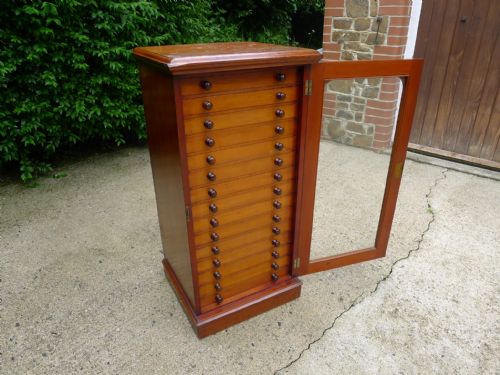


Mahogany Butterfly Chest
A mahogany butterfly chest is a substantial timber cabinet designed to house natural history specimens, bringing disciplined order to any room.
Mahogany Butterfly Chest
The primary purpose of these cabinets is the secure housing and organisation of delicate collections behind panelled or glass-fronted doors. Buyers encounter English pieces constructed primarily in solid mahogany, often featuring numerous internal drawers fitted with brass pulls and glass panels.
How they were made
Construction relies on solid mahogany timbers joined with traditional cabinetmaking techniques to ensure structural stability across dozens of shallow drawers. Brass hardware, including drop handles and escutcheons, secures the functional elements, while glass is utilised in doors and viewing panels.
Internal components frequently incorporate secondary woods and occasionally bone elements for numbering or labelling systems. Exterior surfaces receive polished finishes that highlight the natural grain of the mahogany.
Many cabinets retain tiny handwritten labels in the drawer margins, recording century-old insect sightings in fading ink.
What varies in quality
Scale and drawer capacity dictate much of the architectural ambition, ranging from modest six-drawer units to monumental forty-drawer works by known makers. The precision of the drawer construction and the integration of glass-fronted display doors separate utilitarian storage from superior cabinetmaking.
Attribution to documented makers elevates the standing of a piece within the field of natural history storage. The choice of timber density and the retention of original brass and glass components further distinguish individual cabinets.
Watkins And Doncaster·Brady Of Edmonton·Charles William Schofield·Standish
The Mahogany Butterfly Chest Glossary
- Collectors cabinet
- A multi-drawer timber case designed for the organised storage of natural history specimens, coins, or antiquities. These pieces feature banks of shallow drawers enclosed by locking doors.
- Specimen cabinet
- A specialised storage chest housing scientific items for study and display. They share the multi-drawer format of collectors cabinets.
- Georgian
- A design period spanning the eighteenth and early nineteenth centuries, preceding the Regency era. Furniture from this time exhibits classical proportions and fine timber selection.
- Victorian
- The period of British design spanning the reign of Queen Victoria during the nineteenth century. Cabinets from this era show diverse drawer counts and robust mahogany construction.
Mahogany Butterfly Chest: Frequently Asked Questions
What are these cabinets used for?
These cabinets were built to house and organise natural history collections, particularly insects and botanical specimens, within shallow, dust-proof drawers.
Today, owners utilise them to store small collections, textiles, or documents while displaying the traditional craftsmanship of period cabinetmakers.
How do I identify the period?
Dating relies on stylistic cues, construction methods, and timber characteristics associated with Georgian, Victorian, and Edwardian eras. Earlier pieces often display simpler lines, while late Victorian and Edwardian examples can feature larger drawer capacities.
Makers' stamps or labels, when present, provide definitive dates and workshop attributions to contextualise the piece.
Are the drawers interchangeable?
Drawers in these cabinets are typically fitted individually to specific slots to maintain a dust-proof seal. Swapping them between positions can disrupt the alignment.
Keeping each drawer in its original slot preserves the historical integrity and smooth operation of the cabinet.
How should I care for the mahogany?
Maintaining the wood requires stable room humidity and protection from direct sunlight to prevent the mahogany from drying or fading. Regular dusting with a dry, soft cloth preserves the polished surface.
Avoid liquid polishes or silicone cleaners, which can penetrate the grain and damage historic finishes over time.