




Mahogany Bed Posts
Mahogany bed posts are substantial structural supports salvaged from historic four poster beds, offering rich timber and traditional turning for architectural interior schemes.
Mahogany Bed Posts
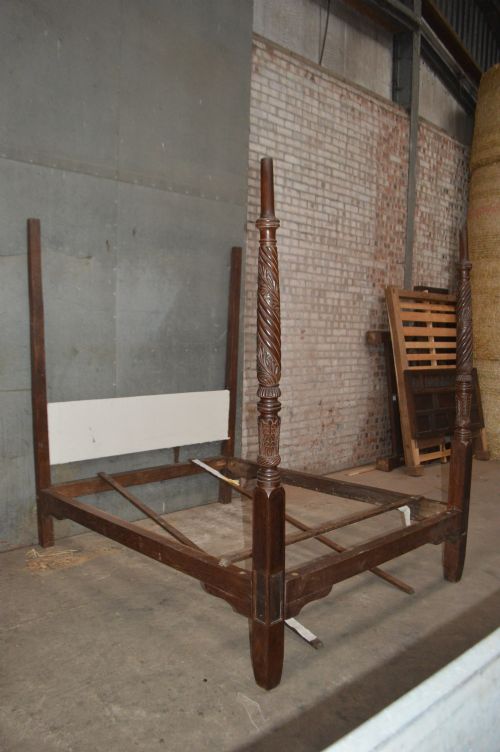
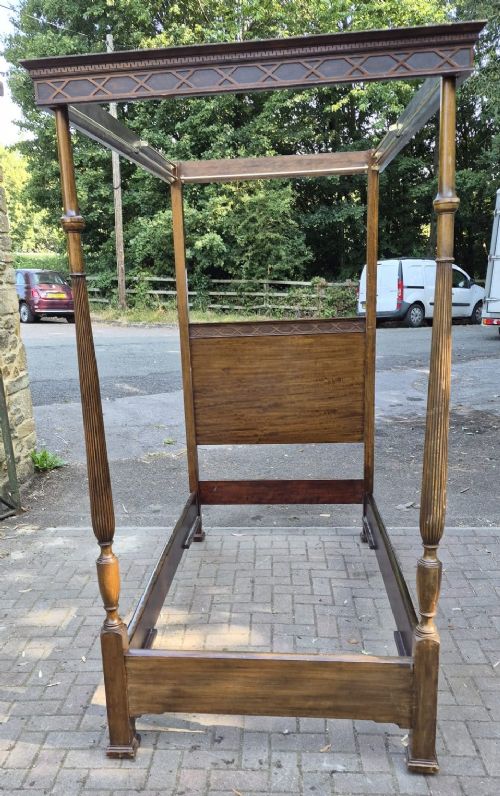
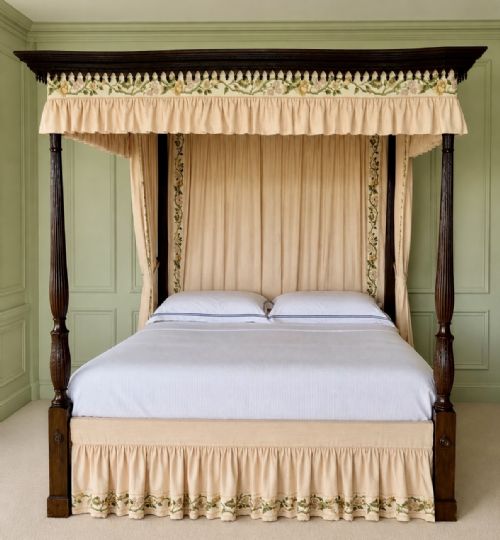
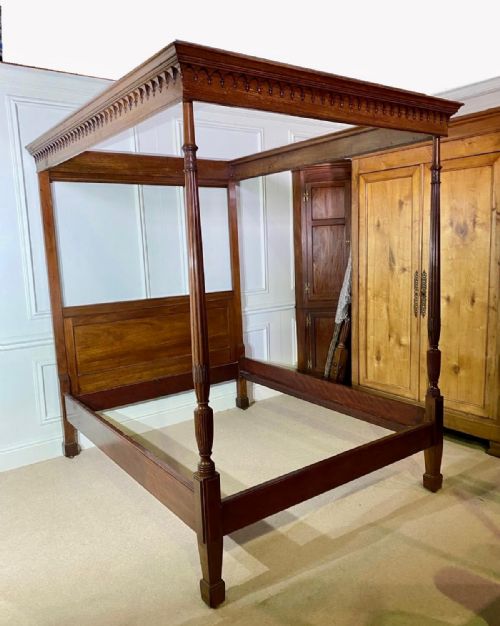
When you search for mahogany bed posts, you are looking at substantial timber supports that once held the testers of grand four poster beds. These architectural elements frequently appear as matched pairs salvaged from larger bedsteads, reflecting Georgian, Regency, and Victorian craftsmanship.
The versions most commonly met on this page date from the nineteenth century, ranging from crisp Regency turning to heavier William IV and Victorian carving. Some survive as detached columns adapted into architectural stands, while others remain part of complete bed frames.
Originating across British and colonial workshops, these pieces showcase the dense tropical hardwood favoured by cabinet makers for its deep colour and durability. Buyers acquire them to restore historic bedsteads or to incorporate classical timber columns into interior architectural projects.
How they were made
Cabinet makers constructed these posts from dense tropical timber, selecting straight-grained stock that could withstand the structural tension of a heavy wooden canopy. Workshops often integrated secondary timbers like pine in hidden framing areas, though the visible columns remained solid mahogany throughout.
Turning on a lathe formed the primary fluted and reeded shafts, while skilled carvers added traditional details such as acanthus leaves, drapery, or reeded spirals by hand. Surface finishing relied on hand-applied wax or polish to bring out the natural reddish-brown depth of the wood grain.
Some nineteenth-century posts retain faint nail holes where bed curtains were hastily tacked down by generations of sleepy occupants.
What varies in quality
The distinction between ordinary and exceptional examples rests upon the depth and crispness of the hand carving along the shaft. Sharply defined acanthus foliage and well-proportioned reeding demonstrate superior bench work compared to softer, more mechanically finished surfaces.
Proportion and wood selection also dictate the standing of a piece within the range, as deeply figured grain patterns and substantial timber scantlings denote higher ambition in the original workshop. Pairs that retain their matching proportions and original mounting blocks command greater interest than mismatched survivors.
Howard & Sons
The Mahogany Bed Posts Glossary
- Tester
- The wooden canopy framework supported by the upper sections of the posts. It frequently carried fabric hangings designed to keep out draughts in historic bedchambers.
- Reeding
- A decorative series of parallel convex mouldings carved directly into the timber shaft. This classical motif appears frequently on Regency and Victorian columns.
- Acanthus
- A carved leaf ornament derived from classical architecture, commonly wrapping the lower portion of larger bed posts. Carvers rendered these in varying depths according to the period style.
- Scantling
- The specific dimensional thickness and width of the timber used to turn the post. Heavier scantlings indicate grander bedsteads intended for principal chambers.
Mahogany Bed Posts: Frequently Asked Questions
How were mahogany bed posts used?
These posts served as the structural vertical supports for large four poster canopy beds in substantial period homes. They held up the overhead wooden frame and heavy fabric curtains.
Today, surviving posts are often displayed as architectural ornaments, mounted as floor-standing columns, or utilised in the restoration of antique bedsteads.
How do I identify Regency bed posts?
Regency examples generally feature clean classical lines, slender proportions, and precise reeding or fluting along the timber shafts. They reflect a shift towards lighter, antiquarian inspiration.
Unlike heavier Victorian or William IV pieces, Regency turnings often display restrained carving and a smooth, polished mahogany surface without bulky ornamentation.
Can single posts be matched into pairs?
Matching separate bed posts is difficult because historic timber dimensions, turning patterns, and mahogany grain variations differ between workshops and periods. Even posts from the same era often show subtle discrepancies.
Most buyers seek out pairs that have remained together since manufacture to ensure uniform height, diameter, and decorative detail for display.
How do I care for antique mahogany?
Maintain the timber by applying a traditional beeswax polish sparingly and buffing gently with a soft cloth. Avoid modern silicone sprays that build up residue on the historic surface.
Keep the posts away from direct sunlight and strong heat sources to prevent the mahogany from drying out, fading, or developing splits in the grain.