
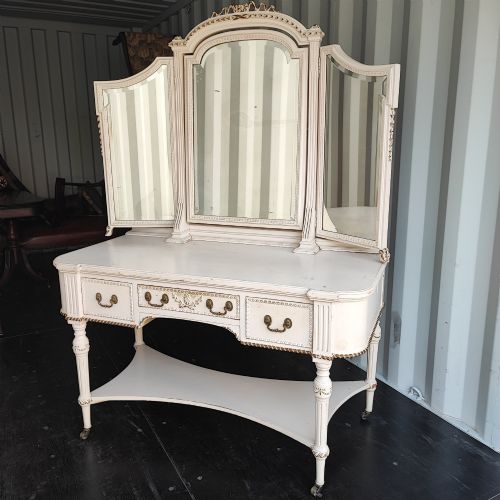


Louis XVI Style Dressing Table
A louis xvi style dressing table brings neoclassical restraint and fine marquetry to a bedroom.
Louis XVI Style Dressing Table
When you search for a louis xvi style dressing table, you encounter pieces that translate eighteenth-century French elegance into nineteenth-century revival forms. These examples range from dedicated poudreuses with hinged tops to refined writing desks and side tables adapted for the mirror.
The material vocabulary spans mahogany, satinwood, kingwood, and tulipwood veneers, alongside painted wood and gilded finishes. Surviving pieces frequently pair these surfaces with ormolu mounts and brass details characteristic of the revival period.
Most entries originate from the nineteenth century, including specific dates around 1880, 1890, and 1900, alongside Victorian interpretations. Alongside dressing tables, the record includes occasional tables, chests of drawers, and matching seating such as boudoir stools and window seats.
How they were made
Cabinetmakers constructed carcasses in timbers such as mahogany and walnut, applying decorative veneers including satinwood, kingwood, and tulipwood. Marquetry inlays formed intricate geometric or floral patterns across table tops and drawer fronts.
Ormolu and brass mounts provided structural and decorative highlights, fixed to corners, legs, and aprons. Painted surfaces and giltwood finishes received specialist hand applications to achieve the characteristic aesthetic of the revival style.
The listings combine mahogany, satinwood, and painted wood with ormolu and brass mounts across nineteenth-century periods.
What varies in quality
The refinement of the ormolu mounts and the precision of the marquetry inlay set the standard for individual examples. Crisp casting in metalwork and tight grain matching in wood veneers indicate superior workshop execution.
Original painted surfaces and integrated glass mirrors retain historical value compared to later restorations. The choice of secondary timbers and the subtlety of the carved details further distinguish masterwork pieces from commercial production.
The Louis XVI Style Dressing Table Glossary
- Ormolu
- Gilded bronze used for mounts and decorative hardware. It provides metallic contrast against wood veneers and painted surfaces.
- Poudreuse
- A type of dressing table featuring a hinged top that opens to reveal a mirror and compartments. These pieces often double as writing desks.
- Marquetry
- Inlaid wood veneers arranged in pictorial or geometric designs. Craftsmen utilise contrasting timbers to create patterns across tabletops.
- Bonheur du jour
- A light lady's writing desk featuring a small cabinet or set of drawers on the upper surface. This form frequently appears alongside dressing tables in revival interiors.
- Commode
- A low chest of drawers, often topped with marble in Louis XVI revival examples. They share the characteristic straight tapered legs of the style.
Louis XVI Style Dressing Table: Frequently Asked Questions
How do I identify a louis xvi style dressing table?
Look for straight tapered legs, neoclassical symmetry, and ormolu mounts rather than the curving lines of the preceding Louis XV style. Fluted columns and subtle architectural carvings often define the framework.
Check the secondary timbers and the construction of the drawers to confirm nineteenth-century revival production methods.
Were these dressing tables used for actual grooming?
Original poudreuses and dressing tables contained compartments for cosmetics, powders, and brushes beneath hinged tops. Integrated mirrors allowed daily use in nineteenth-century boudoirs.
Today, they function effectively as compact desks or vanity tables in modern bedrooms.
How should I care for wood veneers and ormolu?
Maintain stable room humidity to prevent veneer lifting or cracking across the top and sides. Dust regularly with a soft, dry cloth without applying harsh chemical polishes.
Keep ormolu mounts free of moisture to preserve the original gilded finish.
Can I match a dressing table with other revival furniture?
The listings show complementary pieces such as boudoir stools, window seats, and occasional tables from the same nineteenth-century periods. Combining these forms creates a cohesive neoclassical interior scheme.
Pay attention to the primary wood tone, whether mahogany, satinwood, or painted finish, when pairing items.