


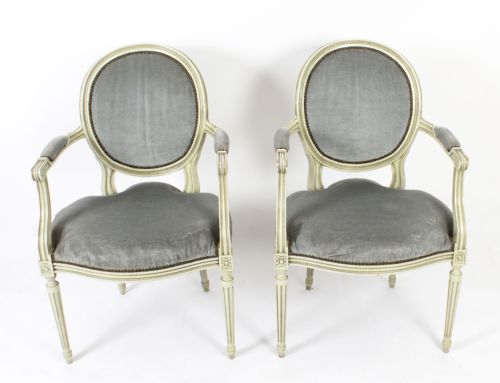
Louis XVI Revival Seating
Louis xvi revival seating brings neoclassical elegance into modern rooms through gilded frames, upholstered salon chairs, and finely carved wood.
Louis XVI Revival Seating
Louis xvi revival seating captures the architectural rigour and refined geometry of the late eighteenth century, reinterpreted by nineteenth and early twentieth-century makers. Buyers hunting for these pieces encounter formal armchairs, salon chairs, and matching stools designed to evoke French chateau interiors.
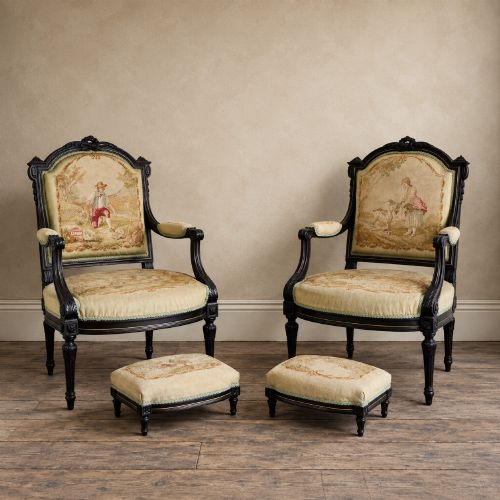
The selection on this page relies heavily on nineteenth-century craftsmanship alongside Edwardian and early twentieth-century interpretations. These chairs typically present balanced proportions, straight tapered legs, and decorative vocabulary drawn directly from neoclassical revival styles.
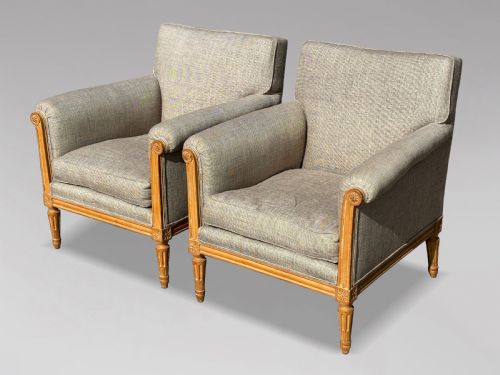
Armchairs and side chairs form the core of the available types, often appearing in matched pairs suitable for formal seating arrangements. The forms emphasise straight lines and crisp symmetry rather than the exuberant curves found in earlier rococo revivals.
Materials and construction
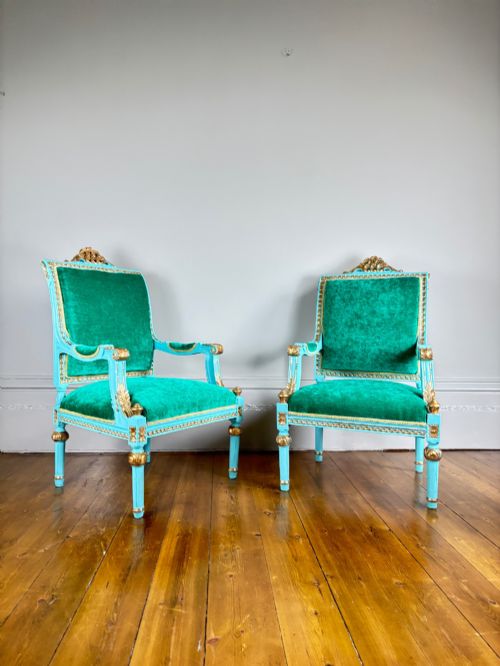
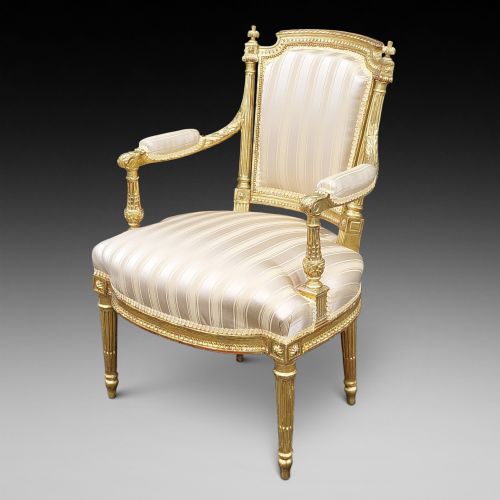
Cabinetmakers utilised robust timbers such as beech, ebonised beech, and rosewood to form the structural skeletons of these chairs. Giltwood finishes and painted wood treatments provided the decorative surface layers favoured in formal French salon furnishings.
Upholstery played a central role in the completion of each piece, incorporating tactile textiles like silk, velvet, and tapestry fabric. Brass elements occasionally reinforced structural joints or added subtle metallic highlights to the carved wooden frames.
Some nineteenth-century makers secretly hid their trade cards beneath the horsehair stuffing of music stools.
Assessing quality in revival seating
Quality rests primarily in the crispness of the wood carving and the integrity of the underlying frame construction. Finer examples display deeply undercut foliage and fluting on the tapered legs, whereas simpler pieces rely on superficial surface decoration.
The treatment of the finish significantly separates tiers of craftsmanship, from hand-applied gilding on carved giltwood to durable painted surfaces on ebonised beech. Original or high-grade textile choices, including period-appropriate silk and tapestry fabric, elevate the overall integrity of the piece.
Charles Nosotti·Holland & Sons
The Louis XVI Revival Seating Glossary
- Giltwood
- Wood coated with gold leaf or a gold-coloured metallic finish to create a brilliant decorative surface. This treatment appeared frequently on formal nineteenth-century salon furniture.
- Fauteuil
- An open-armed upholstered armchair with wooden sides left partially exposed. These chairs typically feature padded armrests designed for comfort during formal gatherings.
- Ebonised
- Wood treated with a chemical stain or finish to imitate expensive ebony. This dark, uniform coloration provided a striking contrast against bright upholstery fabrics.
- Neoclassical
- A style rooted in the art and architecture of classical antiquity, emphasising straight lines and symmetry. Revival pieces draw directly from these architectural precedents.
Louis XVI Revival Seating: Frequently Asked Questions
How do I distinguish these from earlier styles?
Earlier rococo designs favoured asymmetrical curves, C-scrolls, and flowing organic shapes without strict architectural symmetry. In contrast, louis xvi revival pieces rely on straight vertical lines, fluted columns, and disciplined rectangular or oval forms.
The structural framework typically feels more restrained and ordered, reflecting the return to classical antiquity in furniture design.
Where were these chairs placed originally?
Owners positioned them in formal salons, drawing rooms, and reception spaces where guests gathered for conversation and entertainment. Pairs of armchairs often flanked fireplaces or stood symmetrically against panelled walls.
Matching footstools and music stools provided functional seating for specific parlour activities.
How should I care for gilded wood frames?
Giltwood surfaces require gentle dusting with a soft, dry brush to prevent the accumulation of abrasive particles. Avoid liquid cleaners and modern polishes, which can strip or damage delicate metallic leaf applications over time.
Maintaining stable room humidity protects both the underlying timber and the fragile surface finish from cracking.
Are these chairs suitable for daily use?
Most antique salon chairs function well for light seating when placed in low-traffic areas of the home. Original upholstery fabrics may require careful handling or conservation depending on their age and condition.
Heavier everyday lounging is better suited to sturdier, modern upholstered furniture rather than delicate historic frames.