
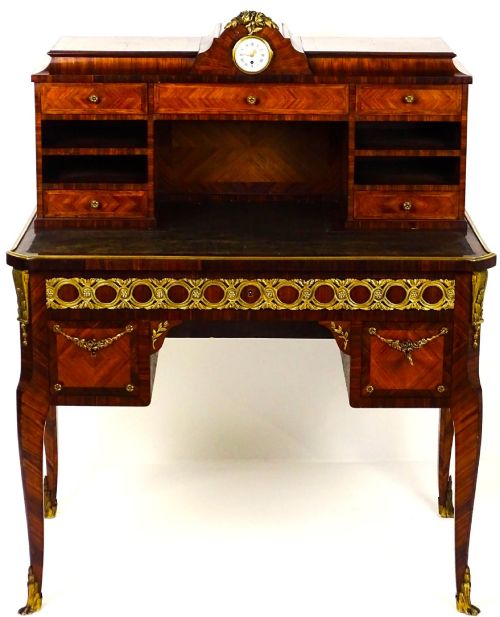
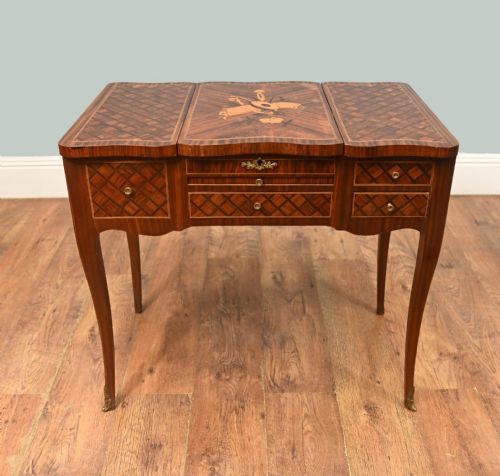


Louis XVI Bonheur Du Jour
These louis xvi bonheur du jour desks are refined French writing tables with tiered superstructures, offering private compartments and elegant surfaces for correspondence.
Louis XVI Bonheur Du Jour
A louis xvi bonheur du jour is a small, light lady's writing desk featuring a tiered superstructure with shelves, drawers, or a cabinet above the writing surface. These pieces emerge primarily in nineteenth-century French revival forms, spanning styles from Louis XVI and French Empire to Napoleon III.
The desks you encounter on this page range from standard nineteenth-century interpretations to specific cabinetmaker pieces. Forms include dressing tables, side cabinets, and secretaire cabinets alongside traditional writing desks.
Origins trace across various decades, with nineteenth-century revival pieces heavily represented alongside Georgian examples. The construction balances delicate proportions with functional compartments designed for correspondence and toilette.
Materials and Construction
Cabinetmakers constructed these desks using figured hardwoods such as kingwood, mahogany, satinwood, and rosewood, often applied as intricate veneers. Ormolu mounts and brass details accent the framework, highlighting structural lines and corners.
Surfaces frequently incorporate inset leather writing panels and marble tops, paired with glazed cabinet doors or roll-top mechanisms. These combined elements reflect meticulous nineteenth-century joinery and decorative metalwork techniques.
Listings feature eighteenth and nineteenth-century periods, utilising kingwood, mahogany, satinwood, rosewood, ormolu, brass, marble, and leather.
Distinguishing Quality
The distinction between standard nineteenth-century production and superior examples rests on the precision of the marquetry and the weight of the ormolu mounts. Finer pieces display crisp, chased bronze mounts and expertly selected wood veneers across curved and flat surfaces alike.
Attribution to documented makers elevates a piece, as demonstrated by signed works from known Paris workshops. The integration of materials like genuine marble tops and supple leather writing inserts further separates workshop execution.
Paul Sormani·Gamichon A Paris·Jean Werner
The Louis XVI Bonheur Du Jour Glossary
- Bonheur du jour
- A small lady's writing desk with a tiered superstructure, appearing in France during the eighteenth century and revived later. It translates literally as day's happiness.
- Ormolu
- Gilt bronze mounts applied to furniture for decoration, cast and chased with great detail. This technique provides metallic contrast against dark wood veneers.
- Kingwood
- A dense, heavily figured Brazilian timber utilised for decorative veneer work on fine cabinets. Its rich grain patterns define high-end nineteenth-century surfaces.
- Marquetry
- The art of applying pieces of veneer to a structure to form decorative designs and patterns. Skilled cabinetmakers used contrasting woods to create pictorial or geometric motifs.
- Superstructure
- The set of small drawers, shelves, or cabinets mounted upon the upper rear of the desk. This tier provides enclosed storage above the main writing surface.
Louis XVI Bonheur Du Jour: Frequently Asked Questions
What is a bonheur du jour?
A bonheur du jour is a small, elegant writing desk featuring a raised tier of compartments, drawers, or a small cupboard on the upper surface. These desks were designed primarily for women to write letters and keep personal papers.
The form originated in France and saw a significant revival during the nineteenth century, resulting in the decorative revival pieces commonly found today.
How do I date these desks?
Dating relies on examining the timber veneers, construction methods, and mount styles. Nineteenth-century revival pieces often emulate eighteenth-century models but utilise distinct hardware attachment techniques and machine-assisted joinery.
Maker signatures, stamped cabinetmaker marks, and specific revival styles such as Napoleon III or Louis XVI provide further chronological markers.
Where were these desks placed?
These pieces were intended for private boudoirs, drawing rooms, or feminine sitting rooms rather than formal libraries. Their compact proportions allowed them to sit comfortably against walls or near windows.
The finished backs on many examples indicate they were designed to stand away from the wall and remain visible from multiple angles within a room.
How do I care for the surface?
Maintenance requires protecting the wood veneers and leather writing inserts from direct sunlight and extreme humidity changes. Gentle dusting with a dry, soft cloth preserves the polished finish without harming the delicate ormolu mounts.
Leather writing surfaces benefit from occasional specialist conditioning to prevent cracking, while marble tops require simple wiping with a damp cloth.