
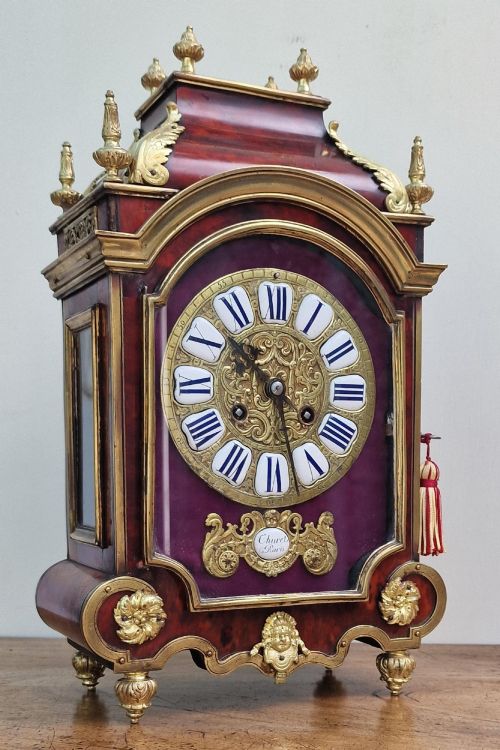


Louis XIV Clock
A louis xiv clock brings dramatic French Baroque grandeur to a room through tortoiseshell, brass and gilt bronze.
Louis XIV Clock
When you search for a louis xiv clock, you are looking at elaborate timepieces that follow the sculptural and decorative traditions of the seventeenth-century French court. These pieces include both mantel clocks and wall bracket clocks with matching shelves, designed to command attention in a principal room.
The version you are most likely to meet on this page is the nineteenth-century revival piece, often created during the Victorian or Napoleon III periods. These later interpretations adopt the grand Louis XIV style and French Baroque aesthetics using tortoiseshell, brass, gilt bronze and ormolu.
Makers such as Samuel Marti, Charles Hour, Vincenti and Japy Fréres produced many of these movements, alongside attributed pieces associated with Henri Dasson and Thuret. They span mantel clocks and bracket clocks that range from ebonised wood to intricate Boulle marquetry.
How they were made
Artisans built these clocks using tortoiseshell and brass inlay set into ebonised wood or mahogany, creating the distinctive Boulle marquetry pattern. Ormolu and gilt bronze mounts were cast and chased by hand to frame the dial and accentuate the architectural corners.
Glass panels protect the enamel or silvered bronze dials, while heavy cast bronze movements drive the timekeeping. Each bracket clock often includes an original matching wall bracket constructed to support the substantial weight of the timber and metal case.
Tortoiseshell panels were often backed with red or blue metallic foil to make the translucent amber shell glow like embers beneath the brass inlay.
What varies in quality
The precision and depth of the cast bronze or ormolu mounts separate standard production from exceptional work. Crisp chasing on the gilt surfaces shows the hand of a skilled artisan rather than a generic factory cast.
The complexity of the Boulle marquetry, the quality of the tortoiseshell and the presence of a signed movement by makers such as Henri Dasson or Samuel Marti elevate a piece. An original matching wall bracket intact with the main clock also marks a higher standard of preservation.
Thuret·Samuel Marti·Henri Dasson·Vincenti·Charles Hour·Japy Fréres
The Louis XIV Clock Glossary
- Boulle
- A form of marquetry using contrasting panels of tortoiseshell and brass, named after the cabinetmaker André-Charles Boulle. It defines the rich decorative surfaces seen on many French revival clocks.
- Ormolu
- A technique of applying finely ground high-carat gold to a bronze object, creating a rich golden finish. It provides the bright decorative highlights on the case corners and feet.
- Bracket clock
- A portable clock designed to sit on a wall bracket or a furniture top. Many examples include a matching wooden shelf specifically made to display the clock on the wall.
- Enamel
- A glassy substance fused to a metal dial through firing, used to form the white chapter rings and numerals. It provides a smooth, durable surface for the clock face.
Louis XIV Clock: Frequently Asked Questions
How do I hang a bracket clock?
Bracket clocks are heavy objects that require secure fixing directly into a solid wall stud or masonry using appropriate wall anchors. The matching wooden bracket must be firmly anchored before placing the clock on top.
Ensure the shelf is completely level to allow the pendulum to swing evenly. Once mounted, secure the movement before setting the time.
Are these clocks from the seventeenth century?
Most pieces available are nineteenth-century revival interpretations created during the Victorian and Napoleon III eras. They adopt the grand style of the original seventeenth-century court.
True seventeenth-century examples are exceedingly scarce and typically reside in museums or major collections. The nineteenth-century pieces represent skilled interpretations of those earlier designs.
What is Boulle work?
Boulle work is a meticulous marquetry technique where thin sheets of tortoiseshell and brass are cut together in matching patterns. This creates contrasting dark and metallic surfaces across the clock case.
Artisans then applied these panels to an ebonised wooden carcase. The technique creates a shimmering texture that catches the light in a room.
How do I wind the movement?
Winding requires a dedicated key inserted into the winding holes on the enamel or metal dial. Turn the key gently until you feel resistance, taking care not to overwind the mainspring.
Maintain a regular schedule for winding to keep the clock running accurately. Consult the specific movement type, such as those by Japy Fréres or Samuel Marti, for precise instructions.