


London Mercury Barometer
A London mercury barometer measures atmospheric pressure through the rise and fall of liquid metal inside glass tubes housed in period timber cases.
London Mercury Barometer
A London mercury barometer records changes in weather through the movement of liquid metal within a sealed glass tube. When searching for a London mercury barometer, you encounter instruments originating from the Georgian, Regency, and Victorian eras.
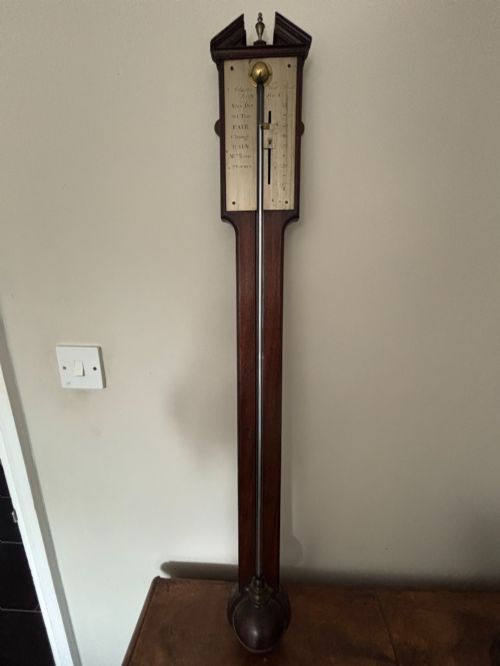
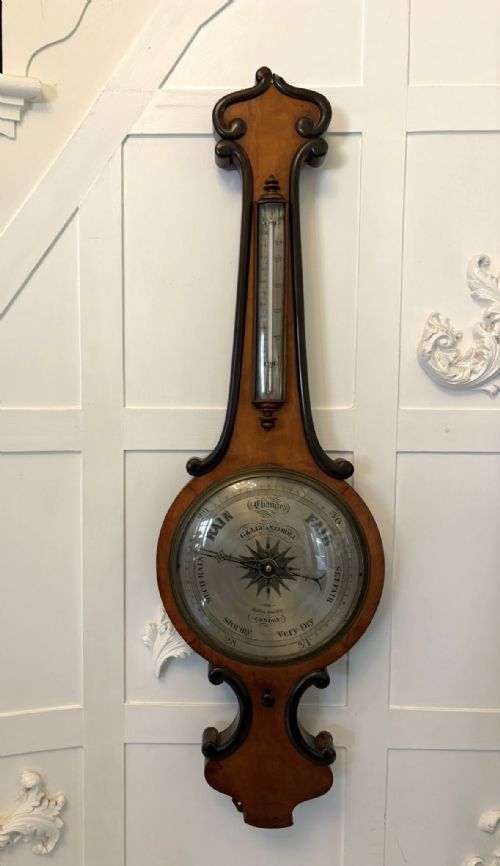
The selection on this page splits primarily between vertical stick barometers and circular wheel barometers. Stick barometers emphasise linear measurement in narrow timber housings, whilst wheel barometers present circular dials framed in mahogany, rosewood, or walnut.
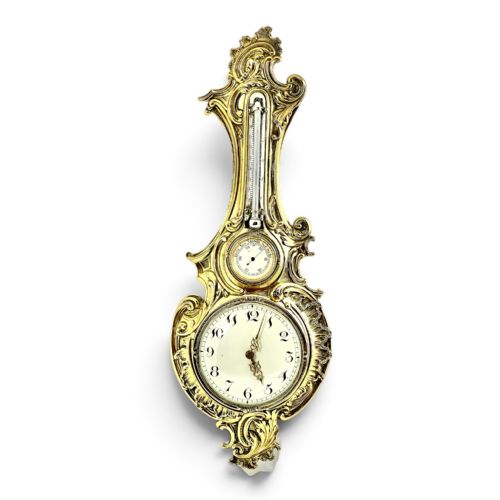
Makers working in the capital produced these meteorological instruments across the eighteenth and nineteenth centuries. Examples range from simple domestic weather glasses to complex marine stick barometers and multi-function weather stations combining thermometers and clocks.
What varies in quality
The refinement of the cabinetwork and the legibility of the engraved scale plates determine the standing of an instrument. Finer examples display crisp boxwood and ebony inlay, carved wooden cistern covers, and well-proportioned architectural pediments.
The reputation of the maker inscribed on the silvered dial influences the character of the piece. Workshops employing skilled precision engravers and cabinetmakers produced instruments with superior mechanical stability and sharper dial markings.
The listings span the Georgian, Regency, and Victorian periods, executed in mahogany, rosewood, oak, walnut, and glass.
George Adams·Negretti and Zambra·Dollond of London·Joseph Somalvico·James Gatty
The London Mercury Barometer Glossary
- Stick barometer
- A vertical instrument utilising a long glass tube exposed or partially enclosed in wood to show atmospheric pressure changes through the height of the mercury column.
- Wheel barometer
- A circular instrument employing a glass siphon tube and a pulley mechanism to drive a hand around a dial face in response to barometric shifts.
- Silvered metal
- A brass or copper plate treated with a silver compound to create a bright, reflective surface for engraved graduation scales.
- Vernier
- A secondary sliding scale attached to the main barometer plate allowing precise readings down to fractions of an inch.
- Cistern
- The reservoir at the base of the barometer tube that holds the reserve of liquid metal open to atmospheric pressure.
London Mercury Barometer: Frequently Asked Questions
How do I read a mercury barometer?
Read the height of the mercury column against the engraved scale plate or follow the pointer on a wheel dial. Rising levels indicate fair weather while falling levels point towards rain.
Use the movable vernier scale to take precise measurements from the top of the meniscus. Comparing readings over several hours shows the trend in atmospheric pressure.
Where should I place a barometer at home?
Hang your instrument on an interior wall away from direct sunlight, radiators, and draughts. Rapid temperature fluctuations affect the mercury and timber casing.
Choose a stable vertical surface at eye level where the scale remains clearly visible. Hallways or studies away from exterior doors provide ideal conditions for accurate operation.
How do I tell a Georgian barometer from a Victorian one?
Georgian instruments often feature understated mahogany cases with simple architectural pediments and fine string inlay. Makers from this period favoured restrained proportions and delicate engraving.
Victorian examples frequently display heavier timber sections, carved walnut ornamentation, or expanded weather station formats combining thermometers and hygrometers. Case designs shifted towards robust mouldings and decorative architectural flourishes.
Can these barometers still be transported safely?
Moving a mercury barometer requires tilting the instrument carefully to allow the metal to flow to the top of the glass tube. This prevents air pockets from forming during transit.
Professional handlers secure the cistern or lock the mercury column in place before packing the timber case. Once relocated, the barometer hangs plumb and returns to normal operation.