


Leather Hip Flask
A leather hip flask brings together glass, precious metal, and worked hide to form a portable vessel made for field use.
Leather Hip Flask
When you search for a leather hip flask, you encounter pocket-sized spirits containers formed from glass bodies bound in hide and mounted with metal caps and cups. The most frequently seen examples on this page date from the Victorian, Edwardian, and George V periods, alongside pieces from the 1920s and 1930s.
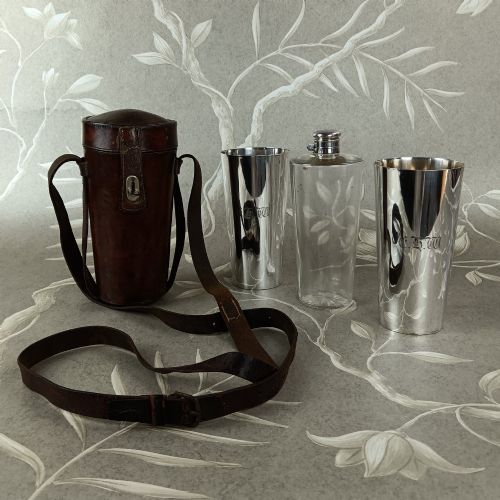
Makers such as James Dixon & Sons and Hukin & Heath produced these barware items in varying formats, ranging from standard pocket curves to large campaign spirit sets and hunting flasks. Many survive with their original silver-plated or sterling silver cups attached to the base.
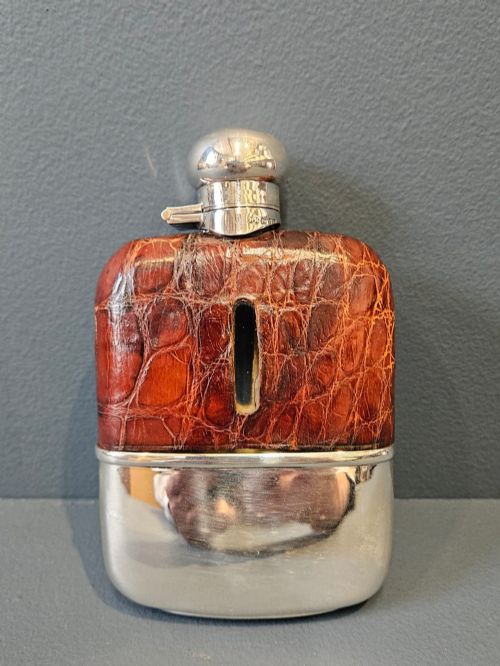
The outer coverings utilise plain leathers or textured crocodile skin, paired with inner glass reservoirs designed to hold spirits securely during travel.
How they were made
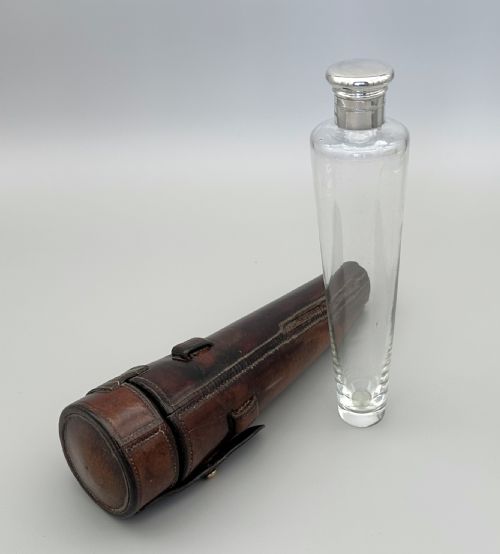
Glass forms the internal reservoir of each piece, shaped to fit the pocket while holding a specific volume of spirit. This glass body is then fitted with a threaded metal neck and cap, often paired with a removable cup that slips over the lower portion.
Outer casings combine stitched leather or crocodile skin wrapped tightly around the glass centre, sometimes complemented by solid sterling silver or silver-plated mounts and hallmarked components.
What varies in quality
The distinction between tiers rests on the metal used for the mounts and cups, shifting from standard silver plate to hallmarked sterling silver. Finer specimens incorporate genuine crocodile skin rather than embossed calf leather.
Execution of the metalwork, integrity of the glass, and precision in the stitching of the leather wrap define the standard of the finished object.
James Dixon & Sons·Hukin & Heath
The Leather Hip Flask Glossary
- Hallmark
- Official stamps applied to precious metals indicating the assay office, standard of purity, and date letter. These marks confirm the silver content on sterling mounts.
- Campaign set
- A portable collection of spirit flasks and beakers arranged for travel or outdoor field sports. These comprehensive sets frequently include fitted leather cases.
- Sterling silver
- An alloy consisting of pure silver and other metals to increase durability. This material appears frequently on high-grade mounts and cups.
- Silver plate
- A layer of silver fused to a base metal substrate. Many period examples utilise this technique to achieve the appearance of solid silver at a different scale.
- Crocodile leather
- Exotic hide utilised as a textured outer wrap on select pocket vessels. It provides a distinct scale pattern across the body of the container.
Leather Hip Flask: Frequently Asked Questions
What is a leather hip flask?
A pocket container featuring a glass body encased in hide and fitted with metal mounts for carrying spirits.
These pieces served travellers, hunters, and field sports participants during the nineteenth and twentieth centuries.
How do I date a silver and leather flask?
Dating relies on hallmarks stamped onto the metal mounts, which reveal the assay office and year of production.
Stylistic cues and maker marks also help place pieces within the Victorian, Edwardian, or George V eras.
Are these flasks made of real crocodile skin?
Period examples often feature genuine crocodile hide or skin used as an outer wrap for the glass body.
Other variations utilise calf leather embossed to replicate a crocodile scale texture.
How should I clean my antique flask?
Maintenance requires gentle cleaning of the metal components with appropriate silver polish while protecting the leather wrap.
The glass interior should be rinsed carefully and left unsealed to dry completely.