
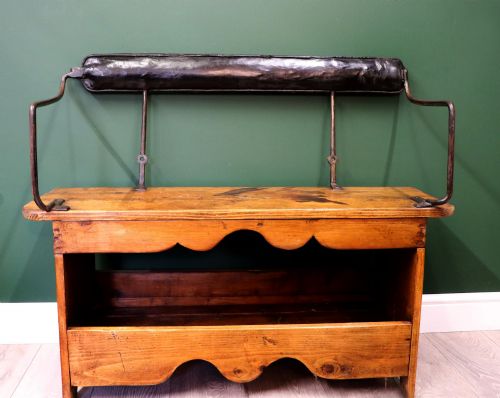


Leather Hall Bench
A leather hall bench anchors an entrance with authority, offering a firm seat and centuries of timber and hide craftsmanship.
Leather Hall Bench
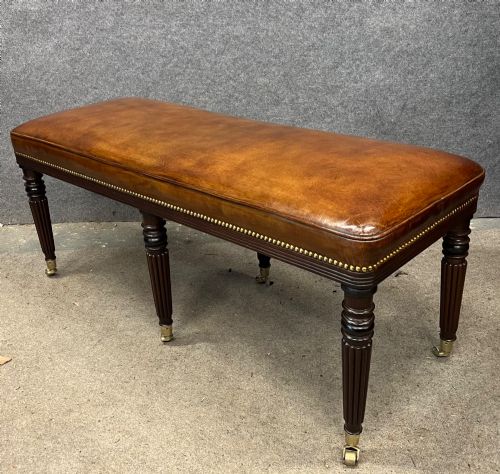
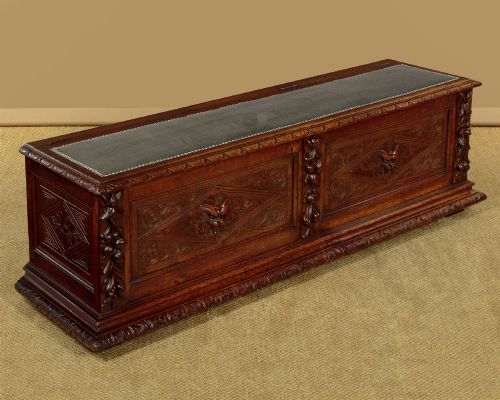
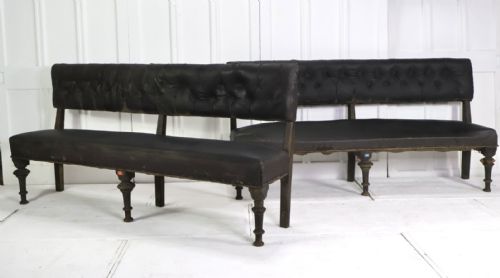
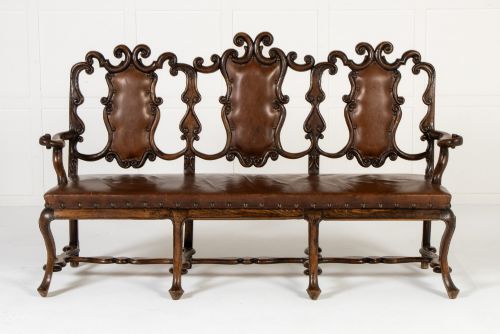
A leather hall bench serves as a substantial seat for an entrance passage, corridor, or reception room, designed to manage outdoor gear and greet callers. When exploring the market for a leather hall bench, buyers encounter varied iterations spanning the nineteenth and early twentieth centuries, including substantial settle boxes, long window seats, and carved Italian or French settees.
The selections on this page draw from distinct regional workshops and stylistic revivals, ranging from English oak settles to Irish country house benches and French Belle Epoque banquettes. Forms vary from low stools and ottoman blanket boxes to paired long benches with upholstered tops, showing how different eras adapted the form for domestic utility.
Materials and construction methods
Makers built these pieces using dense hardwoods such as oak, walnut, mahogany, birch, and regional timbers like stinkwood, assembling frames with traditional joinery. Carved details frequently appear on the wooden structures, reflecting Victorian Gothic, Baroque, or Carolean influences.
Upholstery relies on leather, sometimes paired with velvet trim or secured with brass detailing, stretched over firm padding within bench seats, settees, and ottoman lids.
One listed piece comes complete with a novel twist in its seating arrangement.
Distinctions in craftsmanship and origin
Quality separates pieces through the depth and crispness of the timber carving, the selection of dense hardwoods like walnut or mahogany over softer pine, and the integrity of the structural joinery. Finer examples display meticulous hand-carving and balanced proportions, characteristic of bespoke regional workshop production or named furniture makers.
The treatment of the leather upholstery and associated trims, such as brass accents or velvet borders, indicates the original grade of the commission. Pieces retaining integrated storage functions, such as hinged ottoman seats or blanket boxes, demonstrate thoughtful internal carpentry alongside exterior decorative ambition.
The Leather Hall Bench Glossary
- Settle
- A wooden bench with a high back, solid arms, and often a hinged seat concealing a storage box. This form kept drafts at bay in historic hallways.
- Banquette
- An upholstered long bench or sofa, frequently associated with nineteenth-century French seating design. It provides structured padded comfort for public or domestic spaces.
- Ottoman
- A low, upholstered seat or box with a cushioned lid that lifts to reveal storage space. These items combine textile work with practical box construction.
- Carolean
- A decorative style spanning the late seventeenth century, characterised by rich wood carving and scrollwork. Later nineteenth-century revivals reinterpreted these ornate motifs on hall seats.
- Fluted
- Surface decoration formed by parallel shallow grooves carved vertically into wooden legs or columns. This classical detail appears frequently on Regency and nineteenth-century frames.
Leather Hall Bench: Frequently Asked Questions
Where should I place a leather hall bench?
These pieces suit wide entryways, grand hallways, or large reception rooms where a substantial seating element is required.
They also function effectively at the foot of a bed or within a spacious dressing room.
How do I care for antique leather upholstery?
Maintain the material by keeping it away from direct heat sources and applying appropriate leather conditioning treatments periodically.
Avoid excessive moisture and dust the wooden frames regularly with a soft cloth.
How do I identify nineteenth-century styles?
Examine the timber species, the character of the hand-carving, and the upholstery technique to align the piece with periods such as the Regency or Victorian era.
Stylistic revivals like Gothic or Baroque provide additional clues through specific decorative motifs.