
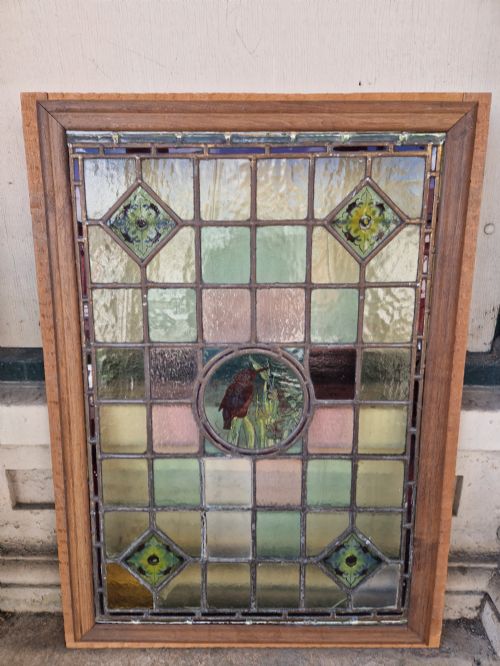


Leaded Glass Window Light
These leaded glass window light pieces bring architectural glass into a room, filtering daylight through coloured and painted panes.
Leaded Glass Window Light
A leaded glass window light functions as architectural salvage, bringing historic glazing into domestic interiors. These panels span the Victorian, Edwardian and 1930s periods, showing how light transformed domestic and ecclesiastical spaces.
The pieces appearing here range from simple clear panels with bullseyes to detailed pictorial works. Hand-painted scenes of countryside landscapes, farmhouses, birds and floral motifs dominate the selection.
Origins stretch from the 19th century through the early decades of the 20th century. Styles include Arts and Crafts, Art Nouveau, Gothic Revival and Dutch Folk Art.
How they were made
Maker's workshops joined individual pieces of glass using flexible lead cames, soldering the joints to form secure geometric and pictorial matrices. Many panels incorporate hand-painted details fired onto the glass surface.
Support structures frequently involve timber frames made of pine, holding the fragile leaded panels for architectural installation.
Listings span periods from the 19th century through the 1930s, featuring timber frames of pine alongside lead and stained glass.
What varies in quality
Quality depends on the artistic ambition of the painted design and the complexity of the lead work. Hand-painted pictorial scenes showing birds, figures or landscapes demand greater skill than repeating geometric patterns.
The condition of the lead matrix and the inclusion of decorative elements like amber bullseyes influence the visual impact of the panel.
The Leaded Glass Window Light Glossary
- Came
- A slender grooved strip of lead used to hold pieces of glass together in a window. These pliable strips form the structural grid of the panel.
- Bullseye
- A small, circular centre piece of blown glass with a thickened lump in the middle. They add texture and amber tones to the surrounding clear glass.
- Architectural salvage
- Building components rescued from older structures for reuse in modern interiors. These windows often retain their original timber frames.
- Stained glass
- Glass coloured by the addition of metallic oxides during its manufacture or painted and fired on the surface. It alters the quality of incoming daylight.
Leaded Glass Window Light: Frequently Asked Questions
How do I hang a leaded glass window light?
These panels require secure mounting within a timber frame or hanging by sturdy chains from a ceiling joist in front of an existing light source.
Weight varies depending on the size and whether a pine frame remains attached to the glass.
How do I identify a Victorian panel?
Victorian examples often employ Gothic Revival motifs or deep rich colours with traditional leaded joins.
Matching the stylistic markers to the recorded periods helps date the architectural salvage.
What subjects appear on these windows?
Common imagery includes hand-painted countryside scenes, farmhouses, winter landscapes, and birds in flight.
Other designs feature floral swags, fruit, and Dutch boy and girl motifs.
Are these windows set in wood?
Many panels retain their original pine timber frames from the period of manufacture.
Others exist as standalone stained glass panels ready for bespoke framing.