


Late 19th Century Candlesticks
Late 19th century candlesticks bring together ornate casting, mixed metals, and diverse revival styles that anchor a room with period character.
Late 19th Century Candlesticks
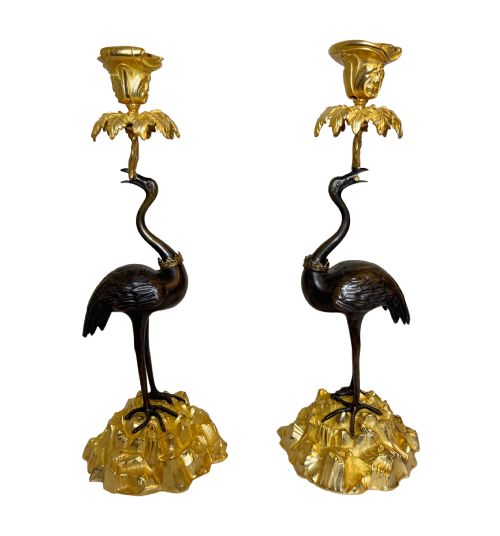
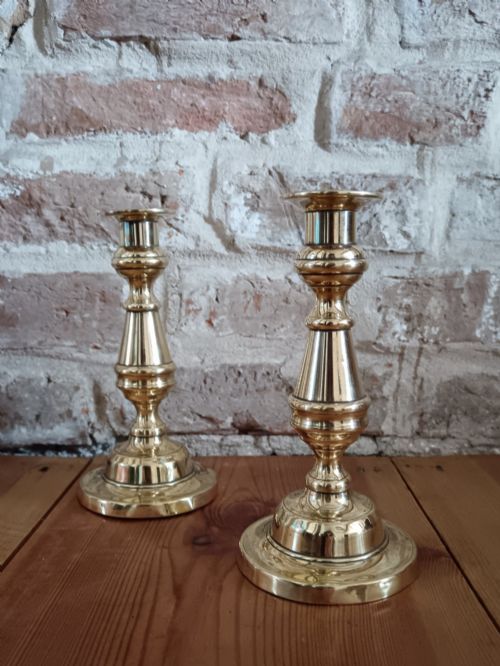
When evaluating late 19th century candlesticks, collectors encounter objects spanning several decades from the 1870s through the close of the Victorian era. The selection ranges from domestic brass table pairs to elaborate French ecclesiastical examples and figural porcelain pieces.
The dominant forms include standard tapers, chamber candlesticks with saucers, and multi-arm candelabra. Many items reflect historicist revivals, drawing heavily on Rococo, Gothic, and Regency vocabularies alongside contemporary Aesthetic Movement and Arts & Crafts designs.
Origin points divide cleanly between British domestic workshops and continental European centres, particularly France and Germany. Makers utilised traditional casting alongside modern industrial techniques to meet shifting middle-class demands for mantel and table illumination.
Materials and Construction Methods
Foundry casting in brass, bronze, and gilt bronze forms the backbone of these pieces, often combined with secondary elements like marble bases, porcelain figures, or glass bodies. Metal components show varying degrees of chasing, patination, and gilding applied by hand after the initial mould work.
Silver plating on copper, including Sheffield plate, provides the surface finish for formal dining table wares, while specialised items incorporate mahogany turned wood, enamel, or tortoiseshell boulle-work. Assemblage relies on threaded rods, pins, and precise mechanical joints typical of period workshop production.
Cats and flamingos sneak into the metalwork, proving that Victorian domestic lighting had a distinct sense of humour.
Distinctions in Quality and Execution
The division between standard commercial output and superior tier pieces rests on the crispness of the casting and the depth of the finishing work. Master modellers ensured that botanical motifs, animal figures, and classical scrollwork retained sharp definition rather than softening into blurred mass-produced shapes.
Weight and structural integrity also separate fine examples from routine workshop stock. Superior pairs demonstrate solid metal gauge thickness, well-fitted components, and balanced proportions that maintain stability when supporting candles or wiring for conversion.
Volkstedt·Dr Christopher Dresser·WM Tonks & Sons·Royal Worcester·James Hadley·Claude Clodion·Thomas Bradbury & Sons
The Late 19th Century Candlesticks Glossary
- Ejector
- A built-in internal spring or sliding mechanism designed to push the spent candle stub out of the socket. This practical device appears frequently on nineteenth-century brass pairs.
- Ormolu
- Gilded bronze, where a layer of gold amalgam is applied to a bronze base and heated to bond the finish. It yields a rich golden lustre seen on French decorative objects.
- Pricket
- A sharp metal spike set in the drip pan to impale a large wax candle or taper. These appear most often on ecclesiastical or altar forms.
- Boulle-work
- An elaborate marquetry technique using tortoise-shell and brass inlaid in intricate patterns. It adorns high-end decorative items.
- Chamber candlestick
- A low candleholder fitted with a broad pan and a loop handle for carrying through a house at night. They often include a matching conical snuffer.
Late 19th Century Candlesticks: Frequently Asked Questions
How do I clean antique brass candlesticks?
Maintenance requires only a soft cloth and mild soapy water to remove accumulated dust and surface grime. Avoid harsh chemical polishes that strip away historical patination and age.
Leaving the natural oxidation intact preserves the character developed over more than a century of existence. Gentle dusting keeps the metal stable without altering its surface.
Can these candlesticks be converted into table lamps?
Many examples are adapted for modern electric wiring, often using a hollow brass rod threaded through the existing central shaft. This modification allows contemporary use while retaining the antique base.
Reversible conversion methods ensure the original structure remains unaltered by avoiding permanent drilling where possible. Professional wiring protects both the piece and the household.
How do I date a pair of candlesticks?
Dating relies on stylistic clues, maker marks, casting techniques, and material combinations recorded across Victorian and late nineteenth-century production. Stamped registration numbers or foundry marks offer precise clues when present.
Comparing construction joints and fastener types against known period timelines helps narrow the production window. Weight, proportion, and decorative motifs reinforce these chronological brackets.