





Large Red Flatweave Rug
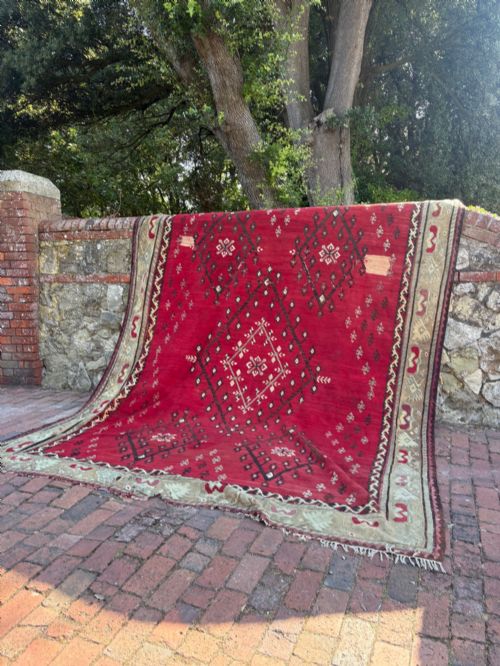
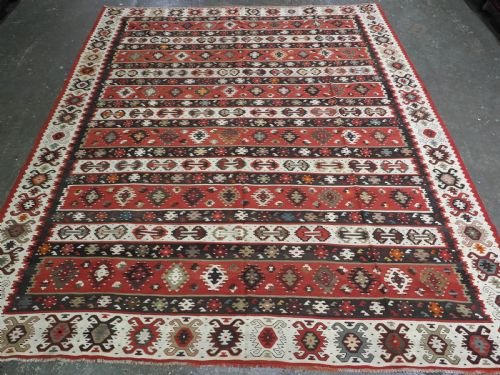
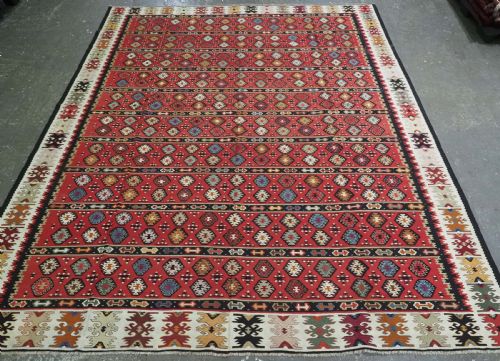
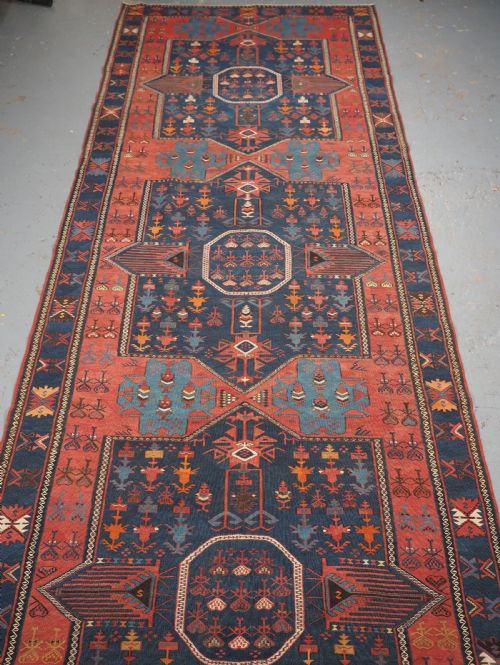
A large red flatweave rug brings substantial floor presence through flat-woven textiles spanning the late nineteenth century to the nineteen-twenties.
Large Red Flatweave Rug
A large red flatweave rug functions as a room-sized floor covering formed without a pile. These pieces span origins from Anatolia, the Caucasus, and the Balkans, appearing predominantly in nineteenth-century and early twentieth-century examples.
Buyers encounter flat-woven kilims, needlepoint carpets, and Aubusson carpets in substantial room dimensions. The selection relies heavily on regional weaves such as Pirot, Sharkoy, and Bessarabian productions.
The aesthetic centres on large formats displaying bold medallions, repeat patterns, and banded designs in red colourways. These textiles offer practical room coverage with a flat profile suitable for heavy furniture placement.
What varies in quality
The execution of the design distinguishes superior weaving from standard production. Tightly beaten wefts create a firmer, more resilient fabric that maintains structural integrity across large room dimensions.
The nuance and consistency of the red dye work determine visual depth. Finer examples retain crisp geometric or floral motifs with harmonious colour saturation throughout the field.
Regional styles represented include Anatolian, Caucasian, Bessarabian, and Balkan traditions.
The Large Red Flatweave Rug Glossary
- Kilim
- A flat-woven carpet or rug produced in countries of the former Ottoman Empire, Persia, and Central Asia. These textiles lack a pile and rely on interlocking weft threads.
- Warp
- The vertical threads held under tension on a loom before weaving begins. The weft threads pass horizontally through these structural cords.
- Weft
- The horizontal threads passed through the warp to build the pattern and fabric of the rug. Tightly packed wefts completely conceal the underlying warp.
- Flatweave
- A textile technique creating a smooth surface without raised pile loops. Such rugs sit flat on floors and function well beneath doors and furniture.
- Bessarabian
- A style of European flat-woven carpet known for floral designs and dark grounds. These pieces often reflect neoclassical or traditional regional motifs.
Large Red Flatweave Rug: Frequently Asked Questions
How do I care for a flatweave rug?
Vacuum gently without a rotating brush roll to remove dust and grit from the flat textile surface. Professional cleaning is recommended for antique wool and cotton pieces to preserve the natural fibres.
Keep these rugs out of direct sunlight to prevent fading of the red dyes. Use a quality rug underlay to reduce friction and prevent slipping on hard floors.
Are these rugs suitable for high traffic areas?
The flat-woven structure offers high durability because there is no pile to crush or mat down over time. Wool and cotton construction handles regular foot traffic effectively in living spaces and dining rooms.
Large formats distribute wear evenly across the floor area. Periodic rotation helps ensure balanced exposure and usage across the room.
How do I determine the age of a rug?
Examine the wool consistency, dye characteristics, and regional weaving structures to estimate the period of production. Pieces from the late nineteenth century and early twentieth century show specific tribal and regional motifs.
Slight irregularities in hand-spun wool and natural dye variations indicate older craftsmanship. Comparing structural details against documented regional types helps confirm the era.
Can I place furniture on these large carpets?
The flat profile provides a stable foundation for tables, chairs, and heavy room furniture without rocking. Distributing weight across a large surface helps anchor the rug securely in place.
Using felt furniture pads protects the wool fibres from heavy pressure indentation. Lift furniture rather than dragging items across the textile.