





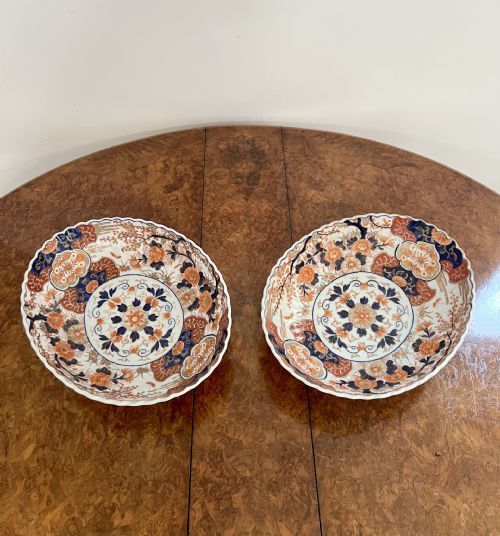


Large Imari Bowl
A large imari bowl brings rich palettes of iron-red, cobalt blue, and gold leaf into a room, offering striking decorative presence.
Large Imari Bowl
A large imari bowl is a substantial ceramic vessel typically found from the seventeenth, eighteenth, and nineteenth centuries, spanning periods such as the Edo and Meiji eras. These pieces often take the form of decorative bowls, scalloped edge bowls, chargers, and jardiniere vessels.
Forms range from deep bowls and covered vessels to shallow dishes and large jug and basin sets. Each piece displays distinct cultural stylistic influences, from traditional Japanese motifs to Victorian Chinoiserie interpretations.
Materials and construction
These pieces are constructed from porcelain, ironstone ceramic, and earthenware bodies shaped into robust vessels. Potters applied underglaze cobalt blue and vibrant enamel colours directly to the ceramic base.
Gilt, gold leaf, and surface gilding embellish the designs, often highlighting intricate floral and geometric borders. Clear glaze seals the pigments during firing, creating a durable and lustrous finish.
Large Imari Bowl Retail Price Guide 2026
Typical asking prices for large imari bowl among the pieces listed under this phrase on Sellingantiques today, from the lower quarter to the upper quarter. They describe what is for sale here now, not the wider market.
Some nineteenth-century British potteries painted whimsical animal titles like 'Crazy Cow' onto their large decorative vessels.
Markers of quality
Quality rests upon the crispness of the hand-painted cobalt blue and the precision of the enamel work. Finer examples display balanced compositions and carefully applied gold leaf rather than hasty brushwork.
The weight, wall thickness, and refinement of the porcelain or ironstone body distinguish standard production from exceptional pieces. Intricate moulding, such as scalloped rims or fitted covers, elevates the standard of the vessel.
Minton
The Large Imari Bowl Glossary
- Imari
- A style of Japanese porcelain decorated in underglaze blue, iron-red, and gilt. It originated in Arita and became widely exported to Europe.
- Arita
- The Japanese town and surrounding region where porcelain production began in the seventeenth century. Kilns here produced much of the early export ware.
- Jardiniere
- A large ornamental pot or bowl designed to hold growing plants or flowers. These vessels often feature heavy ceramic walls to support damp soil.
- Ironstone ceramic
- A patented British earthenware body known for its durability and strength. It served as a robust alternative to true porcelain.
- Chinoiserie
- European decorative style reflecting Chinese artistic influences. It frequently appears on nineteenth-century British ceramics.
- Meiji Period
- The era of Japanese history lasting from 1868 to 1912. Export wares from this time often exhibit refined enamelling techniques.
Large Imari Bowl: Frequently Asked Questions
What is a large imari bowl used for?
These vessels serve primarily as decorative centrepieces on tables, sideboards, or pedestals. Their substantial size and rich colour palette make them natural focal points in a room.
Some variations, such as jardinieres or covered bowls, were historically utilised for housing plants or storing dry goods. Today, most owners display them empty to preserve the painted surfaces.
How do I date a large imari bowl?
Dating relies on examining the clay body, the quality of the glaze, and the specific palette of the enamels. Eighteenth-century pieces often display heavier potting and distinct cobalt tones compared to later export wares.
Maker marks, where present on British ironstone or porcelain variants, provide precise production dates. Japanese pieces are generally attributed by stylistic eras such as the Edo or Meiji periods.
Are these bowls made of porcelain?
Many examples consist of fine Japanese or Chinese porcelain fired at high temperatures. These pieces feature thin, resonant walls and white ceramic bases beneath the glaze.
Other examples utilise ironstone ceramic or earthenware, particularly British interpretations from the nineteenth century. These alternative bodies offer greater weight and structural thickness.
How should I care for an antique bowl?
Maintenance requires gentle dusting with a soft, dry cloth to prevent accumulation on the glazed surface. Harsh chemical cleaners and abrasive scrubbing pads must be avoided to protect the enamel and gold leaf.
Display the bowl away from direct sunlight and areas subject to sudden temperature fluctuations. Ensuring stable placement on a level surface prevents accidental tipping.