

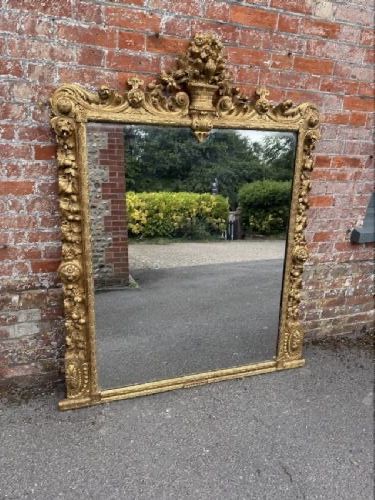


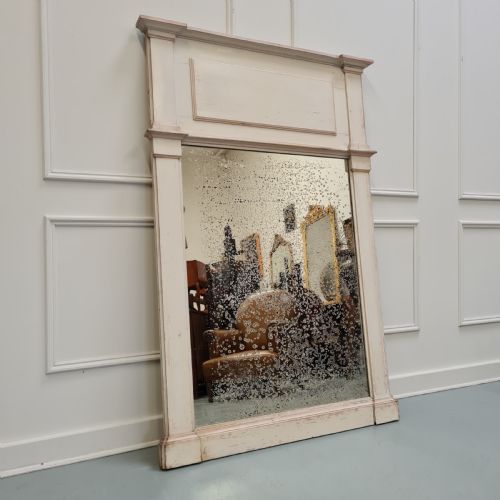

Large French Architectural Mirror
A large french architectural mirror commands a room, reflecting light and space through substantial frames built to echo classical buildings.
Large French Architectural Mirror
A large french architectural mirror brings structural presence into an interior, drawing on classical building forms for its surround. Buyers seeking this form encounter overmantel mirrors, pier mirrors, window mirrors, and trumeau mirrors designed to anchor a wall.
The pieces on this page originate predominantly from the nineteenth century, spanning decades from eighteen fifty to nineteen hundred. Makers shaped these frames within Victorian, Rococo Revival, French Empire, Neoclassical, and Renaissance Revival idioms.
Overmantel mirrors dominate the selection, frequently featuring arched or shaped tops intended to sit above a fireplace. Alongside these, wall mirrors, pier mirrors, and mirrors styled as architectural windows populate the inventory.
Evaluating Quality and Detail
The depth and clarity of the woodcarving separate standard pieces from exceptional examples. Crisp detailing on columns, crests, and ornate frames demonstrates superior handwork by nineteenth-century artisans.
The integrity of the surface finish, whether original paint, parcel gilt, or gold leaf applied over gesso, dictates visual impact. Uniformity and preservation of these layered finishes elevate a piece within its period.
Listings span the nineteenth century from eighteen fifty to nineteen hundred, encompassing French Empire, Neoclassical, and Victorian styles executed in giltwood, carved oak, and painted wood.
Nosotti's
The Large French Architectural Mirror Glossary
- Overmantel mirror
- A large mirror specifically designed to hang on the wall directly above a fireplace mantel. These pieces often incorporate arched or shaped tops to match interior architectural proportions.
- Trumeau mirror
- A decorative wall mirror paired with a panel above or below, frequently integrated into nineteenth-century interior panelling. These pieces originate from French decorative traditions.
- Giltwood
- Timber that has been coated with a thin layer of gold leaf or gold powder. This technique provides a luminous metallic finish to carved architectural frames.
- Gesso
- A plaster-like mixture applied to wood frames as a smooth base for gilding and paint. It allows artisans to mould crisp relief details before applying gold leaf.
- Pier mirror
- A tall mirror designed to hang on the wall space between two windows. These tall glasses amplify natural light in nineteenth-century rooms.
Large French Architectural Mirror: Frequently Asked Questions
Where should I hang an architectural mirror?
These large pieces find their traditional place above a fireplace mantel or mounted on a principal wall to reflect light. Their substantial scale requires solid wall fixings to support the heavy wood and glass frames safely.
Positioning them opposite a window maximises the illusion of space and illuminates darker corners of a room.
How do I identify a nineteenth-century frame?
Nineteenth-century frames display hand-carved wood construction, often layered with gesso before receiving gold leaf or paint finishes. Examining the backboards, joinery, and the weight of the timber helps confirm the period.
Stylistic cues such as French Empire columns or Rococo Revival curves align with the manufacturing dates recorded across these items.
What is a trumeau mirror?
A trumeau mirror combines a glass plate with a decorative painted or carved wooden panel within a single unified frame. Originating in French interiors, these pieces served as permanent architectural fittings.
They bring distinct vertical emphasis and decorative painted detail to a wall scheme.
Are the mirror plates original?
Mirror plates vary, with some pieces retaining their original antique glass showing age spots and silvering degradation. Other items may feature replacement glass fitted during the long history of the object.
Checking the reflections and edges of the glass reveals the character of the mirror plate.