
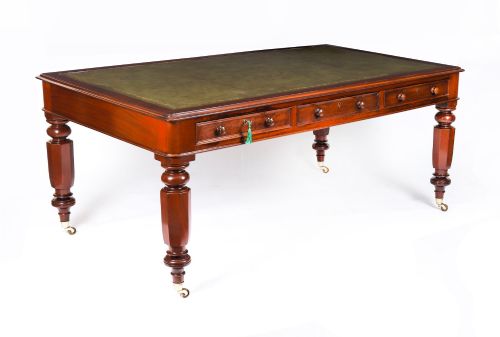
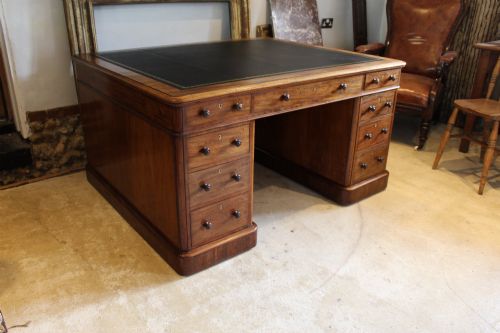
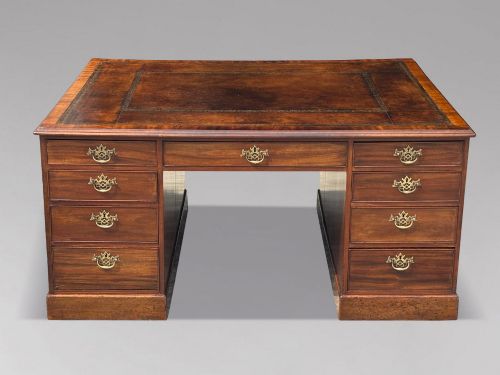


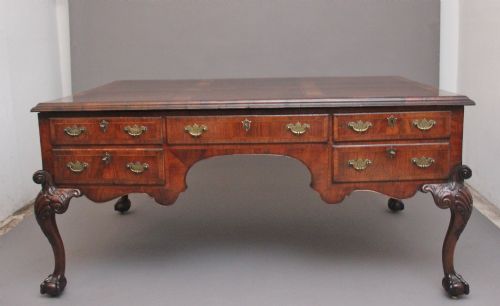


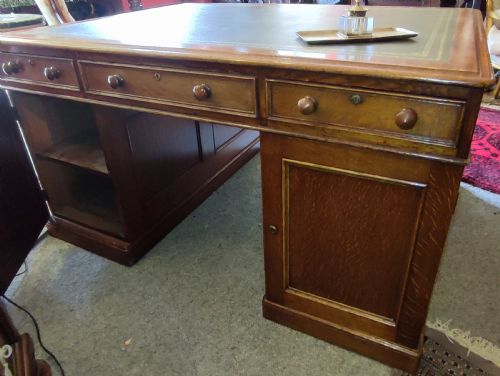


Large Double Sided Desk
A large double sided desk provides workspace on both faces, serving libraries and studies with double pedestals and cupboards.
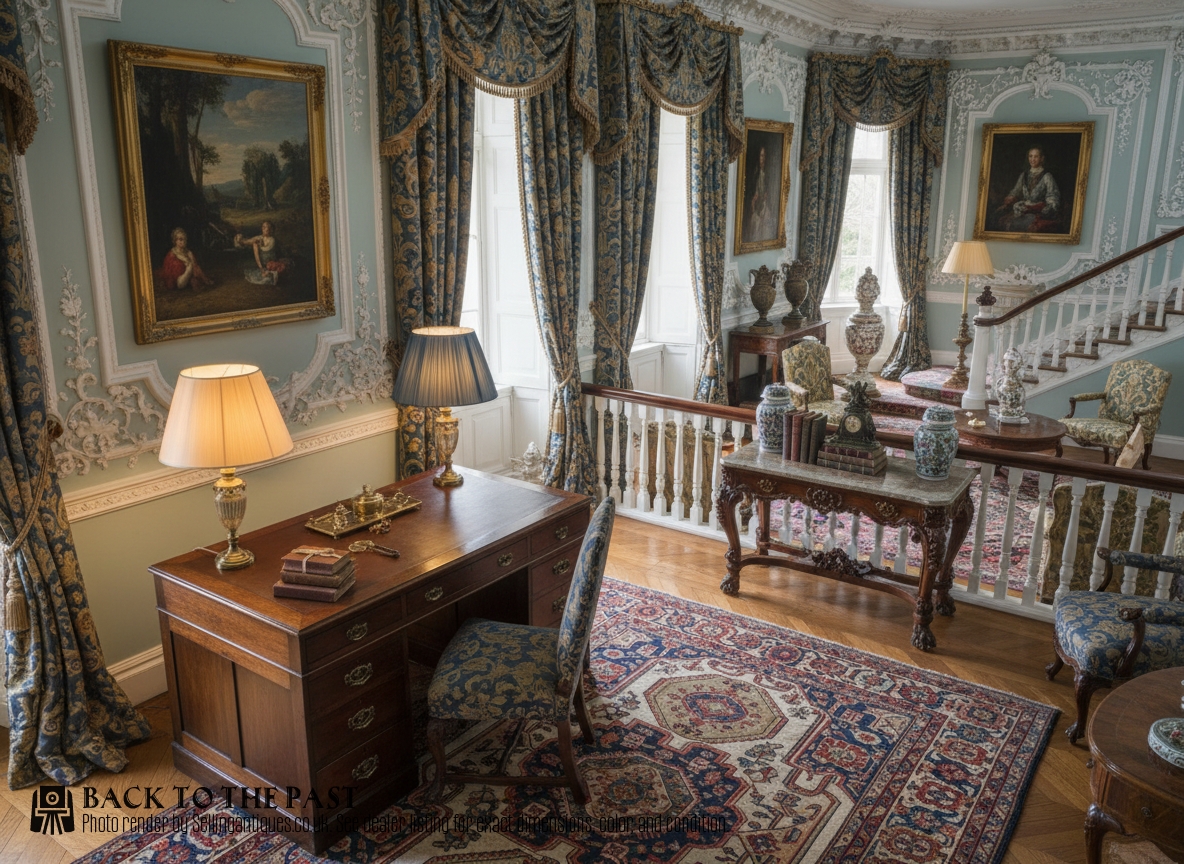
Large Double Sided Desk
A large double sided desk, frequently called a partners desk, offers deep proportions and matching drawers or cupboards on both long faces. These pieces date across the eighteenth, nineteenth, and early twentieth centuries, appearing in periods from Georgian and Regency through to Victorian and Edwardian.
The standard form on this page uses twin pedestals supporting a wide top inset with leather, flanked by banks of drawers or doors facing outward in both directions. Walnut, oak, and mahogany form the primary carcasses, often shaped with serpentine fronts or raised on heavy plinths.
How they were made
Cabinet makers constructed these large pieces using dense timbers such as mahogany, oak, walnut, and rosewood, frequently selecting flame mahogany, burr walnut, or curl mahogany veneers for the primary surfaces. Solid timber carcases received careful hand-cut dovetailing in the drawer linings and robust framing to support heavy daily use.
Writing surfaces were traditionally lined with tooled leather, secured around the edges with brass tacking or blind tooling. Brass handles, escutcheons, and locks completed the hardware, providing secure storage across the multiple drawers typical of these large library tables.
Listings feature mahogany, oak, walnut, rosewood, and leather across Georgian, Victorian, and Edwardian periods.
What varies in quality
The grade of timber selection dictates much of the visual distinction, moving from plain utility oak up to highly figured flame mahogany and burr walnut veneers matched across wide expanses. Cabinetmaking finesse shows in the crispness of carved mouldings, serpentine drawer fronts, and the seamless integration of double-sided banks of drawers.
Proportion and scale also separate standard utility examples from important library pieces commissioned for substantial period interiors. Superior hardware, original tooled leather surfaces, and secondary timbers of solid oak or mahogany indicate higher workshop origins.
Charles Andrea Nosotti·T Wilson·Holland and Sons
The Large Double Sided Desk Glossary
- Partners desk
- A large double sided desk designed for two people to work opposite one another, featuring drawers and cupboards on both faces.
- Pedestal desk
- A heavy freestanding writing table supported by two piers or columns of drawers flanking a central kneehole.
- Flame mahogany
- A veneer cut from the branch junction of a mahogany tree, showing a distinctive flickering flame pattern.
- Burr walnut
- Timber taken from a tree growth or burl, yielding intricate swirling grain patterns highly prized for luxury cabinet work.
- Serpentine
- A curved furniture front with a convex centre flanked by concave wings, creating a flowing wave shape.
Large Double Sided Desk: Frequently Asked Questions
What is a large double sided desk?
A large double sided desk is a substantial freestanding table designed to allow two people to sit and write facing each other. These pieces incorporate matching drawers and cupboards on both longitudinal faces.
Originally built for partners in banks, legal practices, and large private libraries, they offer deep proportions and generous surface areas.
How do I date a partners desk?
Dating relies on stylistic clues, timber choices, and construction methods. Eighteenth-century and Regency examples show different leg structures and mouldings compared to Victorian or Edwardian pieces.
Examine the secondary timbers inside the drawers and the style of the brass hardware to help confirm the period of manufacture.
What timber are these desks made from?
Mahogany is the most frequent timber seen, appearing in plain, flame, and curl varieties. Oak and walnut also feature prominently, alongside occasional rosewood and burr walnut.
These dense hardwoods provided the structural integrity needed for heavy pedestals and wide writing surfaces.
How were partners desks used?
They were designed for shared offices, libraries, and boardrooms where two professionals needed simultaneous access to workspace and storage. The duplicate sets of drawers allowed each user to keep papers organised separately.
Their placement in the centre of a room rather than against a wall made use of both accessible sides.