



Large Church Prickets
Large church prickets are towering altar lights built to support heavy tapers during sacred rites, offering commanding height and solemn presence to any interior.
Large Church Prickets
Large church prickets are substantial ecclesiastical candlesticks terminating in a vertical metal spike rather than a socket, designed to hold thick wax candles firmly in place. These imposing objects emerge primarily from the eighteenth and nineteenth centuries, taking the form of tall altar sticks, floor-standing torchères, and heavy pairs shaped by continental or British ecclesiastical traditions.
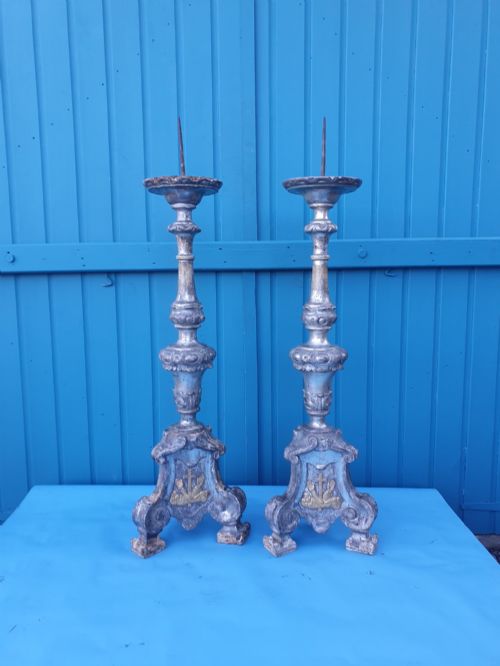
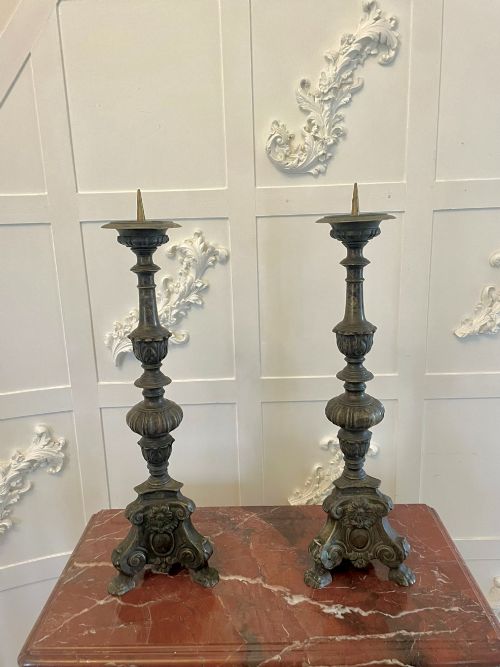
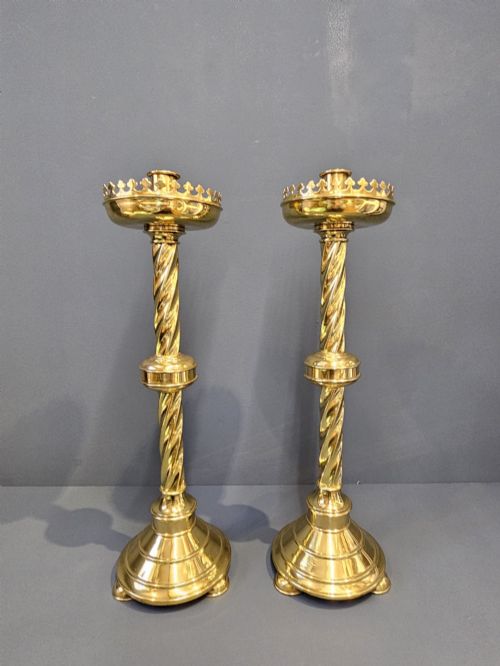
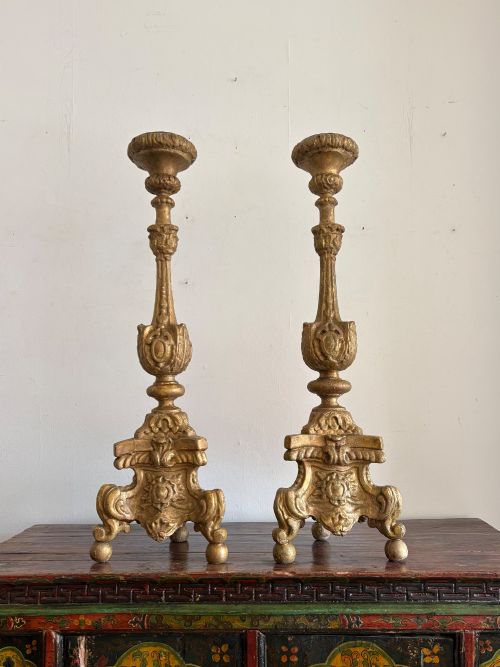
Buyers encountering this group will most frequently find nineteenth-century brass examples alongside eighteenth-century carved giltwood Italian altar pieces and substantial twentieth-century Amsterdam School designs. The forms range from strict Gothic Revival interpretations to ornate Baroque and Rococo silhouettes, often standing well over a metre in height.
The fundamental purpose of these tall candle holders was illumination within large liturgical spaces, yet their architectural proportions translate readily into domestic settings today. Whether sourced as matched pairs or individual floor-standing pillars, they function as sculptural floor elements or dramatic focal points upon large tables and sideboards.
Materials and construction
The physical substance of these pieces divides broadly between cast or turned metals and carved timbers coated in decorative finishes. Brass and iron form the durable core of many nineteenth-century examples, while earlier continental pieces rely on carved wood finished with gesso, silver leaf, or rich gilding.
Metals were typically cast in sections and threaded or joined together to achieve significant height without sacrificing structural stability, occasionally combining brass and iron within a single shaft. Wooden alternatives relied on skilled hand-carving to produce intricate Baroque scrolls or restrained columnar shafts before applying delicate layers of gold or silver leaf over a gesso base.
Large Church Prickets Retail Price Guide 2026
Typical asking prices for large church prickets among the pieces listed under this phrase on Sellingantiques today, from the lower quarter to the upper quarter. They describe what is for sale here now, not the wider market.
The inventory spans several distinct aesthetic traditions, uniting nineteenth-century Victorian pieces with earlier eighteenth-century baroque designs and twentieth-century Amsterdam School works.
Judging quality and presence
Quality in large church prickets rests upon the crispness of the original casting or carving and the integrity of the surface finish. Superior examples display deep, deliberate chiselling in wood or sharp, well-defined profiles in brass, avoiding the soft, washed-out details common to mass-produced later copies.
The richness and survival of original gilding, silver leaf, or patinated metal surfaces heavily influence the visual weight of the piece. Masterful proportion between the heavy base, the turned or cast stem, and the spiked drip pan separates standard ecclesiastical hardware from truly exceptional sculptural works.
The Large Church Prickets Glossary
- Pricket
- A sharp metal spike atop a candlestick designed to pierce the base of a thick candle and hold it upright.
- Torchère
- A tall, freestanding stand or candlestick originally intended to carry a single torch or heavy candle.
- Giltwood
- Timber that has been coated with a thin layer of gold leaf or gold dust over a prepared gesso ground.
- Gesso
- A plaster-like mixture applied to wood surfaces as a smooth base for subsequent gilding or painting.
- Altar-style
- Formed in the architectural and decorative tradition associated with ecclesiastical altar furnishings.
Large Church Prickets: Frequently Asked Questions
How were large church prickets used?
These tall fixtures stood upon or beside church altars to support massive wax candles during high ceremonies and masses, projecting light across vast ecclesiastical interiors.
Their commanding height ensured the flame remained visible to congregations while casting upward illumination over liturgical textiles and sacred vessels.
How do I secure a candle on a pricket?
The thick base of a pillar candle is pressed directly downward onto the sharp iron or brass spike at the top of the stick.
A small metal drip pan situated immediately beneath the spike catches melted wax before it can run down the decorated shaft.
Where can I place a floor candelabra at home?
Floor-standing models suit empty architectural corners, deep hallways, or flanking large fireplaces where their height commands the vertical space.
Shorter altar prickets sit comfortably upon heavy sideboards, refectory tables, or mantels where their substantial bases create a strong focal point.
How do I distinguish eighteenth-century pieces from Victorian ones?
Eighteenth-century examples frequently employ carved wood with gesso, silver leaf, or baroque giltwood surfaces reflecting Italian or French ateliers.
Victorian pieces lean heavily toward cast brass and iron, often drawing directly upon Gothic Revival design vocabulary with heavier, more industrial mechanical joints.