


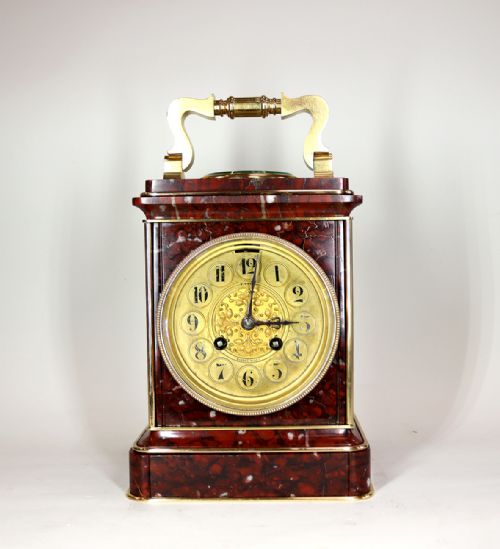


Large Carriage Timepiece
A large carriage timepiece is a substantial brass or silver-cased portable clock built for travel and domestic use, prized for its mechanical complexity and architectural presence.
Large Carriage Timepiece
When you search for a large carriage timepiece, you are looking at substantial portable clocks designed during the nineteenth and twentieth centuries. These pieces originate predominantly from French workshops and British silversmiths, spanning Victorian, Edwardian, and classical revival styles.
The versions most commonly met on this page include heavy brass, gilt bronze, and silver cases housing enamelled dials behind bevelled glass panels. Architectural forms, giant proportions, and gorge cases frequently appear alongside simpler traditional designs.
Many examples incorporate advanced complications such as date work, moon phases, and striking mechanisms. Makers like Henri Jacot and L'Epee represent the level of craftsmanship found within these portable horological objects.
Materials and construction
These clocks rely heavily on cast brass, gilt bronze, and sterling silver for their robust cases. Bevelled glass panels fit tightly into the metal frames to protect the internal escapement and gear train while allowing a clear view of the movement.
Enamel is standard for the dials, fired onto metal plates to provide a crisp, legible surface for roman or arabic numerals. Leather travelling cases frequently accompany the silver and brass bodies to protect the exterior during transit.
Some heavy models arrive with their original fitted leather carrying boxes, having survived more than a century of actual travel.
Judging quality and execution
The calibre of the movement and the weight of the metal case set the baseline for quality. Solid gilt bronze and hallmarked silver require significantly more skilled labour than standard brass castings, elevating the presence of the object.
Refined dial execution, intricate repousse decoration, and signed maker plates distinguish superior pieces. The inclusion of original paperwork, fitted boxes, and fully restored repeating mechanisms further separates exceptional examples from standard timepieces.
Henri Jacot·L Epee·Henry Matthews
The Large Carriage Timepiece Glossary
- Gilt bronze
- Copper alloy coated with a thin layer of gold using fire gilding or electroplating. This finish prevents tarnishing and gives the metal a warm, reflective lustre.
- Gorge case
- A distinctively stepped brass or gilt case shape with a moulded top and base. It represents a classic French carriage clock housing style.
- Repousse
- Metalworking technique where the metal is hammered from the reverse side to form a raised design in relief. It is often seen on silver carriage clock cases.
- Escapement
- The internal mechanical linkage that controls the release of power in the clock train. It maintains the pendulum or balance wheel oscillation.
- Bevelled glass
- Glass panes with angled, polished edges fitted into the brass window apertures. This technique adds depth and catches the light.
Large Carriage Timepiece: Frequently Asked Questions
How do I wind a carriage timepiece?
Most of these clocks utilise a dedicated winding key inserted into the arbour on the rear backplate. Turn the key gently clockwise until resistance indicates the mainspring is fully tensioned.
Avoid overwinding the movement, as this places unnecessary stress on the delicate brass gears and mainspring. Ensure you support the case securely while operating the key.
What is the difference between a clock and a timepiece?
In horological terms, a timepiece indicates the hours and minutes without sounding an alarm or striking the hour on a bell or gong. A clock generally incorporates a striking train to announce the passage of time.
Many listings for large carriage timepieces specifically denote this distinction, focusing purely on accurate visual timekeeping rather than audible strikes.
How should I clean the glass panels?
Wipe the bevelled glass panels carefully using a soft, lint-free microfibre cloth slightly dampened with water or mild glass cleaner. Spraying liquid directly onto the case risks moisture seeping into the movement.
Keep harsh chemical polishes away from the enamel dial and the metal frame to preserve the original gilding and silver surfaces.
Can these clocks travel safely today?
While originally designed for nineteenth-century travel in carriages and trains, modern transit requires extra care. Secure the internal balance wheel if possible, and transport the clock inside a fitted leather outer case.
Sudden impacts or drops can easily damage the delicate glass panels and throw the escapement out of beat, requiring professional adjustment.