
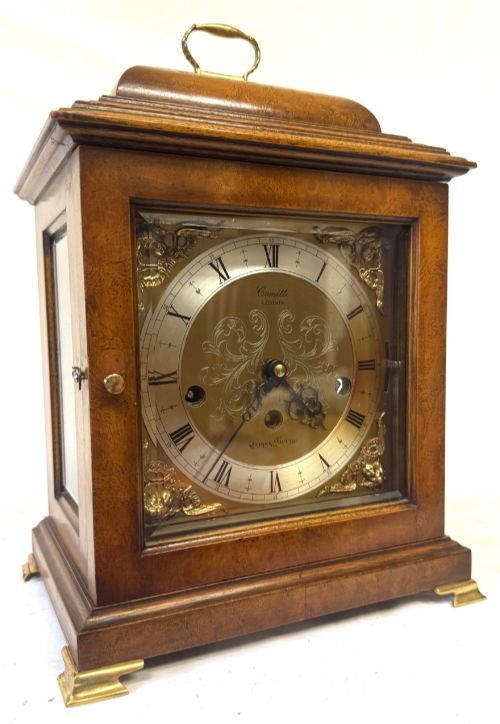
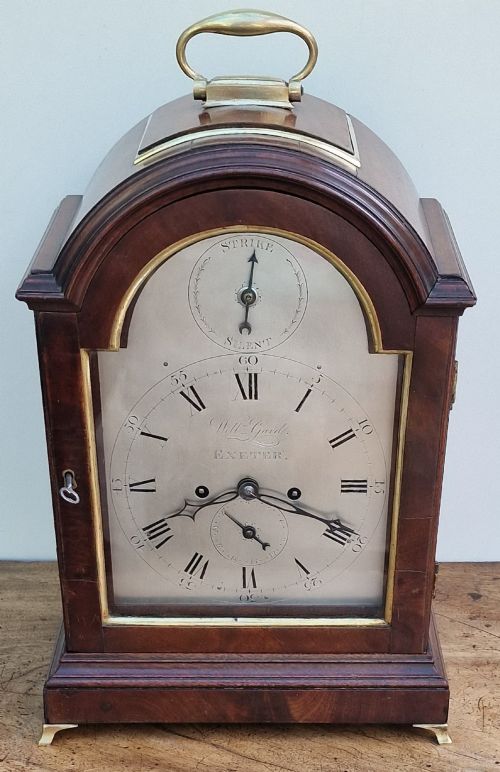


Handle Top Mantel Clock
Handle top mantel clock pieces are striking timepieces driven by craftsmanship, offering both practicality and traditional style for the home.
Handle Top Mantel Clock
A handle top mantel clock is typically housed in a wooden or brass case featuring a carrying handle, merging the portability of a bracket clock with the function of a mantel clock. The selections span diverse periods from the eighteenth century through to the twentieth century, showcasing traditional English designs alongside revival styles.
The forms encompass bracket clocks and carriage clocks, often constructed with distinctive top profiles such as pad tops, bell tops, and caddy tops. Common materials include mahogany, walnut, burr walnut, and ebonised timber, complemented by brass and glass details.
Materials and construction methods
Cases are formed from timbers like mahogany and walnut, frequently housing mechanical movements featuring verge escapements and striking mechanisms. Dials are finished in materials such as silvered metal and enamel, often paired with protective glass panels.
Details such as mechanical chimes and specialised top profiles - including bell tops and pad tops - demonstrate the traditional joinery and metalworking techniques employed across the eighteenth, nineteenth, and twentieth-century periods.
Listings feature clocks from the eighteenth, nineteenth, and twentieth centuries, incorporating materials such as burr walnut, mahogany, and brass.
Assessing quality in handle top mantel clock pieces
Quality is evident in the execution of the timber case, the precision of the dial markings, and the complexity of the movement. Examples featuring signed makers, intricate chime systems, and original components stand apart from simpler iterations.
The integration of the carrying handle with the architectural profile of the case, alongside the preservation of original materials like burr walnut or silvered metal, dictates the overall standard of each piece.
Comitti Of London·Mappin & Webb·Perigal & Duterrau·Watson, London·Joseph Lum Of London
The Handle Top Mantel Clock Glossary
- Bell-top
- A case design featuring a curved, bell-shaped wooden top. This profile is frequently seen on eighteenth-century bracket clocks.
- Verge escapement
- An early type of escapement mechanism used in mechanical clocks. It regulates the speed of the clock by controlling the release of the gear train.
- Silvered metal
- A metal dial surface treated with a silver finish to provide contrast for engraved numerals. It is a common feature on traditional clock faces.
- Bracket clock
- A portable clock originally designed to sit on a wall bracket or table. Many examples include a handle on top for transport.
- Caddy top
- A stepped, rectangular wooden top recalling the shape of tea caddies. This architectural detail appears on traditional bracket clocks.
Handle Top Mantel Clock: Frequently Asked Questions
What is a handle top mantel clock?
A handle top mantel clock is a portable timepiece, often referred to as a bracket clock, designed with a handle on the upper case for carrying.
These pieces span various historical periods and are constructed from woods such as mahogany and walnut, housing mechanical movements.
How do I date a bracket clock?
Dating relies on stylistic clues such as case profiles, dial materials, and movement types. Eighteenth-century examples often feature bell tops or caddy tops with silvered metal dials.
Later pieces from the nineteenth and twentieth centuries adopt different revival styles, while maker signatures can also help pinpoint the origin.
What is a verge escapement?
A verge escapement is the earliest form of mechanical clock escapement. It works with a balance wheel or pendulum to regulate the gear train.
This mechanism is frequently found in older bracket clocks from the eighteenth century.
Where should I place my clock?
These timepieces are traditionally placed on mantels, tables, or specialised wall brackets where the movement can be easily wound and enjoyed.
Ensure the surface is stable and level to keep the mechanical movement running accurately.