




Ladies Cylinder Desk
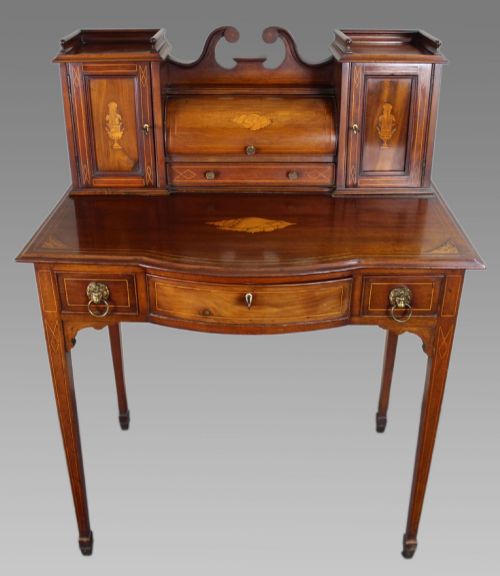
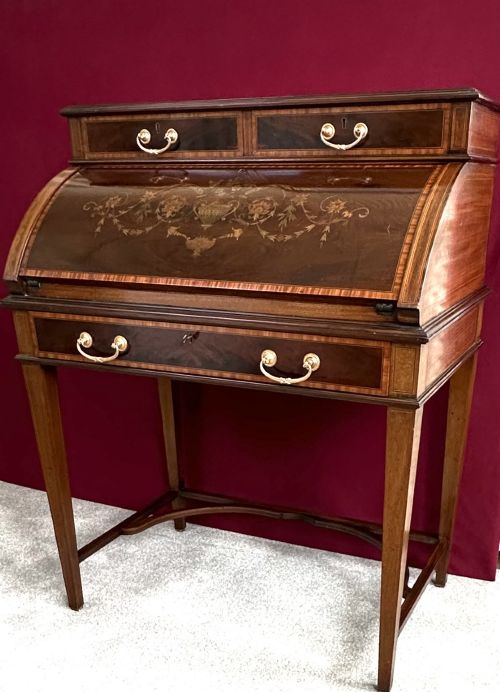
These ladies cylinder desk examples combine a curved roll-top lid with compact proportions, offering a private writing surface that hides your papers when closed.
Ladies Cylinder Desk
A ladies cylinder desk provides a writing surface concealed beneath a rotating curved wooden shutter, offering a neat solution for correspondence. The pieces on this page span several periods, with Edwardian and Victorian examples appearing most frequently alongside earlier Georgian and 19th-century continental forms.
Most variations take the form of compact writing tables or small bureau desks designed to sit comfortably in a parlour or bedroom. You will encounter English mahogany and satinwood pieces alongside French marquetry and kingwood designs featuring similar roll-top mechanisms.
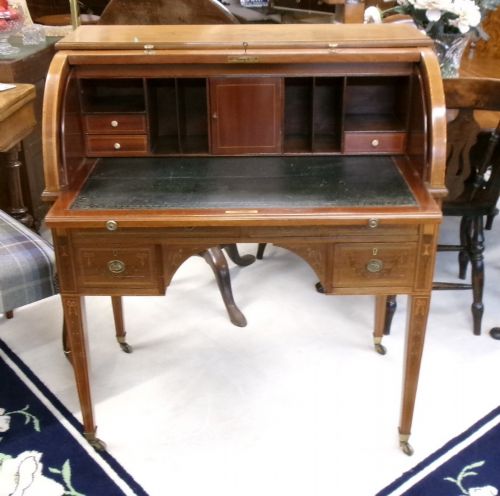
Makers often incorporated fine stringing, crossbanding, and marquetry inlay into the construction, reflecting the Sheraton Revival and French styles of the nineteenth and early twentieth centuries. The internal layout typically includes small drawers and pigeonholes accessed by pulling out the writing slide.
How they were made
Cabinetmakers constructed the main carcase using timbers such as mahogany, satinwood, rosewood, and walnut, often applying decorative veneers and marquetry panels to the exterior surfaces. The curved cylinder shutter itself was frequently built from narrow slats of wood glued to a flexible canvas backing to allow smooth movement within its tracks.
Brass mounts, handles, and gallery rails added refined detail, while writing surfaces were commonly lined with tooled leather. French pieces frequently integrated ormolu mounts and parquetry patterns, demonstrating specialist cabinet work across continental workshops.
Ladies Cylinder Desk Retail Price Guide 2026
Typical asking prices for ladies cylinder desk among the pieces listed under this phrase on Sellingantiques today, from the lower quarter to the upper quarter. They describe what is for sale here now, not the wider market.
Listings feature mahogany, satinwood, and rosewood alongside brass, glass, and marble, spanning Edwardian, Victorian, and Georgian periods.
What varies in quality
The precision of the cylinder mechanism dictates the daily pleasure of use, separating smooth sliding shutters from stiff or binding actions. Cabinet work quality shows in the crispness of the inlay, the tightness of the veneer joints, and the selection of figured timbers across the primary surfaces.
Signed pieces by established makers or retailers add distinct provenance, while finely fitted interiors with secret compartments and original brassware elevate the sophistication of the design.
Edwards & Roberts·Maple & Co·Ray & Miles of Liverpool
The Ladies Cylinder Desk Glossary
- Cylinder desk
- A desk featuring a quarter-circle rotating wooden shutter that covers the writing area and pigeonholes. When pushed back, the shutter disappears into the body of the desk.
- Marquetry
- Decorative veneer work formed by fitting together small pieces of different coloured wood, shell, or ivory to create pictorial designs. It appears frequently on French and Sheraton Revival examples.
- Satinwood
- A durable, lustrous timber native to India and Ceylon with a golden-yellow sheen. It served as a primary wood or decorative veneer in high-end Georgian and Edwardian furniture.
- Sheraton Revival
- A late 19th and early 20th-century design movement inspired by the neoclassical furniture of George III designer Thomas Sheraton. Pieces in this style typically feature light mahogany or satinwood with delicate floral inlay.
- Parquetry
- A geometric mosaic of wood pieces used for decorative floors and furniture surfaces. It creates repeating patterns such as squares, triangles, and cubes on the exterior carcase.
Ladies Cylinder Desk: Frequently Asked Questions
What is a ladies cylinder desk?
A ladies cylinder desk is a compact writing bureau featuring a curved, rotating wooden shutter that conceals the desk interior. These pieces were scaled down for domestic use in parlours or bedrooms during the 18th, 19th, and early 20th centuries.
They combine a pull-out writing slide with small interior drawers and pigeonholes, providing a tidy space for correspondence that could be locked shut when not in use.
How do you open a cylinder desk?
The curved wooden cylinder connects to an internal mechanism where pushing the roll-top back causes the writing slide to extend forward simultaneously in some designs. On most examples, you simply pull the cylinder handle downward to close the shutter or push it upward along its track to reveal the desk surface.
Care should be taken not to force the mechanism if the wooden tracks have expanded through humidity changes.
Where were these desks used?
These desks served primarily in private residential rooms rather than grand libraries or public offices. Their refined proportions allowed them to sit against a drawing room wall or in a private boudoir for writing letters.
Today, they function well in modern home studies or living spaces where compact dimensions and concealed storage are practical advantages.
How do I date a cylinder desk?
Dating relies on examining the secondary timbers, construction methods, handles, and stylistic revival influences. Georgian pieces from the 18th century show different interior configurations and cabinet joinery compared to Edwardian or Victorian Sheraton Revival examples.
Maker stamps, brass lock signatures, and veneer characteristics further help narrow the period of manufacture.