
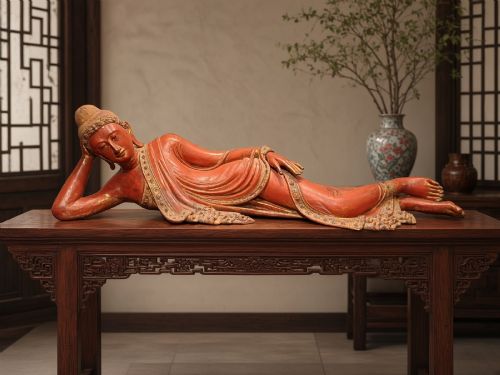


Lacquered Wood Asian Art
Lacquered wood Asian art brings together centuries of regional craftsmanship and rich surface decoration that instantly transforms any wall or mantelpiece.
Lacquered Wood Asian Art
When searching for lacquered wood Asian art, collectors encounter a diverse selection of wall panels, statues, plaques, and masks originating from various periods and traditions. These pieces reflect distinct regional aesthetics, ranging from Chinese carved wooden panels to Japanese lacquer plaques and Burmese Buddha sculptures.
The objects most frequently met on this page span the nineteenth century through the early twentieth century, including Edwardian interpretations and specific regional styles such as Chinoiserie and Mandalay works. Forms vary from functional items like mantel clocks to devotional statues and decorative wall carvings.
Each item demonstrates the specific artistic conventions of its origin, whether it is the robust carving of Chinese antiquities or the expressive forms of Japanese folk art and masks. Buyers select these works to introduce historical depth and cultural resonance into their interiors.
Materials and construction
Makers utilised woods such as softwood alongside specialised substances like urushi lacquer to build the foundations of these panels, masks, and sculptures. Carving was executed by hand to establish deep relief and intricate surface contours before the application of decorative finishes.
Surfaces were frequently enhanced with gold leaf and giltwood to highlight sculptural details and create striking contrasts against dark lacquer backgrounds. Glass components occasionally appear in specific decorative objects like mantel clocks, completing the mixed-media construction of these works.
A stern-faced Daruma figure gazes from the wall, silently judging everyone who forgets to wipe their feet.
Distinctions in quality
Quality rests in the crispness of the hand-carved details and the depth of the lacquer layers applied to the wooden substrate. Superior examples display precise control over gilding and carving, ensuring that motifs remain sharp and expressive rather than softened by wear or secondary finishing.
The integrity of the wooden core and the stability of the surface coatings dictate the overall caliber of a piece. Finer works retain their original decorative harmony without heavy restoration interfering with the historical surface texture.
The Lacquered Wood Asian Art Glossary
- Urushi lacquer
- A natural resin derived from the sap of the lacquer tree, applied in multiple coats to create a durable and lustrous surface. It hardens through a chemical reaction involving humidity rather than mere drying.
- Giltwood
- Timber that has been decorated with a thin layer of gold leaf or powder. This technique accentuates carved architectural elements and sculptural focal points.
- Chinoiserie
- A European artistic style reflecting Chinese aesthetic influences, prominent in decorative objects and furniture design. It adapts traditional Eastern motifs into Western decorative schemes.
Lacquered Wood Asian Art: Frequently Asked Questions
How do I clean lacquered wood Asian art?
Dust surfaces gently with a soft, dry cloth to prevent the accumulation of particles without scratching the delicate lacquer or gold leaf.
Avoid using liquid cleaners, polishes, or chemical solvents, as these substances can permanently damage the historic finish.
Where should I place these sculptures and panels?
Position carved panels and wall plaques away from direct sunlight and sudden temperature fluctuations to protect the wood and lacquer.
Display statues and clocks on stable surfaces where their detailed carvings and gilt finishes can be appreciated at eye level.
How do I identify nineteenth-century pieces?
Examine the tool marks on the reverse of wooden panels and the specific composition of the lacquer layers for signs of age.
Compare the stylistic conventions, such as Qing Dynasty motifs or Mandalay carving styles, with documented examples from the same era.
What is the difference between temple panels and decorative plaques?
Temple panels generally originate from religious architecture and feature deeper, more elaborate religious iconography and structural framing.
Decorative plaques were typically created for domestic display, focusing on pictorial scenes, symbolic figures, or floral arrangements.