

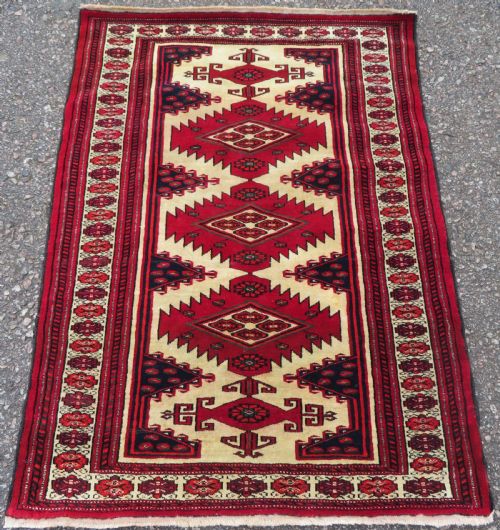


Kizil Ayak Turkmen Rug
These tribal floor coverings offer dense geometric motifs and saturated tones, making a kizil ayak turkmen rug a grounded choice for historical interiors.
Kizil Ayak Turkmen Rug
A kizil ayak turkmen rug represents a distinct tribal weaving tradition from Central Asia, often categorized under Turkmen tribal styles or Afghan connections. The examples encountered here range from compact prayer formats to room-sized carpets dating from the nineteenth and early twentieth centuries.
Buyers frequently find prayer rugs featuring double lanterns, rams horn mihrabs, and mosque designs, alongside chuval faces and main carpets displaying traditional gul motifs. These pieces reflect the utilitarian and decorative output of nomadic and village weavers across multiple decades.
The material evidence spans items attributed directly to the Kizil Ayak grouping as well as overlapping Ersari structures, showing deep roots in Central Asian weaving history. Each piece brings a distinct tribal geometry into a modern domestic setting.
How they were made
Weavers constructed these textiles primarily using wool for the pile and foundations, supplemented by cotton in various structural elements. Natural fibres were spun by hand and dyed to produce deep, lasting colour palettes.
The knotting and structural integrity reflect traditional nomadic techniques designed to withstand heavy daily use. Chuval faces and large carpets demonstrate rigorous attention to symmetrical design layouts and border execution.
Kizil Ayak Turkmen Rug Retail Price Guide 2026
Typical asking prices for kizil ayak turkmen rug among the pieces listed under this phrase on Sellingantiques today, from the lower quarter to the upper quarter. They describe what is for sale here now, not the wider market.
Current listings span periods from eighteen-fifty to nineteen-twenty, featuring wool and cotton materials across tribal Turkmen forms.
What varies in quality
Quality in these tribal pieces rests on the precision of the wool preparation, the crispness of the geometric drawing, and the integrity of the foundation. Finer knot density allows complex elements like rams horn mihrabs and tauk nuska guls to hold sharp definition.
The handling of secondary borders and elem panels separates standard utility work from more ambitious workshop or tribal commissions. Well-preserved pile height and balanced natural dyes elevate the presence of any individual carpet.
The Kizil Ayak Turkmen Rug Glossary
- Gul
- A repeating primary medallion motif used across Central Asian tribal weaving. These octagonal or gabled forms identify specific tribal groups.
- Mihrab
- The arched niche design found in prayer rugs, often referencing the architectural direction of prayer. In these pieces, they frequently incorporate rams horn motifs.
- Chuval
- A large storage bag face produced by Turkmen nomads. They display distinct gul arrangements and decorative lower elem panels.
- Tauk Nuska
- A specific gul design featuring bird or chicken foot motifs within an octagonal framework. This pattern is characteristic of certain Turkmen subgroups.
Kizil Ayak Turkmen Rug: Frequently Asked Questions
How do I use a prayer rug at home?
Prayer rugs provide compact vertical or horizontal visual anchors in smaller spaces. Their concentrated motifs work well mounted on walls or placed as accent floor pieces.
Keep them away from direct, harsh sunlight to preserve the saturation of the wool dyes over time.
What is a rams horn motif?
The rams horn is a traditional protective and fertility symbol incorporated into tribal weaving. It appears frequently within the mihrab arches of mosque rugs.
Weavers rendered these curved horns in varying geometric abstractions depending on their specific tribal lineage.
How do I date these tribal carpets?
Dating relies on examining structural wear, wool characteristics, and the evolution of specific gul designs. Pieces from the nineteenth century often show more archaic drawing styles.
Early twentieth-century examples maintain traditional motifs while reflecting shifts in regional production scales.
Are these rugs suitable for high-traffic areas?
Nomadic carpets were built for enduring utility using durable wool foundations and dense pile. They handle moderate foot traffic well when paired with a quality underlay.
Routine gentle cleaning prevents dust accumulation in the thick wool pile.