



Kingwood Credenza
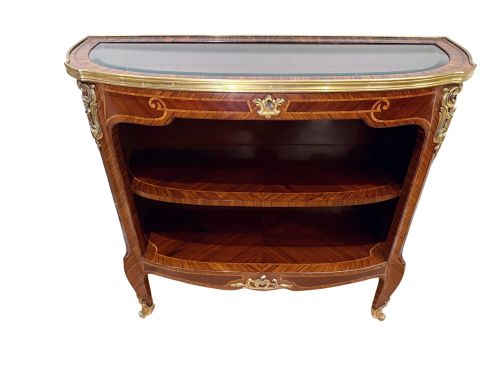
A kingwood credenza is a grand display cabinet built for formal reception rooms, bringing rich violet-brown timber and gilt mounts to the interior.
Kingwood Credenza
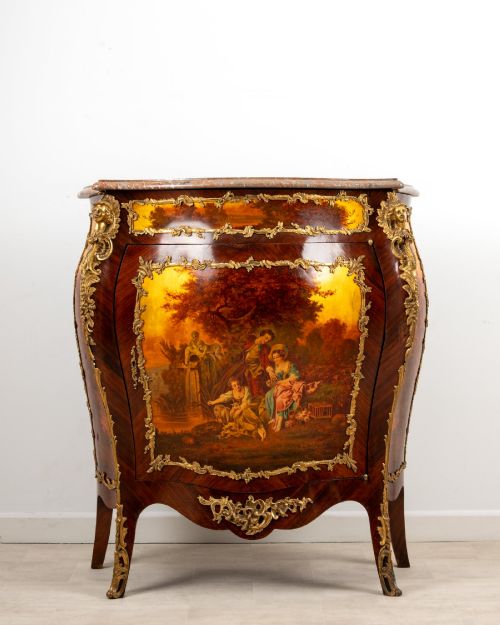
The dominant forms span credenzas, side cabinets, commodes, and bookcases, frequently shaped with serpentine fronts or topped with marble surfaces. French Revival and Louis XV or Louis XVI styles prevail strongly across the selection, often incorporating glazed doors, vitrine tops, or central cupboards flanked by curved side sections.
Materials and construction
The primary visual character relies upon kingwood veneers, frequently arranged in intricate marquetry or parquetry patterns, sometimes paired with walnut, burr walnut, rosewood, or sycamore. Artisans enriched these timber surfaces with cast or chased ormolu mounts, gilt bronze details, and occasional porcelain plaques or Sevres panels.
Cabinetmakers finished the upper surfaces with heavy fitted marble slabs, usually in white or variegated tones, while interior spaces often utilised glass shelving and mirrored backs to catch and reflect light within vitrine compartments.
Craftsmanship and distinction
Quality reveals itself in the precision of the timber matching and the intricacy of the floral or geometric marquetry inlay across curved surfaces. Finer pieces demonstrate superior hand-chasing on the ormolu mounts, where crisp detail and heavy bronze weight replace softer, shallower cast work.
Makers of distinction incorporated documented provenance, exhibition-standard design, or fine porcelain panels, elevating standard side cabinets into exceptional works associated with prominent Parisian workshops.
Maison Millet, Paris·Paul Sormani·Mercier Freres
The Kingwood Credenza Glossary
- Kingwood
- A dense, richly figured Brazilian timber showing violet and dark brown tones with pale streaks, prized for 18th and 19th Century veneer work.
- Ormolu
- Gilt bronze mounts applied to furniture edges and corners, cast and chased by hand to provide ornamental highlights.
- Credenza
- A low cabinet piece designed for dining rooms or reception spaces, often featuring central doors flanked by glazed display sections.
- Marquetry
- The art of forming decorative patterns using thin veneers of different coloured woods assembled onto a carcase.
- Vitrine
- A glass-fronted display cabinet intended to showcase porcelain, silver, or small objects of curiosity.
Kingwood Credenza: Frequently Asked Questions
What is a kingwood credenza used for?
These pieces served primarily in formal drawing rooms and reception spaces to display valued ceramics, glassware, and decorative objects upon marble tops and within glazed compartments.
The enclosed cupboards beneath offered concealed storage for table linen, silver, or documents, combining practical utility with formal display.
How do I identify French revival styles?
French Revival pieces display the sweeping serpentine curves, cabriole legs, and asymmetrical floral marquetry characteristic of Louis XV design, or the straighter, more symmetrical neoclassical lines associated with Louis XVI.
Look for the characteristic application of heavy ormolu mounts framing panels of kingwood and intricate parquetry work across the front and sides.
Where does kingwood come from?
Kingwood is harvested from Dalbergia species native to the forests of Brazil, known for its heavy density and deep violet-brown colouring.
Cabinetmakers valued its striking natural grain contrasts for decorative veneers rather than solid construction.
How should I clean marble tops?
Marble surfaces require gentle wiping with a damp cloth and mild, neutral soap to preserve the polished stone without scratching or etching the finish.
Avoid acidic cleaning solutions or abrasive agents that can damage the polish of the stone.