


Kingwood Chevet Tables
Kingwood chevet tables are refined French bedside pieces offering practical surface space and decorative marquetry.
Kingwood Chevet Tables
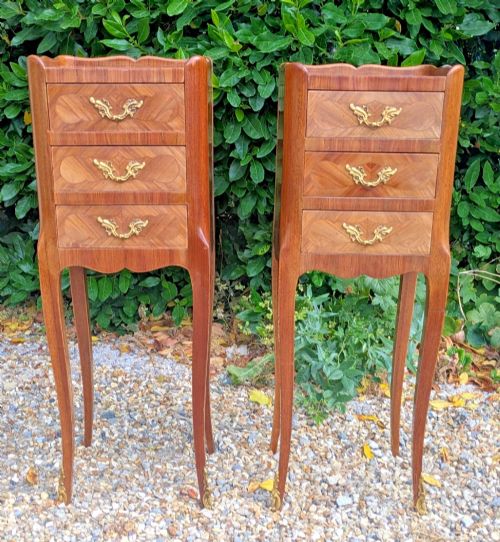
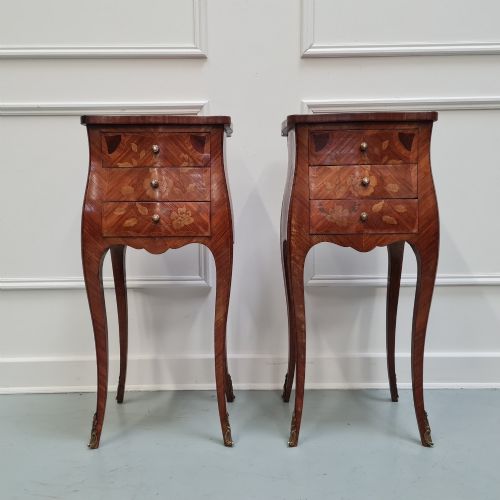
Kingwood chevet tables are compact bedside cabinets and occasional tables originating largely from French stylistic traditions, spanning the nineteenth and early twentieth centuries. When searching for kingwood chevet tables, buyers encounter pieces dated from Victorian periods up to nineteen-thirty, often presented as symmetrical pairs.
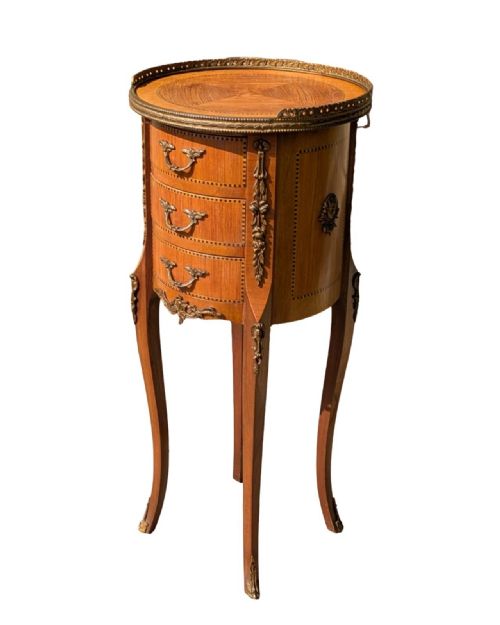
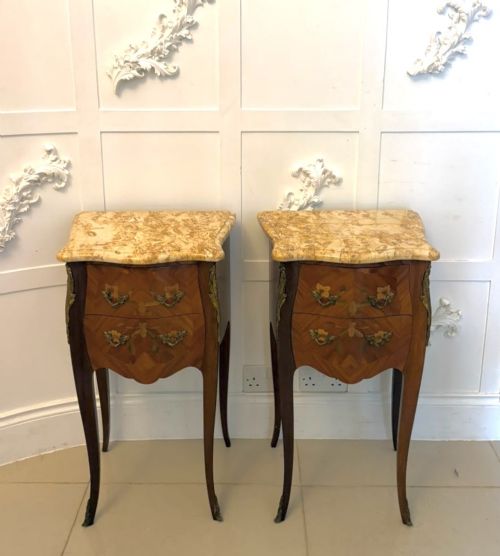
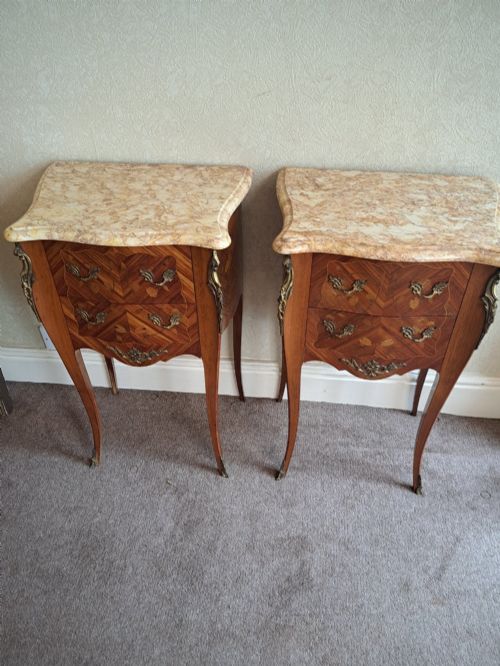
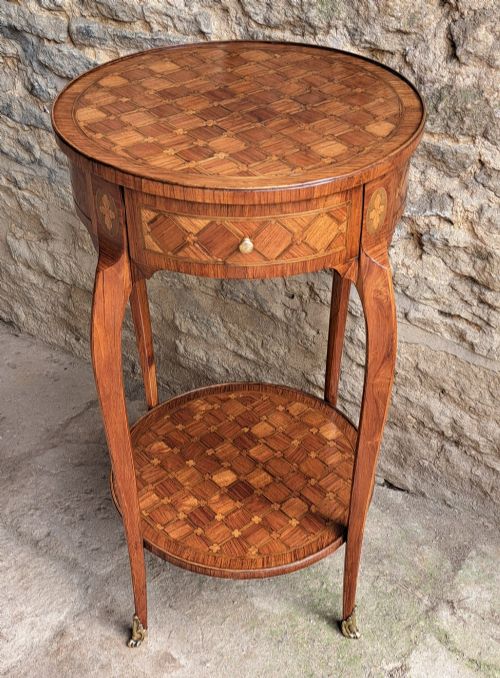
The dominant forms on this page include marble-topped bedside cabinets, bow front chests, and two-tier occasional tables executed in the Louis XV and Louis XVI taste. These pieces serve as functional nightstands while displaying decorative parquetry and floral marquetry.
Origins heavily lean towards French workshops producing polished wood veneer furniture with serpentine or bombés shapes. The selection leans strongly towards matched pairs intended to flank a bed.
How they were made
Construction relies upon a supportive wood carcase overlaid with fine kingwood, rosewood, and satinwood veneers arranged in geometric parquetry or floral marquetry patterns. Craftspeople utilised contrasting timber grains to create complex decorative surfaces across the drawer fronts and cabinet doors.
Mounts and galleries cast in brass, ormolu, and gilt bronze provide structural edge protection and ornamental detailing around the marble tops. These metal elements are fastened to the corners and feet to accent the curves of the French Rococo and neoclassical styles.
Several little bedside cabinets hide secret internal depths beneath their marble tops, built for storing midnight reading material.
What varies in quality
Quality differences emerge in the precision of the marquetry cutting and the choice of timber contrasts within the veneer work. Superior examples exhibit tightly fitted floral patterns and seamless grain matching across multiple panels.
The weight and finish of the cast ormolu mounts and the thickness of the inset marble slabs distinguish higher grade pieces from standard workshop output. Refined execution shows in the crispness of the bronze chasing and the smooth integration of marble tops into the wooden frames.
The Kingwood Chevet Tables Glossary
- Kingwood
- A dense, richly grained tropical timber used extensively as a veneer on fine French furniture. It typically displays deep brown and violet hues.
- Chevet
- A French term for a small bedside table or nightstand. These pieces often incorporate enclosed cabinets or open tiers.
- Marquetry
- The art of applying pieces of veneer to a structure to form decorative patterns and pictorial designs. Cabinetmakers cut various coloured woods to create floral motifs.
- Ormolu
- Gilded bronze applied as decorative mounts on furniture. It provides bright metallic contrast against dark wood veneers.
- Bombe
- A swelling, outward-curving contour found on cabinet sides and drawer fronts. This curved profile characterises much of the Louis XV revival output.
Kingwood Chevet Tables: Frequently Asked Questions
How do I style kingwood chevet tables in a modern bedroom?
Place them beside a low bed frame to contrast the intricate marquetry surfaces against neutral textiles. Their compact proportions allow them to fit neatly in smaller guest rooms without dominating the floor space.
Keep the tops relatively clear with a simple lamp to let the wood grain and ormolu mounts remain visible. The marble surfaces provide practical resistance to water rings from glassware.
Are these tables usually found as pairs?
Many listings consist of matched pairs designed to sit symmetrically on either side of a bed. Single side tables and occasional cabinets also appear frequently.
Matching pairs share identical veneer patterns, dimensions, and mount styles from the same period of manufacture.
What is the difference between Louis XV and Louis XVI styles on these tables?
Louis XV style pieces, often linked to French Rococo, feature sweeping curved lines, serpentine fronts, and bombe profiles. Ormolu mounts on these tables tend to curl organically around the corners.
Louis XVI pieces lean towards straight tapered legs, neoclassical symmetry, and geometric parquetry patterns. The overall silhouette appears more restrained and architectural.
How should I care for the marble tops?
Wipe the marble surface regularly with a soft, damp cloth to remove dust and prevent staining from acidic liquids. Avoid harsh chemical cleaners that can dull the polished stone finish.
Use coasters under glasses and protect the stone from heavy impacts that might chip the edges. The marble lifts out on many models for easier cleaning and transport.