


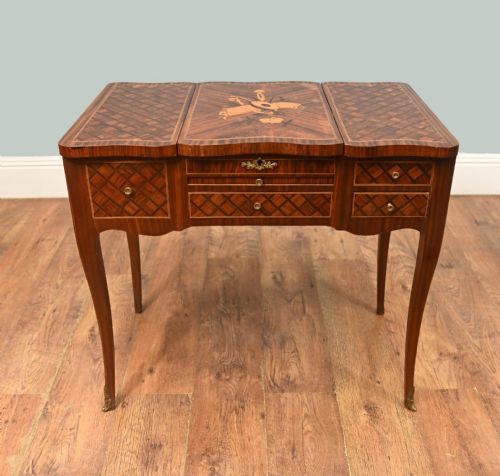


Kingwood Bonheur Du Jour
A kingwood bonheur du jour is a refined small writing desk with an upper tier of compartments, offering an elegant surface for correspondence and precious items.
Kingwood Bonheur Du Jour
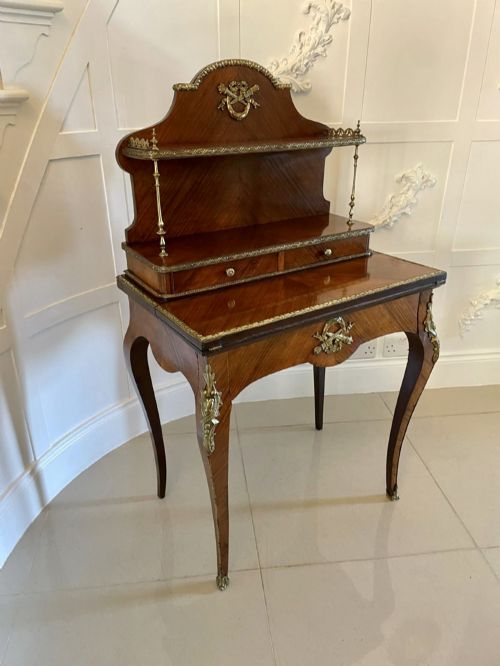
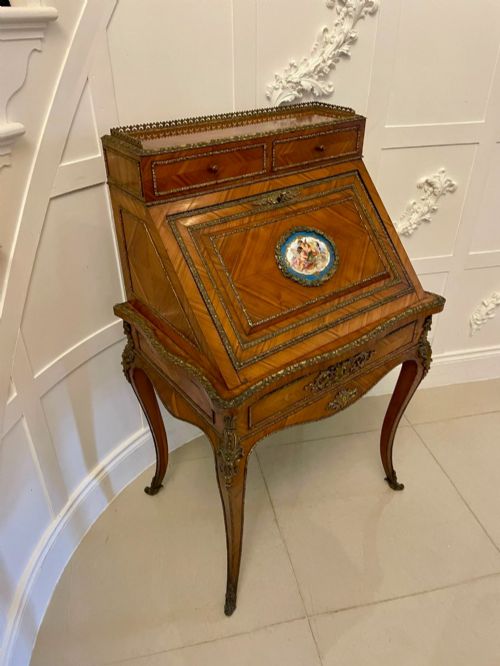
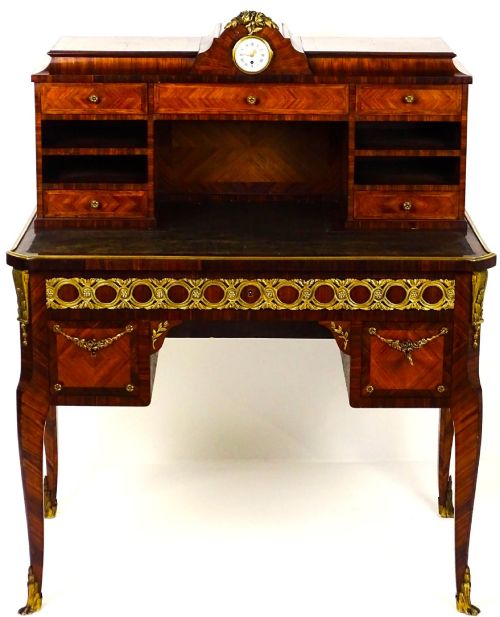
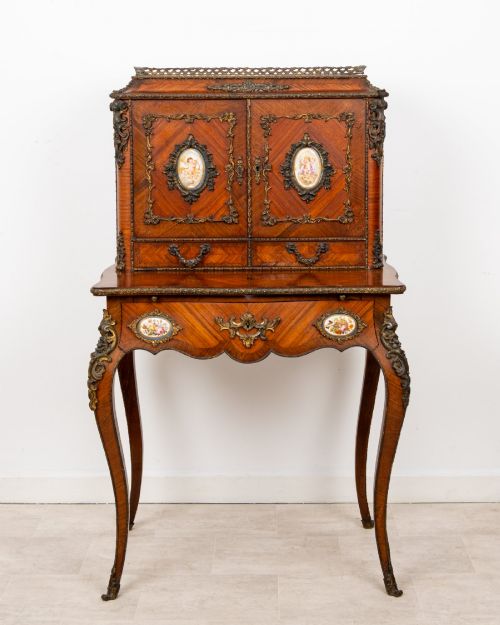
A kingwood bonheur du jour is a refined writing cabinet developed for ladies, typically featuring an upper section with shelves or small doors above a fitted writing surface. These pieces emerge predominantly from the nineteenth century, aligning with Victorian tastes for elaborate French revival furniture.
Most examples encountered on this page reflect French cabinet-making traditions, spanning Louis XV and Louis XVI styles. Makers frequently incorporated delicate cabriole legs, tiered superstructures, and integrated drawers suited for writing materials and correspondence.
Materials and Construction
Cabinet-makers relied on dense exotic kingwood veneers laid over secondary timbers, frequently enhanced by intricate marquetry patterns or contrasting rosewood and walnut. This timber choice provided a distinctive violet-brown grain that took a high polish.
Gilt bronze and ormolu mounts framed edges, drawers, and corners, adding sculptural detail to the wooden carcase. Artisans also integrated porcelain plaques, such as Sevres inserts, and hand-painted Vernis Martin panels into the upper doors and writing flaps.
Writing surfaces frequently incorporated inset panels of tooled leather to provide a durable workspace for correspondence. Brass hardware, glass elements, and gilt metal mounts completed the structural embellishments across nineteenth-century workshops.
Materials recorded on this page include kingwood, ormolu, porcelain plaques, Vernis Martin panels, and tooled leather.
Judging Quality and Craftsmanship
The sophistication of the bronze ormolu mounts separates standard production from exceptional pieces, as finer castings display crisp chasing and careful hand-finishing. Heavier, deeply carved mounts secured with proper screws indicate superior workshop standards.
The intricacy of the timber marquetry and the precision of the veneer matching dictate the visual hierarchy of these desks. Continuous grain flow and delicate floral inlay demonstrate superior cabinet-making compared to simpler veneered surfaces.
Attribution to documented makers elevates certain pieces, particularly when accompanied by signed metalwork, stamped drawer linings, or porcelain plaques of high fidelity. The integration of decorative elements like hand-painted panels reflects the ambition of the original commission.
Paul Sormani·Edwards and Roberts·Jean Werner·Robert Strachan and Co
The Kingwood Bonheur Du Jour Glossary
- Kingwood
- A dense, heavy Brazilian timber with a violet-brown hue and dark stripes. Cabinet-makers used its distinctive grain for decorative veneering on high-status nineteenth-century furniture.
- Ormolu
- Gilded bronze applied as decorative mounts to furniture edges and corners. The technique involved mercury gilding to produce a rich metallic lustre.
- Bonheur du jour
- A small lady's writing desk with an elevated superstructure of shelves and drawers. The French term translates literally to happiness of the day.
- Marquetry
- The art of applying small pieces of veneer to a structure to form decorative patterns. Artisans used various coloured woods to depict floral and geometric designs.
- Vernis Martin
- A simulated Japanese lacquer developed in France during the eighteenth century and revived later. It involved applying multiple layers of translucent varnish over painted panels.
Kingwood Bonheur Du Jour: Frequently Asked Questions
What is a bonheur du jour used for?
These pieces served as intimate writing desks where ladies could manage personal correspondence, read letters, and store small valuables. The upper tier held inkwells, stationery, and decorative porcelain plaques.
Over time, they transitioned from functional writing furniture into display cabinets for drawing rooms and boudoirs. Their compact footprint made them suitable for placement against walls or within intimate parlour settings.
How do I identify Louis XV and Louis XVI styles?
Louis XV style pieces, often linked to French Rococo revival, feature flowing asymmetrical curves, cabriole legs, and organic ormolu mounts. The lines remain sinuous and undulating across both the woodwork and hardware.
Louis XVI style furniture introduces geometric restraint, featuring straight fluted legs, symmetrical mounts, and neoclassical proportions. Cabinet-makers balanced these architectural lines with delicate kingwood marquetry.
Are these desks suitable for daily use?
Kingwood writing desks function adequately for light administrative tasks and modern correspondence when treated with care. The inset leather writing surface provides a stable platform for writing.
Users should protect the polished kingwood veneer and delicate ormolu mounts from moisture, direct sunlight, and heavy impact. Regular dusting with a soft cloth preserves the historic finish.
How can I tell the difference between Victorian and earlier French pieces?
Victorian interpretations often incorporate robust construction methods and British retail stamps alongside French styling. Many bear the distinct influence of nineteenth-century revivalism while maintaining traditional joinery.
Earlier continental examples frequently exhibit lighter internal framing, specific regional stamp marks, and uncompromised French atelier practices. Comparing secondary timbers and internal drawer construction helps clarify origin.