
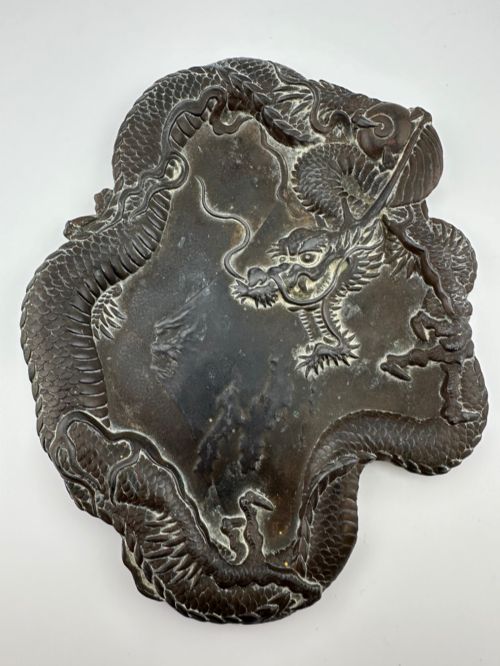



Japanese Dragon Plate
A Japanese dragon plate brings fierce mythical energy and exquisite metalwork into your room.
Japanese Dragon Plate
A Japanese dragon plate is a decorative vessel featuring coiled serpent motifs, spanning chargers, dishes, and trays produced across the Meiji and late Edo periods. These pieces range from large cloisonné enamel chargers measuring up to forty centimetres to mixed-metal brass dishes and Imari porcelain.
The objects most frequently met on this page are circular cloisonné enamel chargers and square trays dating from the 1860s to 1900. They showcase meticulously worked wirework depicting single dragons, alongside occasional pictorial prints and Imari ceramic dishes.
Materials and construction
Makers constructed the primary enamel works using copper bases fitted with fine brass wire to outline the intricate scales and bodies of the dragons. Coloured vitreous enamels were packed into these cellular compartments before firing and polishing.
Alternative forms utilise brass and mixed-metal inlays, exemplified by Komai style compositions featuring deities such as Benzaiten alongside dragons. Paper and mount board appear solely within associated framed art prints.
Listings span from the late Edo period through Victorian Edwardian dates, featuring copper, brass, bronze, and cloisonné enamel.
Judging quality and execution
Quality rests upon the precision of the wirework and the depth of the enamel fields within each Japanese dragon plate. Finer examples display faultless symmetry in the dragon's scales and rigorous control over the coloured vitreous pastes.
Signed works and monumental dimensions distinguish the superior specimens from standard production items. The density of the wire cloisons and the clarity of the background fields separate workshop standards.
The Japanese Dragon Plate Glossary
- Cloisonne Enamel
- A metalwork technique where flat wire is soldered to a metal base to create cells filled with enamel paste. This method defines the majority of the metal vessels found here.
- Charger
- A large ornamental plate intended for display rather than dining use. These substantial pieces dominate the visual scale of the metalwork selections.
- Meiji Period
- The historical Japanese era spanning from 1868 to 1912, noted for intense artistic output in metalwork and enamel. Much of the decorative work seen originates from this era.
- Edo Period
- The period preceding the Meiji era, running until 1868, represented here by late works. Pieces from this transition demonstrate the earliest foundations of the listed styles.
- Imari
- A traditional style of Japanese porcelain decorated in underglaze blue and overglaze red, gold, and black. These ceramic pieces provide an alternative texture to the metalwork.
Japanese Dragon Plate: Frequently Asked Questions
How do I display a large charger safely?
Heavy brass and enamel chargers require robust wall brackets or dedicated plate stands designed for substantial weight. Ensure the mounting hardware secures the rim firmly without placing undue pressure on the enamel surface.
Position the piece away from direct sunlight to preserve the rich tones of the coloured enamels and metal patinas over time.
What is a Komai style dish?
The Komai style refers to specialised metalwork originating from Kyoto, featuring intricate gold and silver damascene on iron or brass bases. These pieces often depict narrative scenes, including deities and dragons.
Such work requires careful handling to protect the delicate metallic inlays from moisture and physical abrasion.
How do I clean antique cloisonne enamel?
Dust the surface gently using a soft, dry microfibre cloth to remove everyday particles. Avoid chemical cleaners, water immersion, or abrasive cloths that can damage the polished metal wires and enamel.
Professional conservation advice should be sought if deeper cleaning becomes necessary for stubborn surface grime.
Are these plates meant for food use?
These decorative plates and chargers are strictly intended for display rather than culinary service. The older metal compositions and enamel surfaces are not food safe and can be damaged by moisture or acidic foods.
Treat them purely as works of decorative art within your interior space.
How can I tell the age of a piece?
Dating relies on stylistic markers, construction materials, and occasional artist signatures found on the reverse or within the design. Pieces spanning the late Edo period through the Meiji era exhibit distinct shifts in wire fineness and colour palettes.
Comparing the manufacturing techniques against documented historical periods helps establish an approximate decade of origin.