


Japanese Cloisonne Enamelware
These pieces of Japanese cloisonne enamelware are intricate metal and glass works, sought after for their detailed depictions of birds, dragons, and landscapes.
Japanese Cloisonne Enamelware
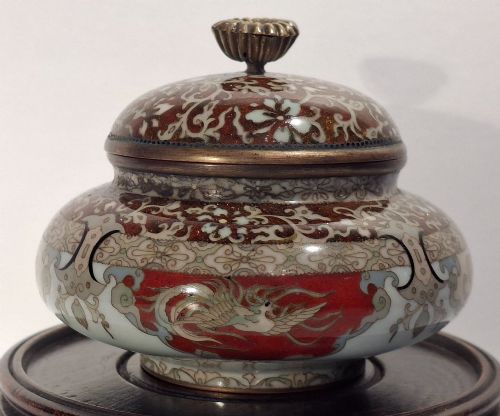
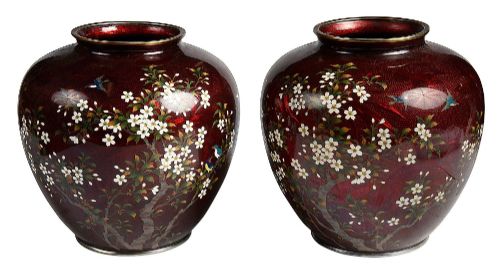
When examining japanese cloisonne enamelware, buyers encounter a diverse range of forms spanning vases, decorative chargers, plates, bowls, jars, and hanging boat koros. These objects predominantly date from the Meiji and Edo periods, alongside later Showa and Edwardian examples.
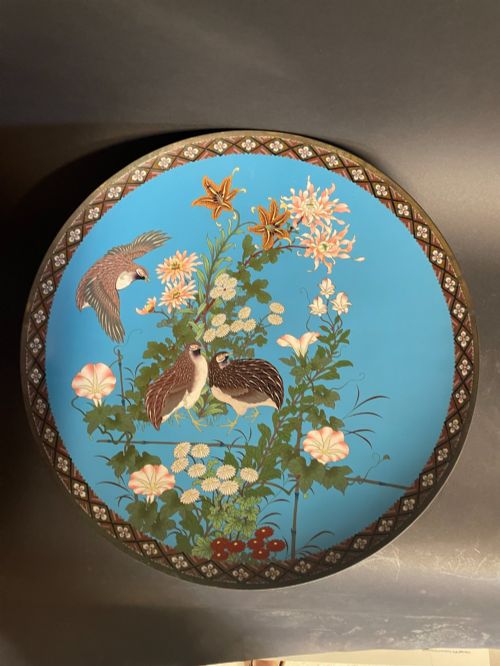
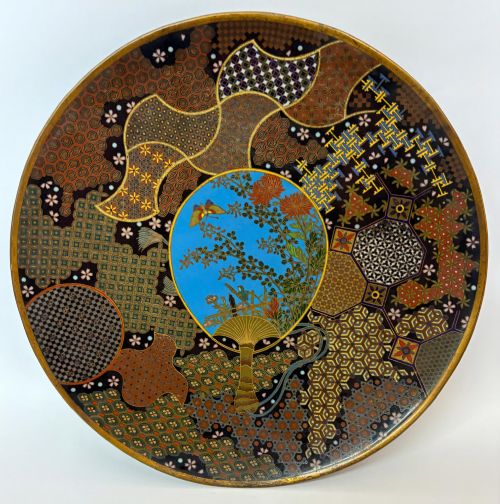
The assortment on this page draws heavily from the nineteenth century, particularly the 1870s, 1880s, and 1890s, when production of decorative chargers and vases reached notable heights. Pieces range from large, spectacular chargers adorned with dragons, birds, and samurai figures to smaller lidded gourd pots and cups with lids.
Materials and construction
These items are constructed using metal bases such as copper, bronze, and brass, onto which delicate brass or silver wires are applied to form compartmentalised designs. Artisans then fill these distinct cells with coloured enamel pastes before firing and polishing the surface to a smooth finish.
Variations in technique include silver wire work, ginbari red enamel, and basse-taille methods, occasionally paired with silver foil foundations and wooden components. Champleve enamel and bronze combinations also appear, supplementing standard wire-work methods with carved recesses for the enamel.
Frogs, butterflies, and hanging boats share the metal stage with imperial dragons and fierce samurai.
Judging quality
Quality in these items is determined by the precision and fineness of the wirework and the complexity of the subject matter, such as multi-coloured landscapes, butterflies, and frogs versus simpler geometric patterns. Masterpieces often display tight, uniform cell structures with intricate pictorial storytelling.
The clarity of the enamel and the finesse of the polishing process distinguish standard production from exceptional pieces. Superior examples exhibit smooth, reflective surfaces without pitting, where the metal wires remain crisp and evenly spaced across complex motifs like dragons and ho-o birds.
Tamura Yukio·Ando Jubei
The Japanese Cloisonne Enamelware Glossary
- Cloisonne
- An enamelling technique where metal wire is soldered to a metal base to create individual cells for coloured glass paste. These cells are then fired and polished flat.
- Charger
- A large decorative plate intended for display rather than dining use. They often feature intricate pictorial scenes covering the entire surface.
- Ginbari
- A technique involving textured or patterned foil applied beneath translucent enamel to create depth and pattern beneath the coloured glass. This method enhances light reflection.
- Basse-taille
- An enamelling method where the metal background is carved or engraved with a low relief design before translucent enamel is applied over it. This allows light to pass through and accentuate the underlying texture.
Japanese Cloisonne Enamelware: Frequently Asked Questions
What are japanese cloisonne enamelware objects made of?
These pieces are constructed primarily from a metal base of copper, brass, or bronze. Fine wire is attached to outline the design before glass enamel is applied and fired.
Additional materials such as silver wire, silver foil, and wood occasionally form part of the construction, particularly in vessels like lidded pots and vases.
How do I identify Meiji period pieces?
Meiji period items typically date between 1868 and 1912, a time of immense technical advancement in metalwork and enamelling. Listings from this era often feature complex pictorial subjects like birds, landscapes, and samurai.
Workmanship from this window frequently displays extreme precision in the wirework and highly refined enamel colours compared to later periods.
How were decorative chargers used?
Decorative chargers were primarily created for display in domestic settings rather than for serving food. Their large surfaces provided artisans with a canvas for elaborate scenes involving dragons, Buddhas, and floral motifs.
Owners typically exhibited them on stands or hung them on walls to showcase the technical skill of the maker.
What is the difference between cloisonne and champleve?
Cloisonne involves soldering flat metal wires onto the surface of a vessel to build up the walls of the design cells. These individual compartments are then filled with enamel paste.
Champleve uses a different approach where the troughs and cells for the enamel are hollowed out directly from the thick metal body rather than built up with wire.