
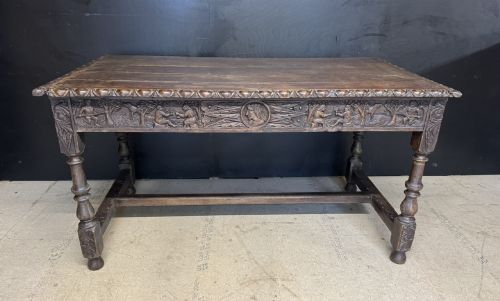
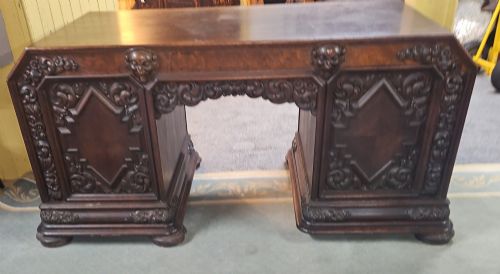


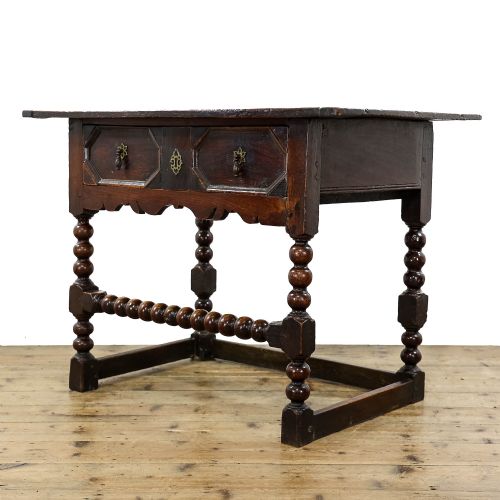


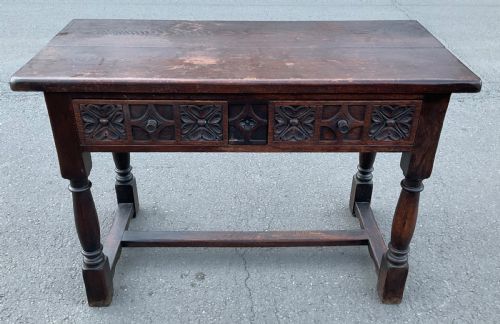


Jacobean Style Writing Table
These jacobean style writing table pieces offer robust timber construction and historic carved detail, providing a practical workspace with distinct period character.
Jacobean Style Writing Table
A jacobean style writing table brings substantial form and dark timber presence into a room, serving as a functional workspace or side surface. When exploring this selection, buyers frequently encounter 19th Century and early 20th Century revivals alongside earlier examples.
The objects span side tables, writing desks, and centre tables, often featuring fitted drawers and occasional tooled leather surfaces. Oak is the primary material across these forms, reflecting the enduring popularity of Revival styles throughout the Victorian era and into the twentieth century.
How they were made
Makers utilised solid oak to construct these pieces, applying heavy carving and turnings to emulate seventeenth-century joinery. Brass handles and iron hardware frequently secure drawers and support the structural joints of the tables.
Surfaces occasionally incorporate inset tooled leather writing panels, contrasting with the dense grain of the surrounding timber. Bobbin turning and elaborate relief work appear across the legs and friezes, executed with hand tools.
The material record for this phrase relies entirely on oak, supported by brass and iron hardware.
What varies in quality
The depth and crispness of the carved ornamentation distinguish superior examples from simpler production. Relief work executed with sharp, deliberate chisel marks possesses greater visual presence than shallow or mechanically smoothed surfaces.
The selection of timber grain and the integrity of the structural joinery determine the overall substance of the table. Pieces retaining original brass hardware and well-fitted drawers demonstrate higher initial craftsmanship.
The Jacobean Style Writing Table Glossary
- Jacobean Revival
- A nineteenth-century architectural and furniture style that imitates the heavy, carved oak designs of the early seventeenth century. This revival produced much of the dark, substantial seating and tables found in later homes.
- Bobbin turned
- A style of furniture leg or stretcher shaped on a lathe to resemble a series of wooden bobbins or spools end-to-end. It appears frequently on seventeenth-century and revival oak furniture.
- Kneehole
- A desk or table configuration featuring a central recess for the legs with banks of drawers on either side. This arrangement allows the user to sit directly facing the centre of the furniture.
- Bible box
- A small wooden desk box, often with a sloping lid, historically used for holding sacred texts or writing materials. When placed on a dedicated stand, it functions as a compact writing desk.
Jacobean Style Writing Table: Frequently Asked Questions
What periods do these writing tables come from?
The pieces span various eras, including genuine eighteenth-century examples alongside nineteenth-century and early twentieth-century revivals. Victorian and Edwardian workshops produced many of these heavily carved items to emulate earlier styles.
Dates within the selection range from the seventeen-fifties through to nineteen-twenty, incorporating styles such as Carolean, Tudor, and Jacobean Revival.
How were these tables used originally?
They served as functional surfaces for correspondence, record-keeping, and general household administration. Drawers provided storage for inkwells, quills, and writing paper.
Some variations, such as bible boxes on stands, combined portable storage with a raised writing slope for reading or writing.
What wood is most common?
Oak is the predominant timber utilised across all listed writing desks and side tables. Its dense grain and heavy weight suited the robust proportions demanded by the style.
Complementary materials such as brass and iron appear in the hardware, while certain examples incorporate leather writing surfaces.
How do I identify a revival piece?
Revival pieces, particularly those from the Victorian and Edwardian periods, often display machine-assisted construction methods alongside traditional hand carving. Tool marks and timber ageing help distinguish nineteenth-century interpretations from original seventeenth-century items.
Stylistic cues like Carolean or Tudor revival elements point towards these later manufacturing dates.