

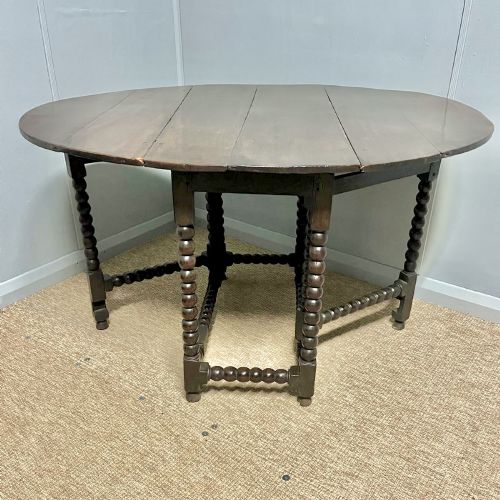
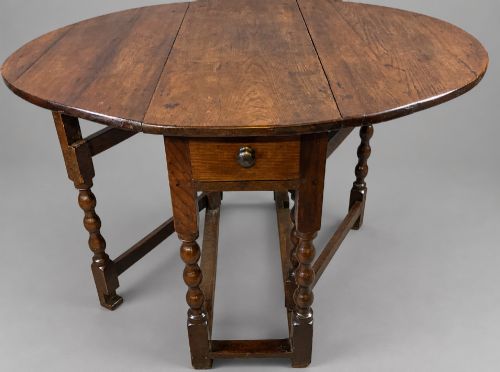
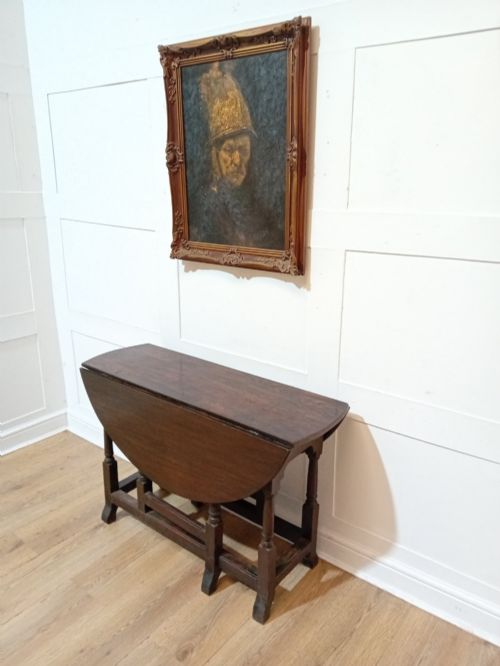
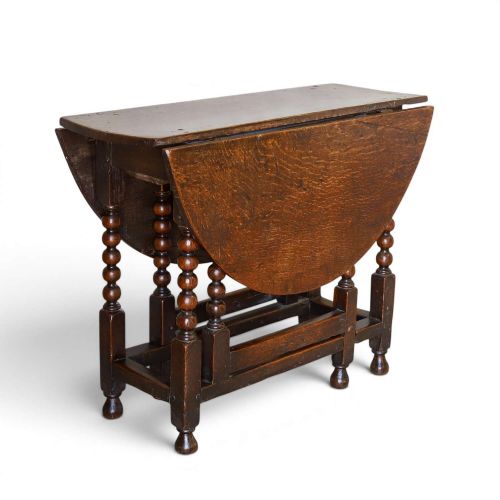
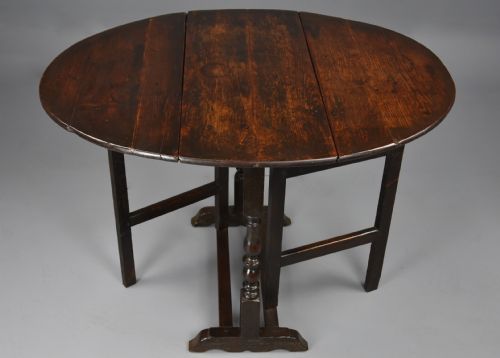
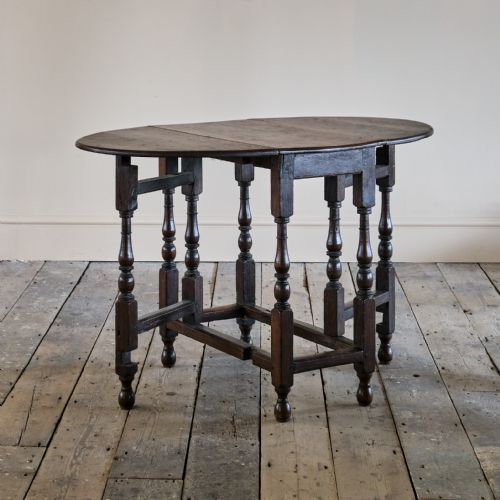

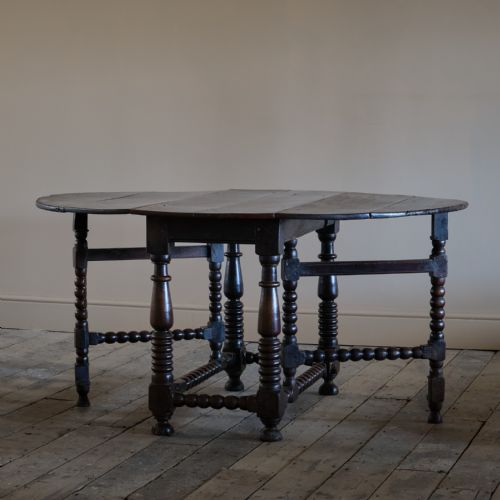
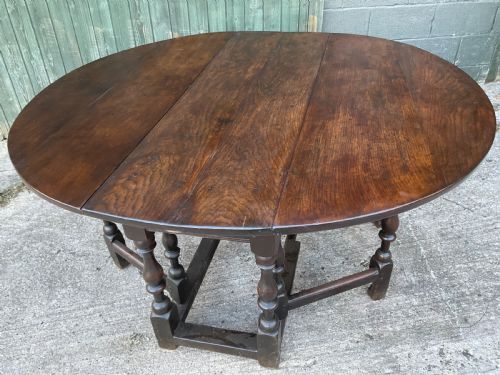


Jacobean Oak Gate Leg Table
A jacobean oak gate leg table brings folding leaves and solid timber together, offering practical surface space with centuries of English character.
Jacobean Oak Gate Leg Table
A jacobean oak gate leg table is a drop leaf dining or occasional table supported by hinged legs that swing outward to hold the leaves. Buyers encounter examples spanning the seventeenth century up through later revival periods, alongside nineteenth century interpretations and twentieth century pieces.
The form appears in various proportions, from compact occasional and coffee tables to large dining versions intended to seat several people. Solid oak serves as the primary material across these formats, often paired with iron or brass hinges and fittings.
Period variations range from seventeenth century originals and Charles II period pieces to eighteenth century country dining tables and later Jacobean Revival iterations. Many pieces display oval tops when fully extended, supported by distinct turned legs.
Materials and Construction
Makers built these tables primarily from solid oak, utilising timber selected for strength and durability. Boards formed the oval or rectangular tops and the drop leaves, joined to robust framework constructions.
Turning techniques shaped the structural supports, resulting in bobbin turned legs and baluster posts that define the appearance of seventeenth century and revival pieces. Hinges in iron or brass enabled the outer gate legs to pivot smoothly outward and support the extended leaves.
Jacobean Oak Gate Leg Table Retail Price Guide 2026
Typical asking prices for jacobean oak gate leg table among the pieces listed under this phrase on Sellingantiques today, from the lower quarter to the upper quarter. They describe what is for sale here now, not the wider market.
Some tables swing open like wooden gates to surprise guests who assume they are standard rigid furniture.
Assessing Quality and Character
Quality rests in the integrity of the timber, the depth of the original surface patina, and the precision of the turning on the legs. Superior examples retain their original structural elements and hinges without extensive timber replacement.
Proportion and scale also separate standard items from finer specimens, particularly in large dining formats where balanced leaf dimensions and sturdy gate mechanisms matter. The crispness of bobbin or baluster turnings indicates the level of craftsmanship invested in the piece.
The Jacobean Oak Gate Leg Table Glossary
- Gateleg table
- A table with hinged leaves supported by one or more legs that swing out like a gate. This design allows the surface area to expand or contract according to domestic needs.
- Bobbin turning
- A type of lathe work producing a series of rounded, spool-like shapes along the length of a leg or stretcher. It appears frequently on seventeenth century and revival furniture.
- Baluster post
- A vertical architectural support shaped with a swelling contour, commonly used for table legs in the seventeenth century. Such posts provide substantial weight-bearing strength.
- Drop leaf
- A hinged flap of wood attached to a fixed table top that can be raised and supported horizontally. This feature defines the folding capability of the furniture.
- Patina
- The surface sheen and colour developed over decades through use, waxing, and ageing. A desirable patina shows genuine historic character.
Jacobean Oak Gate Leg Table: Frequently Asked Questions
How do I seat people comfortably?
The swinging gate legs provide stable clearance underneath, allowing chairs to tuck in close when the leaves are raised. Owners often position the hinged flaps down against a wall when floor space is limited.
Larger versions accommodate multiple diners easily once fully extended, while smaller occasional formats suit sitting areas or side placement.
Are these tables suitable for daily dining?
Solid oak construction makes these pieces robust enough for everyday household use and regular meal service. The folding mechanism allows the footprint to shrink when a smaller surface suffices.
Routine care involves using coasters and treating the timber surface gently to preserve the historic finish against moisture and heat.
How do I distinguish period pieces from revivals?
Examination of the timber movement, joinery methods, and hardware types helps separate seventeenth century originals from nineteenth and twentieth century revival pieces. Tool marks and the nature of the wear provide clues regarding age.
Revival furniture often exhibits uniformity in the turning and cleaner timber surfaces compared to the patination accumulated over centuries of service.
Where should I place an occasional table?
Compact oval and side formats fit well beside seating in living spaces or hallways, offering a surface for lamps and decorative items. Their drop-leaf design lets them adapt to narrow clearances.
Placing them away from direct heat sources protects the solid oak from drying out and keeps the historic joints stable.