
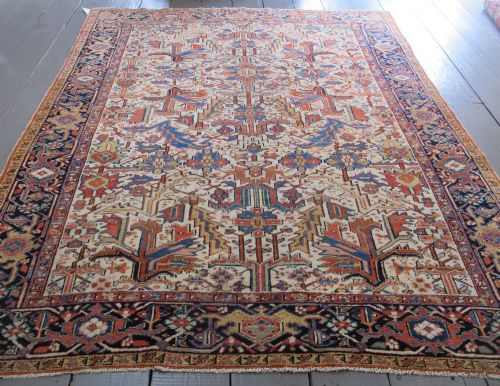


Ivory Ground Carpet
An ivory ground carpet offers a luminous pale field that sets off complex regional medallions and floral lattices.
Ivory Ground Carpet
An ivory ground carpet provides a pale, neutral background that highlights intricate motifs and saturated dyes. When searching for this phrase, buyers encounter hand-knotted room-size carpets and smaller tribal rugs originating from Persian and Anatolian weaving centres.
The pieces represented here span the nineteenth and early twentieth centuries, including styles such as Heriz, Mahal, Tabriz, and various Caucasian prayer rugs. Woven with distinctive regional designs, these carpets serve both as functional floor coverings and decorative wall hangings.
Village and workshop productions dominate the selection, bringing varied medallion layouts and all-over floral patterns to light. The pale ground creates an open aesthetic that suits diverse interior spaces while retaining traditional weaving integrity.
Assessing Quality and Execution
Knot density and the precision of the design execution distinguish finer workshop pieces from robust rural weaves. Finer examples display intricate rendering of floral lattices, geometric medallions, and detailed border guards.
The clarity of the ivory field and the richness of the contrasting secondary colours influence the overall visual impact. Consistency in wool quality and the integrity of the structural foundation determine how well a rug maintains its character over time.
Several small prayer rugs and torba faces hide whimsical animal forms and botanical quirks within their dense floral lattices.
The Ivory Ground Carpet Glossary
- Warp
- The stationary vertical threads stretched upon the loom that form the structural skeleton of the carpet. Fringe ends typically emerge from these parallel foundation cords.
- Weft
- The horizontal threads passed back and forth through the warp to secure the rows of knots in place. This foundational element dictates the firmness of the woven fabric.
- Medallion
- A prominent central ornamental design motif placed in the middle of the carpet field. Many Persian and Anatolian carpets feature this focal geometric or floral element.
- Boteh
- An almond-shaped or paisley motif representing a floral sprout or cypress tree. This ancient symbol appears frequently in regional runners and field patterns.
- Prayer rug
- A small rug featuring a directional mihrab arch design used traditionally for daily devotions. These pieces often display specific architectural niches and floral lattices.
Ivory Ground Carpet: Frequently Asked Questions
Where were these carpets made?
The pieces originate primarily from Persian weaving regions such as Heriz, Mahal, Tabriz, and Malayer, alongside Turkish and Caucasian centres.
Specific towns and nomadic groups each developed distinct design vocabularies and knotting structures.
How do I care for an antique rug?
Regular gentle vacuuming without a rotating brush roll helps remove embedded dust and protects the wool pile.
Professional specialist cleaning is recommended to maintain the integrity of natural dyes and cotton foundations.
What is an all-over design?
An all-over design distributes repeating motifs across the field rather than centring focus on a single large medallion.
This layout includes recurring boteh, floral lattices, or palmettes that extend evenly from edge to edge.
How are different regional styles told apart?
Regional styles are distinguished by specific colour palettes, border arrangements, and structural characteristics like knot type and foundation materials.
Heriz carpets display bold geometric medallions, while Caucasian and Anatolian pieces often feature crisp tribal motifs and prayer arches.