

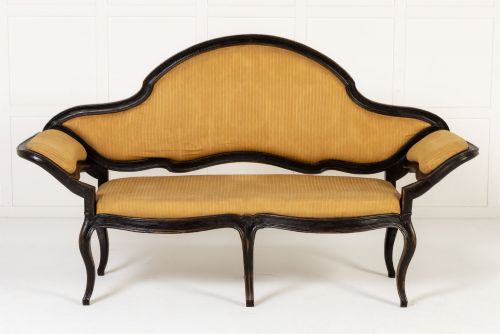
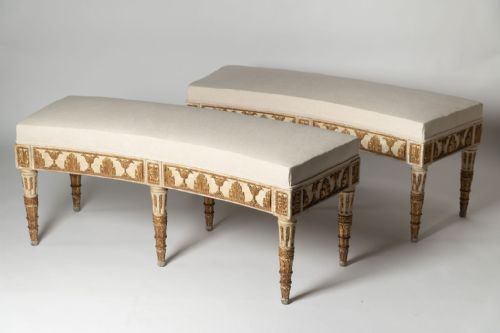
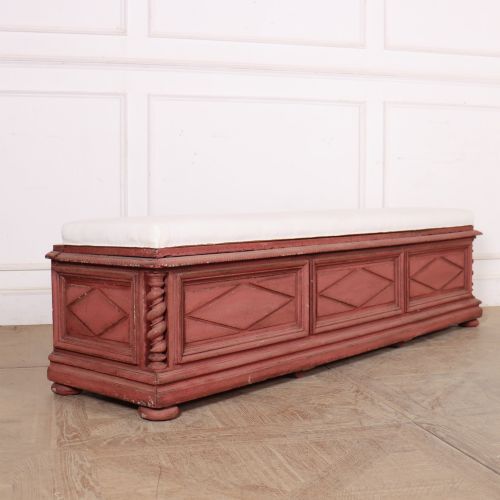


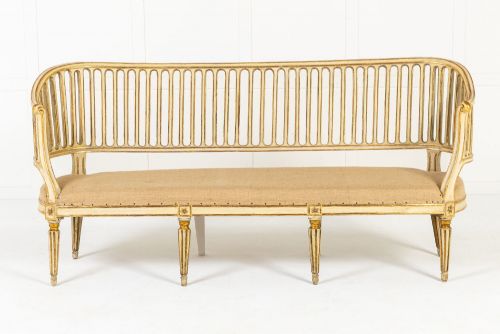
Italian Upholstered Bench
These Italian upholstered bench pieces bring carved woodwork and rich textiles together, offering versatile seating with distinct continental presence.
Italian Upholstered Bench
An Italian upholstered bench bridges the gap between formal seating and decorative woodwork, appearing in forms such as long stools, settees, and daybeds. You are most likely to encounter nineteenth-century painted examples alongside eighteenth-century walnut and giltwood variants on this page.
The objects span multiple historic idioms, encompassing Italian Rococo, Venetian Rococo, Italian Neoclassical, and Italian Baroque styles. Their origins trace back across the eighteenth and nineteenth centuries, featuring carved wooden frames paired with fabric or linen upholstery.
How they were made
Craftsmen built these frames primarily from solid wood, utilising walnut or softer timbers destined for surface decoration. Giltwood pieces received layers of gesso and gold leaf over carved wooden foundations to achieve a brilliant metallic finish.
Painted and polychrome surfaces involved applying pigments directly to the wood, sometimes complemented by ebonisation or hand-carved detailing. Upholstery treatments relied on traditional textiles including linen and patterned needlework stitched over internal padding.
Italian Upholstered Bench Retail Price Guide 2026
Typical asking prices for italian upholstered bench among the pieces listed under this phrase on Sellingantiques today, from the lower quarter to the upper quarter. They describe what is for sale here now, not the wider market.
Venetian gondola chairs offer narrow, sweeping curves designed for domestic spaces that mimic the motion of lagoon travel.
What varies in quality
The sophistication of the hand carving dictates much of the visual distinction, separating deeply articulated scrollwork and figures from simpler, flatter wooden profiles. Crisp execution in gesso and gold leaf layers shows greater discipline than rushed surface gilding.
Original painted or polychrome surfaces retain higher desirability than later repainting efforts, preserving the authentic tone of the period. The harmony between the structural woodwork and the chosen textile covering determines the overall integrity of the piece.
The Italian Upholstered Bench Glossary
- Giltwood
- Wood coated with gold leaf applied over a prepared gesso ground. This technique creates a luminous metallic surface that defines many high-status eighteenth-century frames.
- Polychrome
- Decorated in multiple colours. Artisans painted wooden frames with diverse pigments to create vibrant, decorative surface patterns.
- Gesso
- A plaster-like mixture applied to wood as a smooth base for gilding or painting. It allows intricate carved details to remain sharp beneath surface decoration.
- Ebonisation
- The process of treating wood to resemble ebony. This dark finish gives furniture a stark, formal appearance often associated with specific regional workshops.
Italian Upholstered Bench: Frequently Asked Questions
How do I date an Italian bench?
Dating relies on observing structural characteristics, decorative motifs, and material preparation methods typical of specific eras.
Eighteenth-century examples often display deep carving and walnut construction, whereas nineteenth-century pieces frequently utilise painted finishes or specific neoclassical profiles.
Where should I place a settee?
These pieces suit entrance halls, drawing rooms, or spacious bedrooms where their decorative woodwork remains visible from multiple angles.
Their elongated proportions make them effective against long walls or positioned at the foot of large beds.
What is a tete a tete sofa?
A tete a tete sofa is a specialised double seat designed so two occupants sit facing each other in an S-curve formation.
This form encourages intimate conversation while displaying elaborate carved woodwork and upholstered cushioning.
Are painted and gilt finishes original?
Determining originality requires examining the wear patterns and the interaction between the paint layers and the underlying gesso.
Original surfaces show natural ageing and craquelure that match the expected age of the wooden frame beneath.