




Italian Style Pier Tables
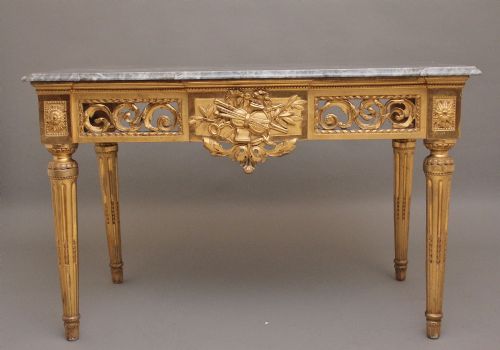
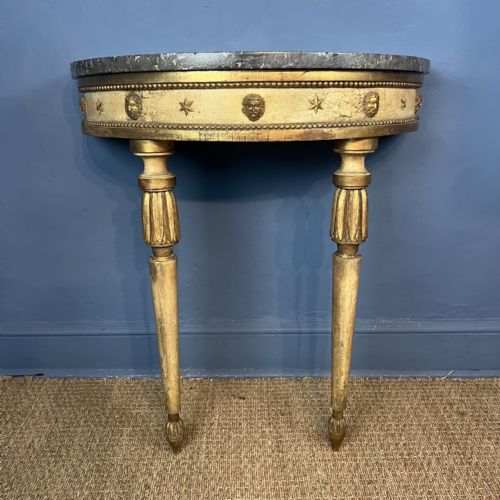
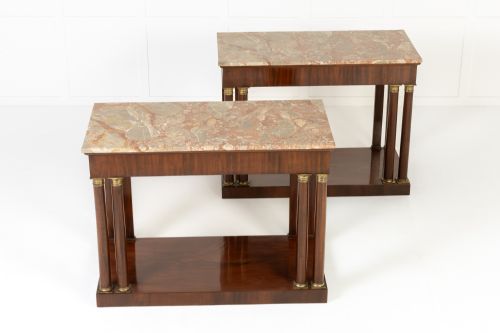
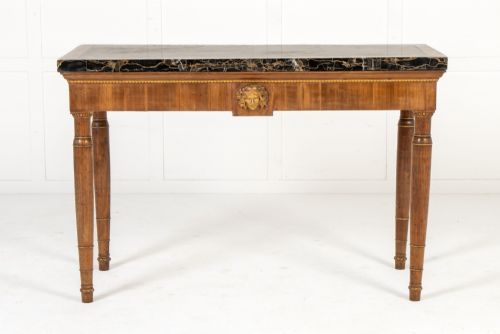
Italian style pier tables are grand console and side tables defined by marble tops and carved frames, bringing a classical presence to any hallway.
Italian Style Pier Tables
Italian style pier tables function primarily as console and side tables designed to sit against a wall, frequently beneath a mirror or window pier. When searching for Italian style pier tables, buyers encounter console tables and side tables spanning the 18th Century, Regency, Victorian era, 1920, and 19th Century.
The materials recorded across these pieces include marble, giltwood, wood, mahogany, gesso, gold leaf, painted wood, and walnut. Styles range from Italian Neoclassical and Rococo Revival to 19th Century Neoclassical, Italian Rococo Revival, Italian Rococo, Baroque, and Italian Neo-Classical.
The versions most commonly met on this page combine carved wooden frames with marble tops, taking the form of console tables or side tables. Surviving examples demonstrate origins across the 18th and 19th centuries, utilising traditional cabinetmaking and carving methods.
How Italian style pier tables were made
The construction of these tables relies on timber frames built from mahogany, walnut, or general wood, which are then shaped through carving. Many examples layer gesso and gold leaf over carved wood to create rich giltwood surfaces.
Alternatively, surfaces receive cream paint or general painted wood finishes, sometimes accented with parcel gilding. Heavy marble tops sit directly upon these structural frames to complete the design.
Italian Style Pier Tables Retail Price Guide 2026
Typical asking prices for italian style pier tables among the pieces listed under this phrase on Sellingantiques today, from the lower quarter to the upper quarter. They describe what is for sale here now, not the wider market.
Listings feature pieces spanning the 18th Century, Regency, Victorian era, 1920, and 19th Century.
What varies in quality in Italian style pier tables
Quality in these tables is driven by the depth and refinement of the carved wood details, such as figurative elements including putti, rams, and maiden heads. Crisp execution in gesso and gold leaf separates superior surfaces from simpler painted wood finishes.
The choice of primary timber, moving from basic wood to figured mahogany or walnut, dictates the underlying calibre of the piece. Additionally, the thickness, veining, and fitting of the marble top establish the overall distinction of the table.
The Italian Style Pier Tables Glossary
- Console table
- A table designed to be fixed against a wall, often supported by front legs or brackets with the rear secured to the wall.
- Giltwood
- Wood that has been coated with gold leaf or gold paint, frequently applied over a prepared gesso ground.
- Gesso
- A plaster-like mixture applied to wood surfaces as a base for painting or gilding.
- Parcel gilt
- A decorative treatment where only specific portions of an object are gilded, leaving the underlying wood or paint visible elsewhere.
- Pier table
- A table constructed to fit against the wall space between two windows.
Italian Style Pier Tables: Frequently Asked Questions
Where do you place a pier table?
These tables traditionally sit flat against a wall, frequently positioned in a hallway or drawing room beneath a mirror. Their narrow footprint allows them to occupy transitional spaces without obstructing movement.
They function well as display surfaces for decorative objects while maintaining a strong architectural presence in a room.
What materials make up the tops?
The tops on these pieces are predominantly formed from heavy stone marble, providing a durable and cool surface. This material contrasts with the softer carved wood frames beneath.
Marble tops often feature natural veining patterns that vary from piece to piece, depending on the specific stone utilised.
How do I identify an 18th Century piece?
Eighteenth-century examples typically display hand-carved giltwood or painted wood details characteristic of periods like Baroque and Rococo. Construction methods involve traditional joinery appropriate to the period.
Examining the underside and the wear on the wood helps confirm the age and construction techniques used by makers of that era.
What is the difference between console and side tables?
Console tables historically rely on wall attachment for total stability, whereas side tables are freestanding structures with four fully supporting legs. In practice, historical terminology often overlaps among these wall-anchored forms.
Both types serve similar decorative and functional roles within period interiors.