


Italian Renaissance Chairs
Italian renaissance chairs combine striking architectural carvings and rich timbers, offering robust seating steeped in historic architectural presence.
Italian Renaissance Chairs
Italian renaissance chairs encompass formal seating forms shaped by classical revival aesthetics, featuring sturdy timber frames and sculptural details. The selection leans heavily towards nineteenth-century revival pieces alongside genuine period examples from the seventeenth and eighteenth centuries.
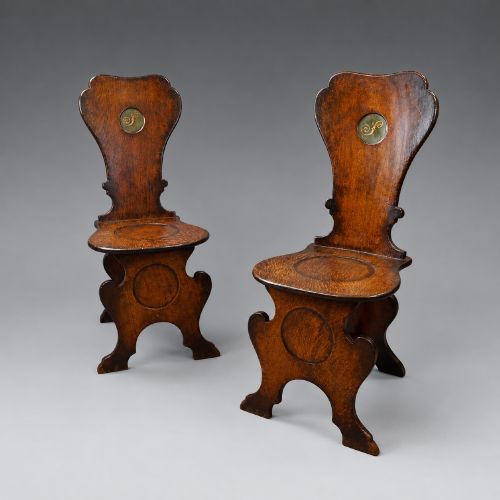
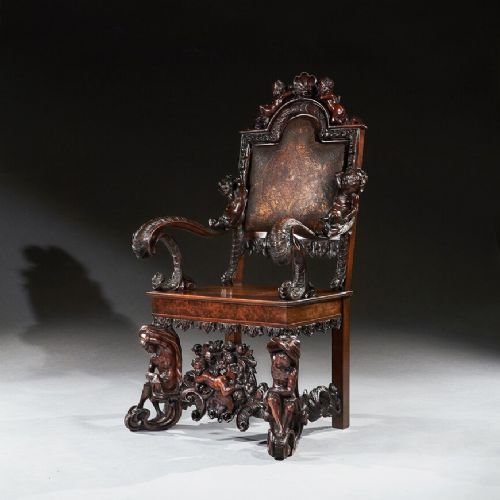
Buyers encounter diverse configurations ranging from high-backed sgabello hall chairs and folding X-framed savonarola models to grand carved armchairs and benches. Walnut and oak dominate the offerings, frequently complemented by period upholstery textiles and carved wooden surfaces.
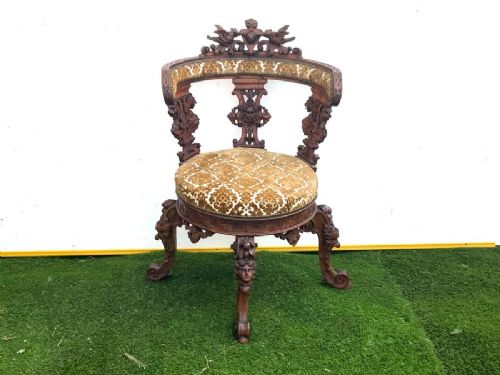
Regional variations appear across the inventory, including Lombardy hall benches and figural corner chairs that highlight the sculptural ambition of Italian furniture makers. These pieces function equally well as striking focal points in modern hallways or as scholarly additions to period interiors.
Materials and Construction
Makers relied primarily on dense hardwoods like walnut, oak, and lime wood, which provided the structural stability needed for deep relief carving. Artisans exploited the natural grain of these timbers to accentuate figural motifs and geometric strapwork across backs and aprons.
Joinery techniques relied on pinned mortise and tenon joints to support heavy frames, particularly in folding X-framed constructions and rigid hall chairs. Surface enrichment often included painted details, bone inlay, and upholstered panels of leather or velvet secured with decorative brass tacks.
Some nineteenth-century makers channelled seventeenth-century sculptors so thoroughly that even the folding chairs demanded respect.
Assessing Quality and Execution
The distinction between standard production and exhibition-quality work lies in the depth and crispness of the hand-carved relief details. Superior examples display anatomically convincing figures and sharp undercut foliage rather than shallow, mechanical moulding.
Structural integrity and timber selection separate finer seating from lesser workshop outputs, with well-figured walnut commanding greater visual presence than plain painted softwoods. Original hardware, intact bone inlays, and period upholstery components further elevate the standing of individual items.
White, Allom & Co.·Andrea Brustolon
The Italian Renaissance Chairs Glossary
- Sgabello
- A light wooden chair with a high back and a base formed of two carved boards rather than conventional legs. This form originated in sixteenth-century Italy for use in halls and corridors.
- Savonarola chair
- A folding chair constructed from multiple intersecting curved wooden slats forming a basket-like seat and back. It is named after the famous fifteenth-century Dominican friar.
- X-framed stool
- A low seat supported by crossed curved or straight timber members forming an X shape when viewed from the side. Such forms date back to classical antiquity and experienced revivals during the nineteenth century.
- Renaissance Revival
- An architectural and decorative style popular in the nineteenth century that drew inspiration from fifteenth and sixteenth-century Italian design. Pieces in this style often incorporate heavy carvings, columns, and classical motifs.
Italian Renaissance Chairs: Frequently Asked Questions
Where should I place an Italian renaissance chair?
These sculptural forms suit spaces where they can be appreciated as standalone objects rather than tucked around a dining table. Hallways, libraries, and wide landings provide ideal settings to showcase their carved backs and structural silhouettes.
Because many examples feature rigid wooden seats or upright frames, pairing them with occasional seating elsewhere ensures comfortable daily use while maintaining historical character.
How do I care for antique walnut wood?
Maintaining walnut surfaces involves gentle dusting with a dry, soft cloth to prevent particulate accumulation in deep carvings. Avoid placing antique timber furniture near direct heat sources or in fluctuating humidity to prevent wood movement.
Applying occasional microcrystalline wax helps nourish the grain and protect historic finishes without building up excessive residue over time.
How do I distinguish revival pieces from earlier periods?
Nineteenth-century revival works often display machine-assisted precision in hidden structural joints alongside hand-finished decorative carving. Examining the underside and interior joinery reveals tool marks and construction methods consistent with nineteenth-century workshop practices.
Patination on seventeenth and eighteenth-century examples typically exhibits deeper oxidation and wear patterns accumulated through centuries of continuous handling.
What is the difference between a sgabello and a standard hall chair?
A sgabello relies on solid board supports or trestle bases rather than four distinct legs, creating a distinct silhouette intended for hallway display. Standard hall chairs utilise traditional four-legged frames combined with upright wooden backs.
Both forms served similar transitional functions in historic interiors, but the sgabello offers a more explicitly Renaissance aesthetic.