
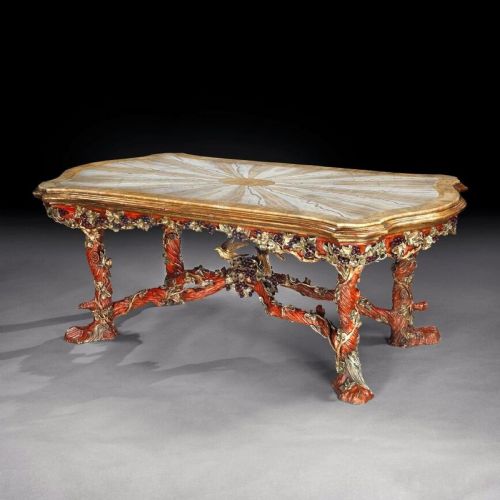
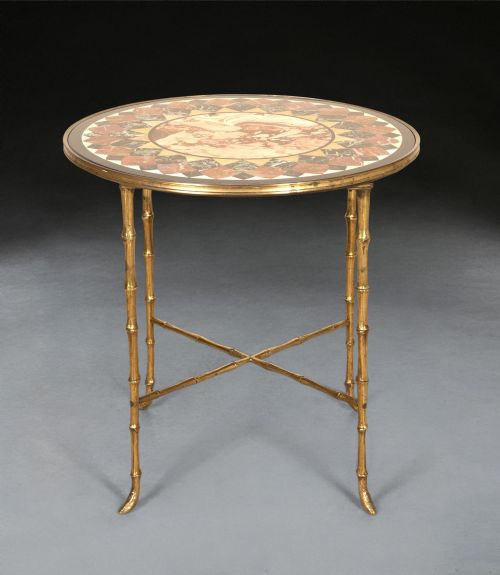


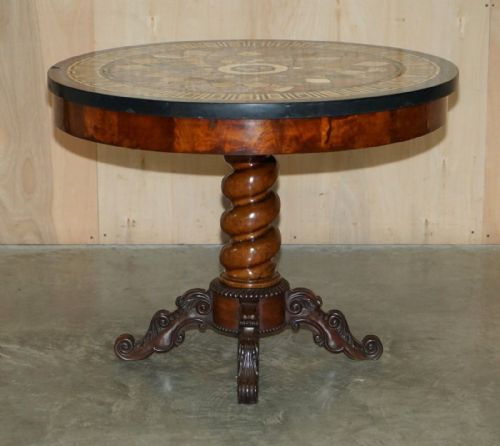
Italian Marble Inlay Table
An italian marble inlay table brings the lapidary precision of classical Italy into a room, offering a hardstone surface built for display.

Italian Marble Inlay Table
An italian marble inlay table serves as a functional surface displaying geometric or pictorial stone compositions. Pieces span the eighteenth, nineteenth, and early twentieth centuries, reflecting changing stylistic revivals across European interiors.
Forms include circular centre tables, occasional tables, and low coffee tables supported by carved wood or ebonised frames. Buyers regularly encounter nineteenth-century circular formats featuring multi-coloured specimen tops alongside occasional and side tables.
Origins trace directly to Italian workshops producing Grand Tour souvenirs and domestic furnishings. The selection encompasses console tables, bedside stands, and low centre tables integrated with pietre dure or scagliola panels.
Materials and construction
Makers utilised solid timbers such as mahogany, walnut, kingwood, and satin birch to build the structural bases and frames. Brass mounts and gilt details frequently accent the woodwork to support heavy stone tops.
Surfaces combine marbles with hardstones, pietra dura, and scagliola to form intricate inlaid patterns. Artisans fitted precise slices of coloured stone into recessed marble bases to create pictorial or geometric designs.
Grand Tour travellers routinely lugged heavy multi-coloured stone tabletops across Europe to prove they had visited Italy.
Factors determining quality
The precision of the stone-to-stone joints dictates the visual coherence of the inlay work. Tighter tolerances between individual specimens reveal superior workshop execution and greater lapidary skill.
The complexity of the pictorial or geometric composition separates standard production from ambitious masterwork pieces. Elaborate avian motifs or dense specimen groupings demand significantly higher technical competence than simple borders.
Amleto Bertoni
The Italian Marble Inlay Table Glossary
- Pietra Dura
- An Italian term for the technique of inlaying cut and fitted polished coloured stones into a base to create pictorial images. This method requires meticulous hand-cutting of hardstones like jasper, chalcedony, and lapis lazuli.
- Specimen Marble
- A tabletop composed of numerous small samples of different marbles and mineral stones arranged in geometric patterns. These pieces were popular acquisitions during the Grand Tour of Europe.
- Scagliola
- A composite material made from pigmented selenite, glue, and plaster that mimics true marble and stone inlay. Artisans applied and polished this paste to create convincing faux-marquetry surfaces.
- Grand Tour
- A traditional trip of Europe undertaken by upper-class European young men of means during the eighteenth and nineteenth centuries. Travellers frequently returned with inlaid stone tables as cultural souvenirs.
- Centre Table
- A freestanding table designed to be viewed from all sides and placed in the middle of a room rather than against a wall. These forms often showcase circular specimen stone tops supported by carved pedestals.
Italian Marble Inlay Table: Frequently Asked Questions
How do I tell pietra dura from scagliola?
Pietra dura consists of individually cut pieces of actual hardstone and marble assembled together by hand. Under close examination, you can feel the distinct boundaries between the natural mineral stones.
Scagliola is a plaster-based composite material moulded and painted to imitate stone inlay. It feels warmer to the touch and lacks the crystalline depth found in genuine mineral specimens.
Where were these tables made?
These tables were produced in Italian workshops catering to domestic markets and international travellers. Florence and Rome served as primary hubs for lapidary work and stone-cutting.
Local artisans mounted these imported or local stone tops onto domestic timber frames made of walnut, mahogany, or ebonised wood.
How do I care for a marble inlay top?
Protect the polished stone surface by using coasters and avoiding acidic liquids that can etch marble and scagliola. Dust the inlay regularly with a soft, dry cloth to prevent abrasion.
Maintain the wooden base using appropriate furniture wax suitable for historic timbers like mahogany or kingwood.