



Ironstone Serving Platter
An ironstone serving platter is a dense, heavy ceramic vessel built for heavy dining rooms, and you want one for its robust scale and striking transfer-printed decoration.
Ironstone Serving Platter
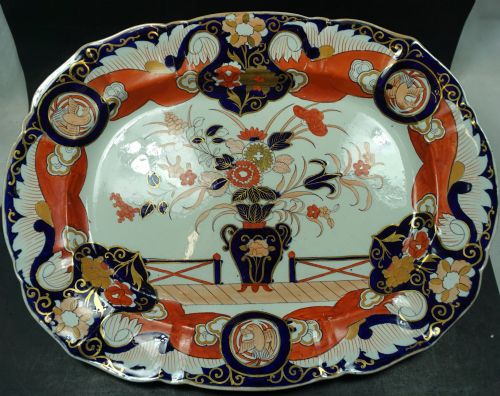
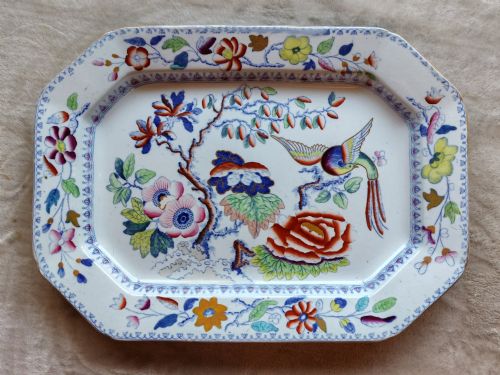
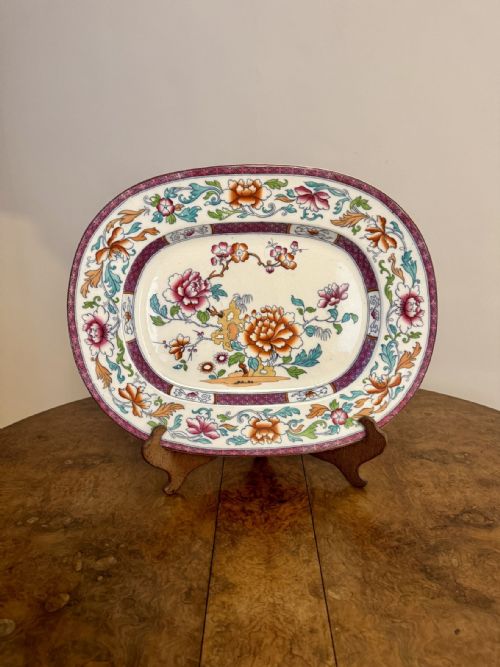
When you search for an ironstone serving platter, you are looking at substantial white ceramic dishes designed for carving and presenting joints of meat at the nineteenth century table. The examples met on this page span the Regency, Georgian, and Victorian eras, taking the form of large meat plates, well and tree platters, and dishes complete with drainer inserts.
Many of these serving pieces feature elaborate patterns drawn from Chinoiserie, Imari, and Italianate landscapes, alongside classic blue and white transfer designs. Makers utilised rich enamel colours and occasional touches of gold leaf to finish surfaces intended for grand dining rooms and country house dining tables.
How they were made
Potters formulated ironstone china using a dense mix of earthenware clay and feldspar, fired at high temperatures to achieve a heavy, vitreous body far stronger than standard earthenware. This durable ceramic resisted chipping during daily service, which explains why so many large platters survive intact today.
The finished white bodies received hand-applied transfer printing or hand-painted enamel decoration under a clear glaze, sometimes accented with gold leaf highlights before a final kiln firing to seal the design.
Ironstone Serving Platter Retail Price Guide 2026
Typical asking prices for ironstone serving platter among the pieces listed under this phrase on Sellingantiques today, from the lower quarter to the upper quarter. They describe what is for sale here now, not the wider market.
Materials recorded across the inventory include glazed ceramic, ironstone china, enamel, and gold leaf.
What varies in quality
The distinction between ordinary utility wares and finer examples rests upon the crispness of the transfer printing and the artistry of the hand-painted enamels. Platters featuring rich Imari palettes or complex Oriental-style scenes demand greater skill from the decorator than simple blue and white patterns.
Structural complexity also separates standard dishes from exceptional ones, particularly pieces that incorporate integral well and tree reservoirs for gathering meat juices or matching ceramic drainer inserts.
Mason's Ironstone·Minton
The Ironstone Serving Platter Glossary
- Ironstone
- A heavy, durable type of ceramic patented in the nineteenth century to imitate Chinese porcelain while offering superior strength for domestic use. It forms the solid body of every platter listed here.
- Well and tree
- A serving platter design featuring a grooved channel around the edge and a sloped surface leading to a central well, engineered to collect meat juices away from the joint during carving.
- Drainer
- A perforated ceramic insert that sits inside a platter to keep meat elevated above accumulated pan juices. These scarce inserts are prized by collectors.
- Chinoiserie
- A European decorative style reflecting imaginative, Western interpretations of Chinese artistic traditions. It appears frequently on nineteenth-century ceramic patterns.
- Imari
- A decorative style borrowing from traditional Japanese export porcelain, characterised by a palette of cobalt blue, iron red, and gold leaf. It creates a vibrant surface on large chargers and meat dishes.
Ironstone Serving Platter: Frequently Asked Questions
What is an ironstone serving platter?
An ironstone serving platter is a heavy, durable ceramic dish produced during the nineteenth century for presenting large joints of meat at the dining table. These substantial pieces were built to withstand the rigours of busy country house dining rooms.
Most examples feature decorative transfer-printed or hand-painted designs, ranging from simple blue and white landscapes to complex Chinoiserie and Imari patterns.
How were well and tree platters used?
Well and tree platters were utilised during formal dinners for carving roasted meats directly at the table or sideboard. The carved channels directed meat juices into a central well, keeping the joint dry.
Some platters included a separate perforated ceramic drainer insert to lift the meat further above the accumulated liquid.
How do I date an antique ironstone platter?
Dating an ironstone platter involves examining the maker's mark stamped or printed on the reverse, along with the stylistic cues of the pattern. Pieces from the Regency and early Victorian periods often display distinct transfer styles and deeper ceramic bodies.
Comparing the border motifs and glazing characteristics against documented manufacturer timelines helps narrow down the decade of production.
Can I use an antique platter for serving food?
These robust ceramic platters remain fully functional for serving dry foods, cheeses, or cold meats at the modern dining table. Their dense ironstone body handles everyday presentation without difficulty.
Hand washing is recommended to preserve the nineteenth-century glaze and any delicate enamel or gold leaf details against harsh detergents.